


























The legendary American REO nameplate returns with an ambitious new family of trucks and an SUV. Designed around simplicity, mechanical durability, affordability and the freedom to repair, the Runabout range wants to remind the automotive world what utility vehicles were originally meant to be.
There was a time when a pickup truck was simply a pickup truck. It was a dependable machine, built to work hard, carry heavy loads, negotiate difficult terrain and keep going long after the paint had lost its shine. You could open the bonnet, understand what was happening underneath, and repair most things without needing a laptop, proprietary software or a specialist diagnostic centre.
Somewhere along the way, things changed.
Modern pickup trucks have become bigger, more luxurious, increasingly complicated and significantly more expensive. Screens have replaced switches, software has become an integral part of vehicle ownership, and even relatively straightforward repairs can require specialised equipment and manufacturer-specific authorisation.
Into this increasingly complicated automotive landscape comes a name with more than a century of American motoring history behind it.
>>> Great Discounts on Car & Bike Accessories <<<
REO is back. And it wants to do things differently.
Unveiled on November 16, 2026, the new REO Runabout family comprises three vehicles: the T4X work truck, the T4C crew-cab pickup and the S4C family SUV. Developed by the revived American marque under founder and CEO Zach De Bernardi, the range is built around a straightforward philosophy: deliver genuine utility, mechanical simplicity and long-term affordability without burdening customers with unnecessary complexity.
The proposition is refreshingly old-school, but the ambition is decidedly modern.
A name with history
To understand the significance of REO’s return, it helps to revisit its origins.
REO was founded in 1905 by Ransom Eli Olds, the pioneering American automobile industrialist who had earlier established Oldsmobile. The company’s name came from his initials, and it quickly developed a reputation for producing practical, hardworking vehicles.
Its most historically significant contribution came in 1915 with the introduction of the REO Speed Wagon, a vehicle widely regarded as one of the ancestors of the modern pickup truck.
For decades, REO built commercial vehicles and trucks in Lansing, Michigan, earning a reputation for durability and dependable service. The original company’s automotive operations eventually came to an end in the 1970s.
Now, more than a century after its foundation, the REO name has returned under a new organisation based in Dallas, Texas.
The new company isn’t attempting to recreate a museum piece. Instead, it is taking the original brand’s practical philosophy and applying it to a completely new generation of vehicles.
The Runabout: Three vehicles, one philosophy
At the centre of REO’s revival is the Runabout platform, a common body-on-frame architecture that underpins all three vehicles.
The T4X, T4C and S4C share the same basic chassis, powertrain concept, front-end design and 119.6-inch wheelbase. Their differences begin behind the B-pillar, where each vehicle receives a body configuration suited to its intended purpose.
This modular approach is central to REO’s strategy. Sharing major components should simplify production, reduce manufacturing complexity and make parts availability easier to manage.
The three models also share mechanical four-wheel drive, a naturally aspirated four-cylinder petrol engine and a traditional ladder-frame construction.
In a market increasingly dominated by turbocharged engines, sophisticated electronics and complex drivetrain systems, REO is deliberately returning to fundamentals.
T4X: The working truck

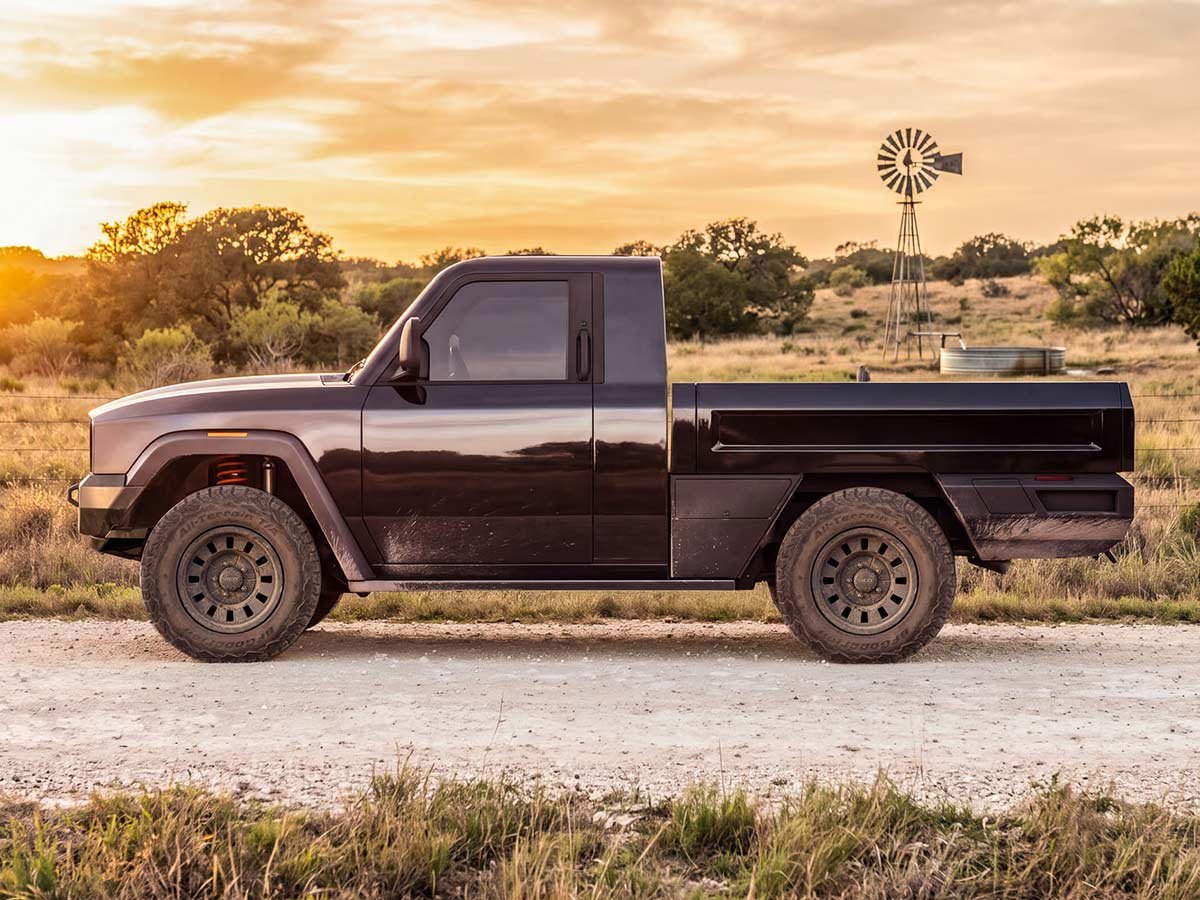
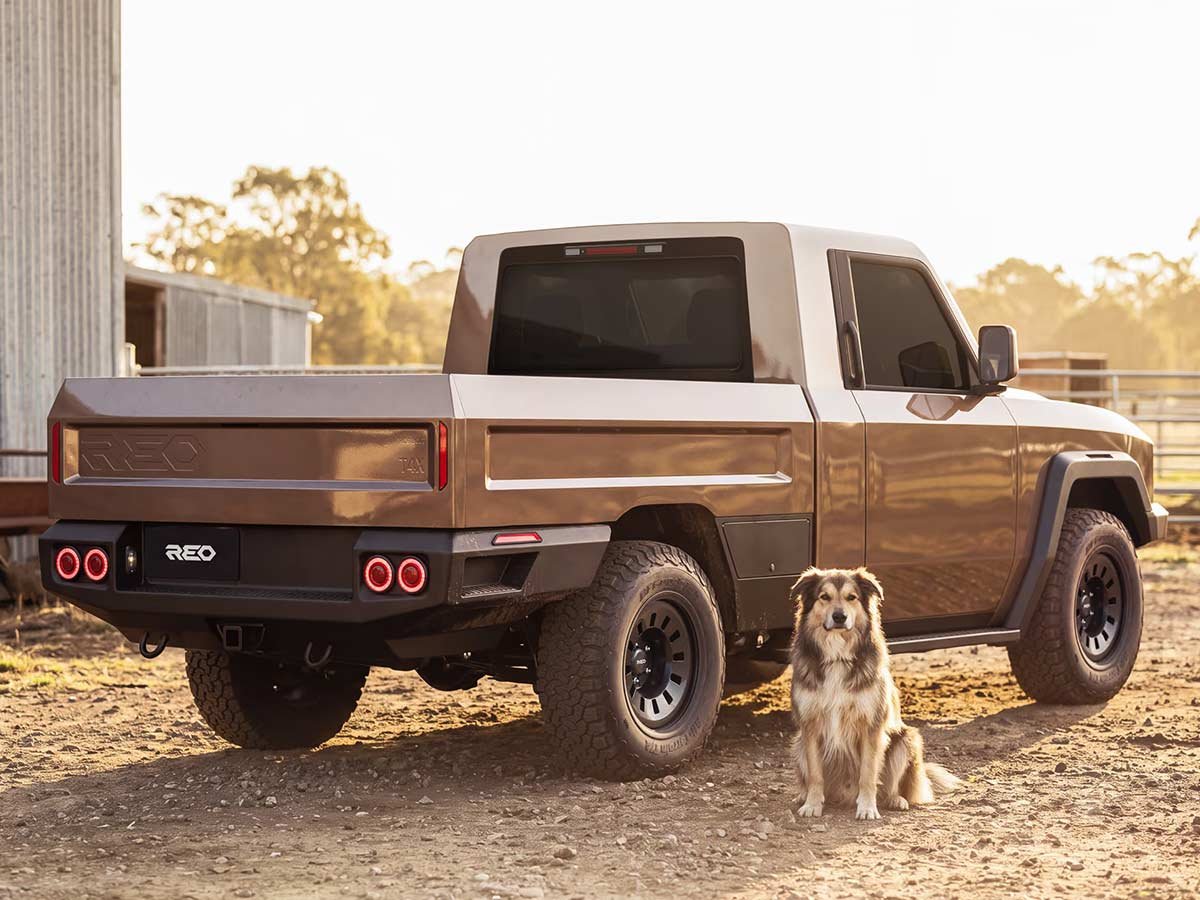
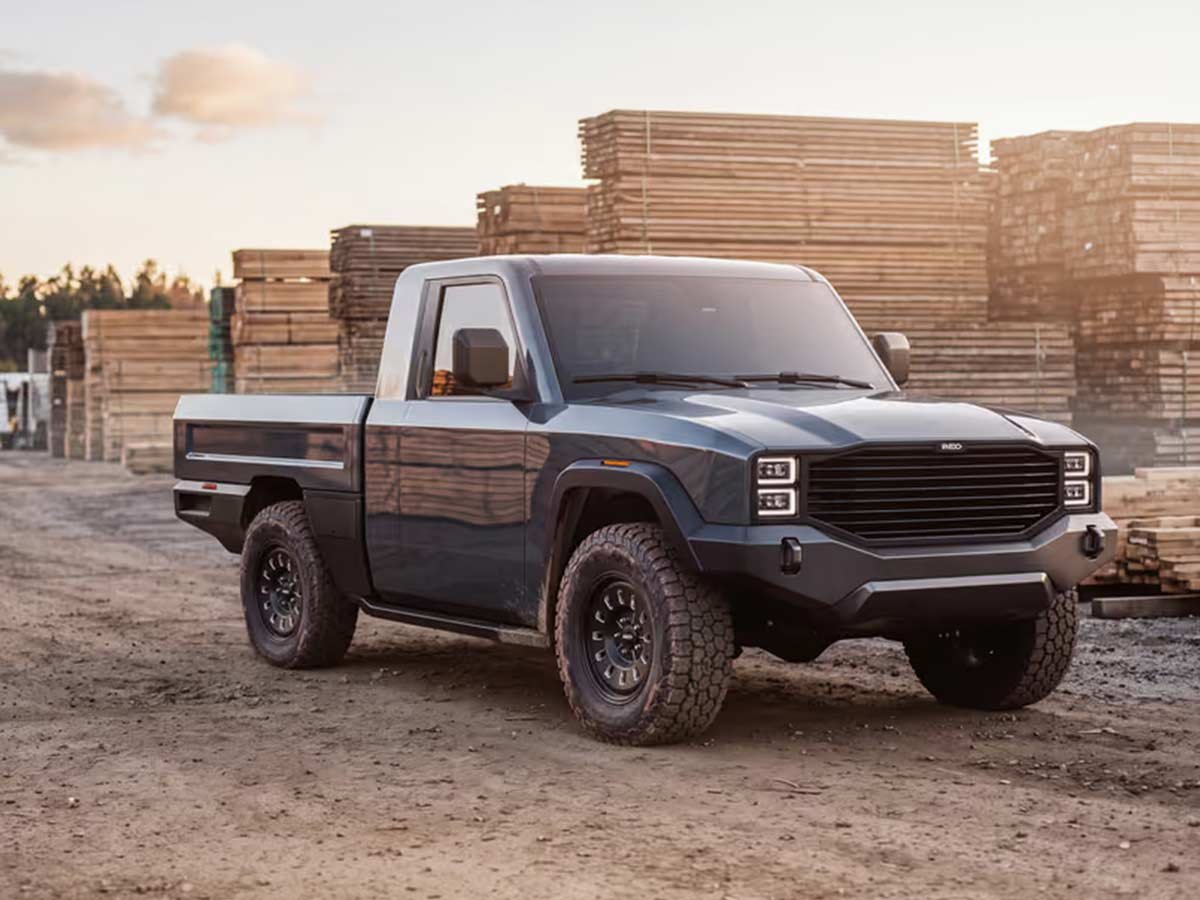
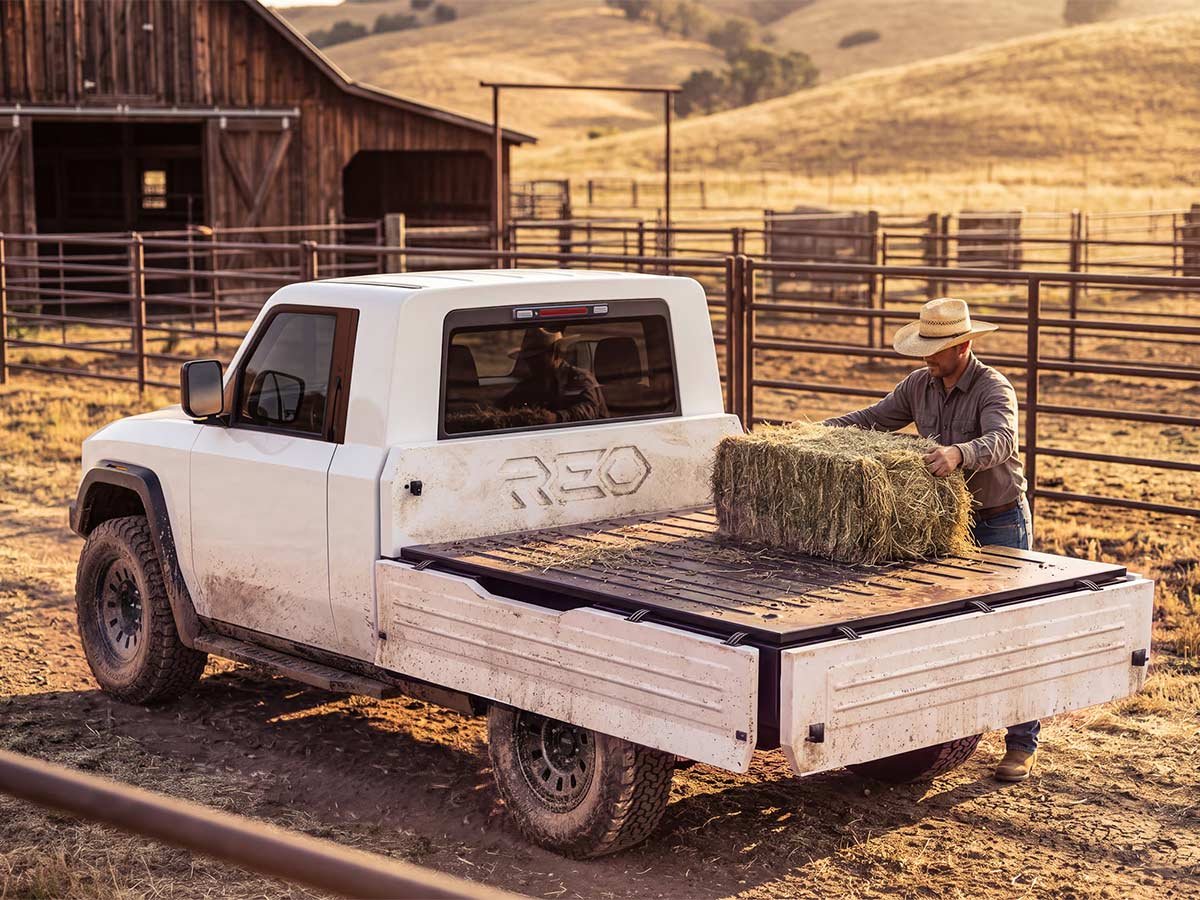
The first vehicle scheduled to reach customers is the REO T4X, a two-seat, single-cab work truck.
Designed around functionality rather than lifestyle appeal, the T4X features a steel drop-side flatbed measuring 79.1 inches in length and 70.6 inches in width between the side walls.
The bed can be accessed from either side as well as the rear, making loading and unloading easier in demanding working environments.
REO has also paid attention to the smaller details that can make a working vehicle genuinely useful. The tailgate incorporates a measuring ruler, cupholders, dedicated recesses for phones and tablets, flat surfaces that can double as seating, and even bottle openers on both sides.
A modular mounting panel on the roof, called the REO Mount Panel, provides provisions for auxiliary lighting and other accessories.
The result is a truck that appears to understand its primary responsibility: getting the job done.
With an announced starting price of $21,500, the T4X is intended to occupy an increasingly neglected segment of the American pickup market.
T4C: The practical double-cab





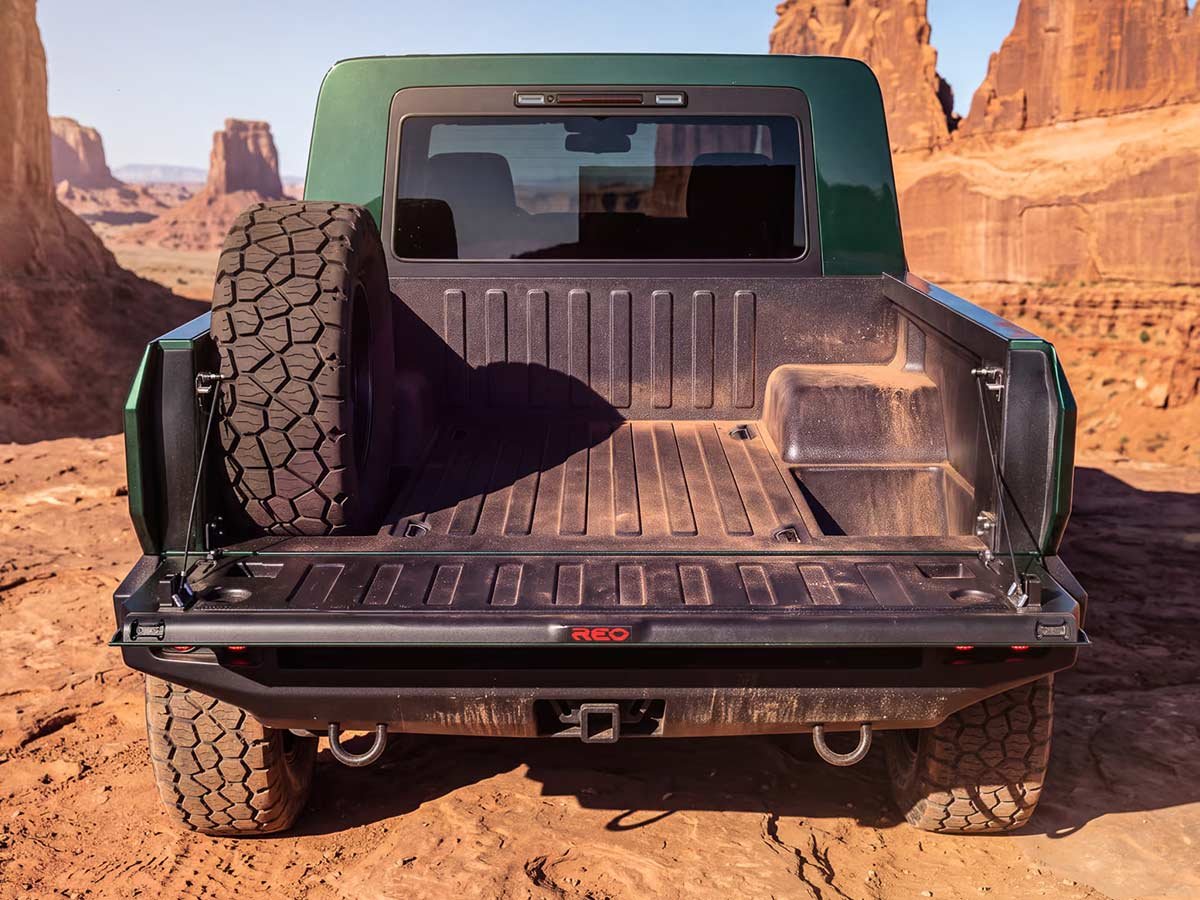
For customers who need the functionality of a pickup without sacrificing passenger accommodation, REO has developed the T4C.
The four-door crew-cab version accommodates five occupants and features a 54.1-inch cargo bed.
It shares the mechanical foundations of the T4X but offers a more versatile configuration for people who need their vehicle to serve both professional and personal requirements.
Interestingly, REO has found space for the spare wheel within a dedicated recess in the cargo bed, helping preserve the vehicle’s overall packaging.
The longer roof also receives two REO Mount Panels, providing additional flexibility for mounting accessories.
Starting at an announced $25,000, the T4C is positioned as the middle member of the Runabout family.
S4C: An SUV with genuine utility ambitions





Perhaps the most interesting member of the family is the S4C.
While many contemporary SUVs are essentially road-oriented passenger vehicles with raised ground clearance, REO wants its offering to retain the underlying mechanical character of a traditional utility vehicle.
The S4C is a six-seat family SUV measuring 182.7 inches in overall length, excluding its rear-mounted spare wheel.
Its shorter rear overhang gives it the best departure angle in the Runabout family, an important advantage when negotiating steep inclines and uneven terrain.
The rear features a full-size, one-piece, side-hinged tailgate. One particularly interesting detail is the rear glass, which can retract fully into the tailgate.
The full-size spare wheel is mounted on a swing-out carrier, while two REO Mount Panels are integrated into the roof.
With an announced starting price of $28,500, the S4C could become the most appealing option for buyers seeking a relatively compact, mechanically conventional, six-seat SUV.
Designed by a familiar automotive name
Although the Runabout range focuses heavily on simplicity, REO hasn’t ignored design.
The company has partnered with frankstephenson design, the studio founded by internationally recognised automotive designer Frank Stephenson.
His portfolio includes some of the most recognisable vehicles of recent decades, including the modern MINI, BMW X5, Fiat 500, Ferrari F430, Maserati MC12 and McLaren P1.
The Runabout’s design brief was deliberately different from that of a conventional contemporary pickup.
Rather than pursuing aggressive styling or excessive visual detailing, Stephenson’s team focused on an honest, functional and unmistakably purposeful appearance.
REO says the vehicle’s stance takes inspiration from the American bison, particularly its broad shoulders, planted posture and powerful forward proportions.
The wide front grille draws inspiration from historic REO trucks, particularly the Speed Wagon. Rectangular LED headlamps, upright bodywork, prominent wheel arches and relatively flat surfaces give the vehicles a distinctive appearance.
The result is a modern interpretation of the traditional American utility vehicle, with a design that prioritises function over fashion.
Mechanical simplicity takes centre stage
Perhaps the most important part of the Runabout story lies underneath the bodywork.
All three models are planned around a naturally aspirated four-cylinder petrol engine. REO has not yet disclosed its displacement, horsepower, torque figures or engine supplier.
A six-speed manual transmission is planned as standard, with an automatic transmission available as an option.
The four-wheel-drive system is mechanical and part-time, incorporating a transfer case with low-range gearing. A locking rear differential is also part of the announced specification.
The suspension follows a traditional arrangement, with solid front and rear axles, coil springs at the front and leaf springs at the rear.
Hydraulic power steering, ventilated front disc brakes and rear drum brakes further underline the company’s preference for conventional engineering.
REO is targeting a powertrain service life of 500,000 miles, approximately 805,000 kilometres. This is an engineering target rather than a verified real-world durability figure.
The company is also avoiding turbocharging, direct injection and automatic engine stop-start technology in its initial powertrain philosophy.
The objective is straightforward: fewer complicated systems, easier maintenance and a vehicle designed to remain useful for decades.
The Ransom package: For those who want to venture further
REO has also announced a more adventurous configuration called the Ransom package.
Designed to improve off-road capability, it includes a 2.5-inch suspension lift, upgraded dampers, reinforced rear suspension components and larger 265/70R17 all-terrain tyres.
The standard configuration uses 245/70R17 all-season tyres.
The additional ride height improves the approach angle from 42.5 to 48.3 degrees and the breakover angle from 16.3 to 21.2 degrees.
Visually, the package is distinguished by orange front dampers and upgraded suspension components.
It is an interesting addition because it demonstrates that REO isn’t simply targeting commercial fleet customers. The company also recognises the appeal of vehicles that can move from everyday duties to more demanding recreational adventures.
An interior that puts physical controls first
The interior has not yet been fully revealed. REO has scheduled its detailed cabin presentation for 2027.
However, the company has already outlined some important principles.
The Runabout will feature a digital instrument cluster and a screen for navigation and media, but the emphasis will remain firmly on physical controls.
Buttons, switches and levers are designed to be operated while wearing gloves, an important consideration for people who actually use their vehicles for work.
Power windows will be standard, while the seats will feature manually adjustable bucket designs.
REO says particular attention has been paid to seating comfort, including sufficient adjustment for taller drivers. The cabin is being designed to accommodate drivers up to approximately 6 feet 5 inches tall.
Other practical features include 120-volt power outlets, pre-wired accessory switches and generous storage spaces.
One particularly unusual detail is a tool bit set in the glovebox designed to fit every fastener on the vehicle.
It is a small touch, but it perfectly captures the Runabout’s philosophy.
The company’s CEO has also made a particularly interesting commitment: essential driving functions will not be hidden behind a touchscreen, and components responsible for steering, braking and shifting will not be controlled or altered through over-the-air software updates.
The right to repair: A different approach to vehicle ownership
Perhaps the most disruptive part of REO’s proposition isn’t the vehicle itself. It is the way the company intends to approach ownership.
The Runabout has been developed around the principle of right to repair.
REO intends to make its parts catalogue and factory service information publicly accessible, while allowing authorised independent manufacturers to produce compatible replacement components.
The company also plans to operate an online marketplace through which approved manufacturers can sell parts directly to owners.
Another interesting detail is the emphasis on easy disassembly. REO says commonly accessed body panels, bumpers, headliners and trim components are designed to be removable in under five minutes using ordinary tools.
A service diagram will also be etched beneath the bonnet, helping owners understand basic maintenance procedures.
The company says its parts catalogue will be supported for 20 years, and components will not be software-locked to individual vehicle identification numbers.
Sales are planned through a direct-to-consumer, no-haggle model, eliminating the traditional dealership negotiation process.
If REO delivers on these promises, its approach could challenge the conventional relationship between manufacturers, repair workshops and vehicle owners.
Pricing: The biggest talking point?
The announced starting prices are perhaps the most attention-grabbing aspect of the Runabout programme.
| Model | Configuration | Starting price |
|---|---|---|
| T4X | Single-cab work truck | $21,500 |
| T4C | Five-seat crew-cab pickup | $25,000 |
| S4C | Six-seat family SUV | $28,500 |
These are announced starting prices, not confirmed final retail prices.
For the American market, they represent an ambitious attempt to bring back relatively affordable, mechanically capable utility vehicles.
REO also claims to have received more than 40,000 paid reservations, with a fully refundable $25 reservation deposit.
The company has not yet demonstrated that it can manufacture these vehicles at the announced prices, so the eventual production costs and final specifications will be important to watch.
When will the new REO vehicles reach the road?
The T4X will be the first model to enter the production programme.
Pilot builds are planned for 2027, with the order book expected to open in 2028. First customer deliveries are targeted for late 2028 or early 2029.
The T4C and S4C will follow later, although their precise production and delivery schedules have not yet been confirmed.
REO intends to manufacture the Runabout range at a brownfield assembly facility in Texas, making use of the established automotive supplier network in the state and neighbouring Mexico.
The company has not yet announced the exact assembly plant, engine supplier or final production specifications.
A refreshing idea in an increasingly complicated industry
The return of REO raises an interesting question about the future of the automobile.
For years, the industry has pursued greater performance, more technology, more luxury and increasingly sophisticated electronic systems. These developments have brought genuine benefits, but they have also pushed prices higher and, in many cases, made vehicles more difficult to maintain independently.
REO is betting that there remains a substantial audience for something different.
Its Runabout range is not promising cutting-edge electrification, autonomous driving features or luxury interiors. Instead, it is promising something that sounds almost radical in today’s automotive environment: a vehicle that is affordable, mechanically understandable, practical and designed to last.
Of course, there is a considerable difference between announcing an ambitious vehicle programme and successfully putting it into production. REO still has to prove its manufacturing capabilities, deliver the promised pricing, establish its service and parts network, and demonstrate that its durability targets can be achieved.
But the idea itself is compelling.
The original REO Speed Wagon helped establish the foundations of the modern pickup truck more than a century ago. Now, the revived company wants to revisit the same philosophy for a new generation.
Three vehicles. One shared platform. A strong emphasis on mechanical engineering and the freedom to repair.
Perhaps the most interesting thing about the new REO isn’t that it wants to build the next generation of trucks. It is that it believes the future of the automobile might benefit from remembering a little more of its past.