
















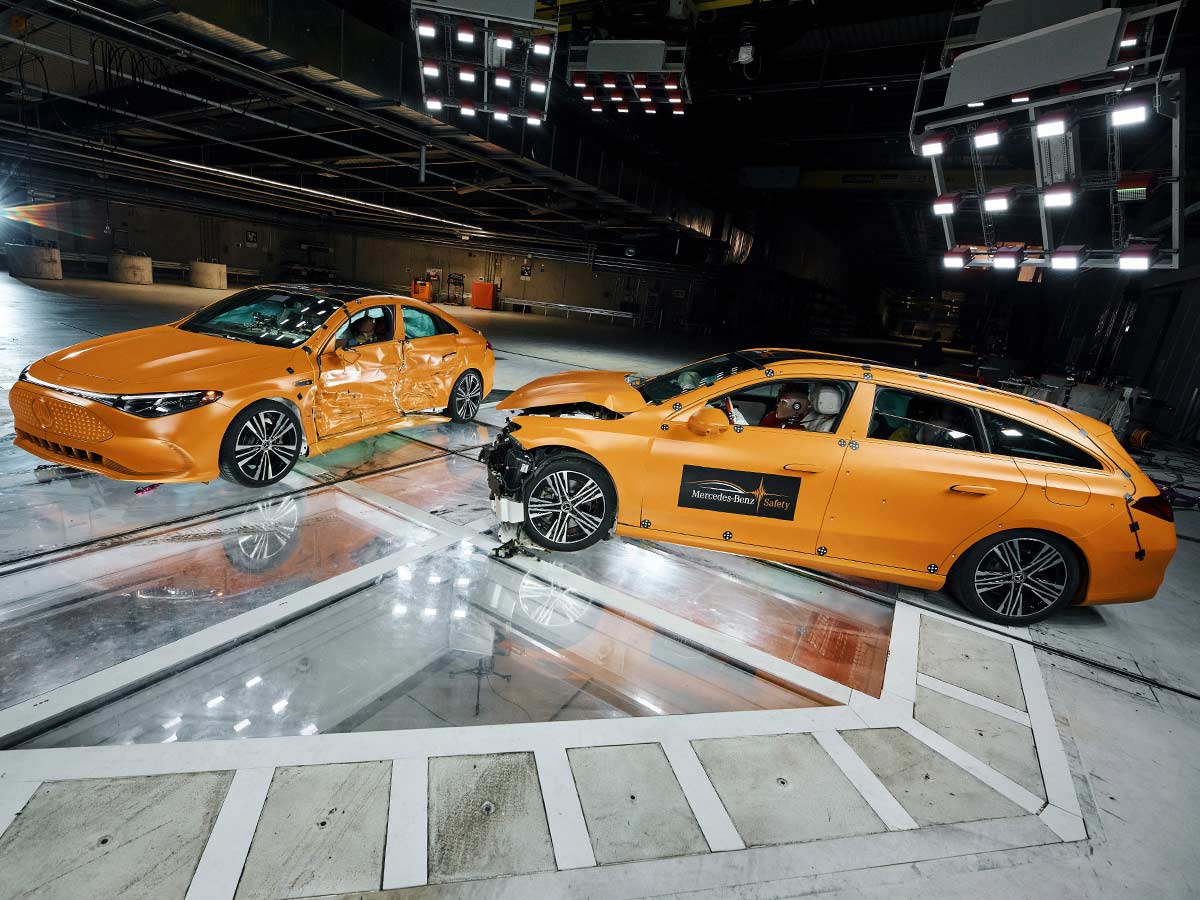
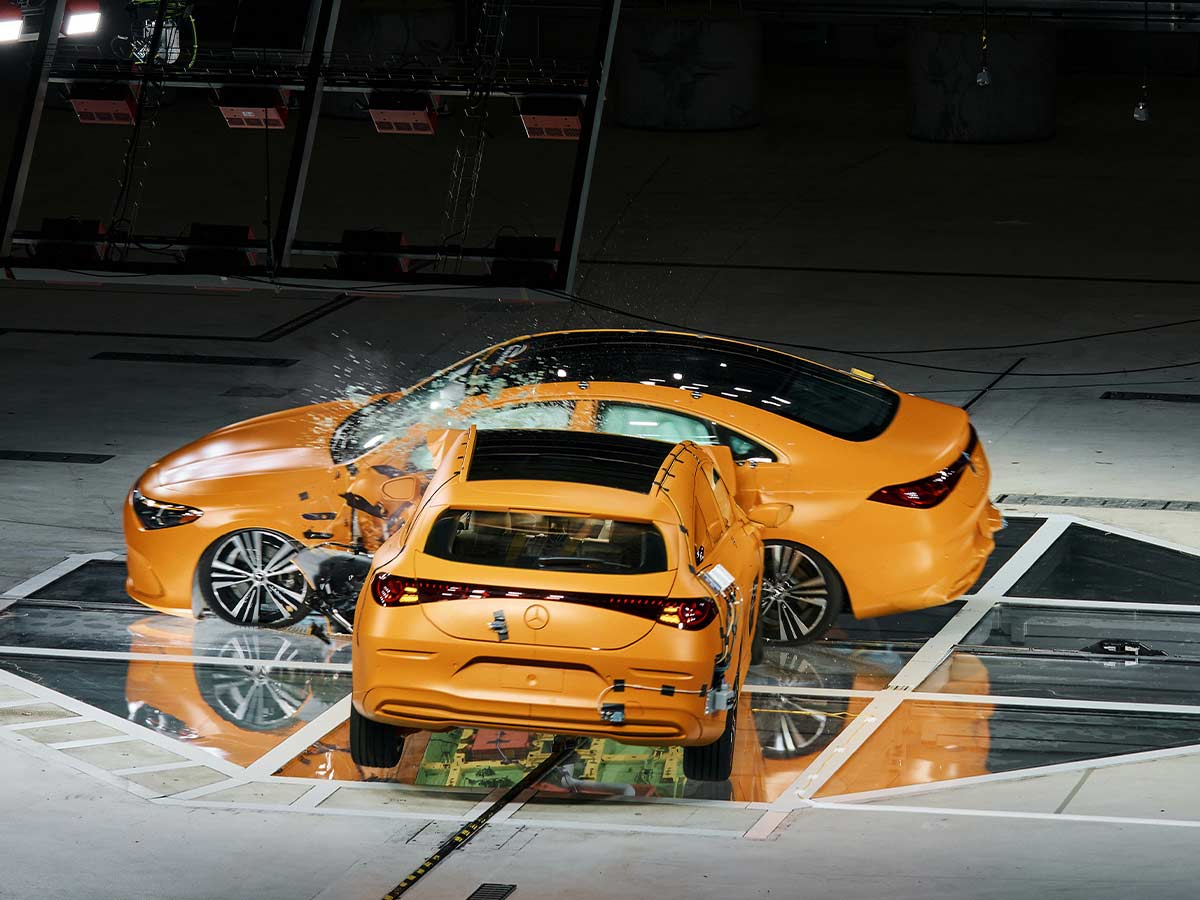
On 20 October 2026, Mercedes-Benz staged an unusually demanding demonstration of automotive safety: two production CLA models collided at a combined closing speed of 112 km/h, with one vehicle striking the driver’s side of the other. Both were travelling at 56 km/h when the impact occurred, and the results offered a closer look at how modern vehicle engineering approaches one of the most difficult problems in crash protection.
The test brought together two distinct versions of the new Mercedes-Benz CLA: a CLA Shooting Brake with an electrified internal combustion engine and a fully electric CLA. According to Mercedes-Benz, both passenger compartments remained intact, readings from all eight crash-test dummies stayed below the relevant biomechanical limits, and the electric model’s high-voltage battery remained undamaged. The demonstration also introduced Mercedes-Benz Rescue Intelligence, a system designed to give emergency services important accident information before they reach the scene.
What makes this test significant is not simply the speed of the collision. It is the combination of two moving production vehicles, a direct side impact, substantial vehicle mass and the additional challenge of protecting a battery housed beneath the floor of an electric car. Together, these elements put the CLA’s structural engineering and occupant-protection systems under pressure in a scenario intended to reflect a serious real-world junction accident.
>>> Great Discounts on Car & Bike Accessories <<<
A Different Kind of Crash Test for the Mercedes-Benz CLA
Crash testing has long been central to the development of modern passenger cars. Yet the conditions used in standardised tests do not necessarily reproduce every detail of an actual collision, particularly when two vehicles are moving towards an intersection and one strikes the side of the other.
Mercedes-Benz designed its CLA demonstration around precisely this distinction. Rather than directing a vehicle into a stationary barrier or a purpose-built impact vehicle, the company brought two production cars into a direct collision, with the CLA Shooting Brake striking the driver’s side of the fully electric CLA.
Both vehicles were travelling at 56 km/h, and the test was conducted without prior braking, following the customary approach described by the manufacturer for this type of test.
The distinction matters. In an actual junction collision, drivers may have little time to recognise a developing hazard, react and bring their vehicles to a stop. The absence of braking in the demonstration removed that intervention from the scenario, allowing the collision itself to place the vehicles’ structures and safety systems under examination.
Mercedes-Benz described the event as the world’s first public high-speed side-impact crash test involving two production vehicles in this configuration. The company’s own accident research identifies the selected speed as being at the upper end of junction collisions encountered in real-world traffic.
The test was deliberately severe. Each vehicle weighed more than two tonnes, while the impact was directed at the side of the all-electric CLA rather than its front. That combination created a demanding assessment of both passenger-compartment integrity and, in the electric vehicle, the protection of its underfloor battery.
The result was intended to demonstrate how the CLA’s safety concept performs when several challenging factors converge, rather than when a vehicle encounters a single, tightly controlled obstacle.
Why a Side-Impact Collision Is So Difficult to Engineer Against
A frontal collision and a side-impact collision place very different demands on a vehicle’s structure. At the front, engineers have more space in which to manage the forces generated during a crash. The front structure can deform progressively, absorbing energy before it reaches the passenger compartment.
The side of a vehicle offers considerably less room for this process. Between the outer bodywork and the occupants, the available structural depth is limited. A severe side impact can therefore transmit substantial forces into the passenger compartment over a relatively short distance.
That is why side-impact protection depends on more than strong exterior panels. The underlying body structure must resist intrusion, the passenger compartment must retain its shape, and the restraint systems must work together to manage the forces acting on occupants.
The CLA demonstration placed these priorities under particular scrutiny because the impact was directed at the driver’s side of the electric model. In addition to the occupants, the vehicle’s high-voltage battery required protection against the consequences of a direct and severe collision.
Passenger-compartment integrity comes first
The passenger compartment is the protected space in which the driver and passengers sit. In a serious collision, maintaining its structural integrity helps preserve the space needed for occupants and allows restraint systems to perform their intended functions.
Mercedes-Benz reported that the passenger compartments of both CLA models remained intact following the impact. That result is important because structural deformation and occupant protection are related, but they are not identical measures.
A vehicle can sustain substantial damage to its exterior while retaining the space designed to protect those inside. Conversely, a relatively limited-looking area of damage can conceal forces that pose serious risks to occupants. For that reason, crash-test assessment considers both the condition of the structure and the measurements recorded by instrumented dummies.
In this demonstration, the intact passenger compartments were accompanied by dummy readings that remained below the relevant biomechanical limits. Taken together, these findings indicate that the vehicles’ protective systems performed as intended under the conditions of the test.
Why vehicle mass adds to the challenge
Both vehicles weighed more than two tonnes, according to Mercedes-Benz. Their substantial mass formed part of the deliberately demanding test scenario.
In a collision, the interaction between the vehicles depends on factors including their masses, speeds, directions of travel and the geometry of the impact. A side-impact collision involving two moving vehicles is therefore different from a test in which one vehicle strikes a stationary barrier.
The speed figures also need to be interpreted correctly. Each CLA was travelling at 56 km/h before impact, but the two vehicles’ speeds should not simply be added and treated as the speed experienced by the occupants. The actual forces and accelerations depend on how the vehicles interact and deform during the collision.
The value of the demonstration lies in the combined scenario: two heavy production vehicles, moving at the same stated speed, meeting in a direct side-impact collision without prior braking.
Eight Crash-Test Dummies, Four Adults and Four Children
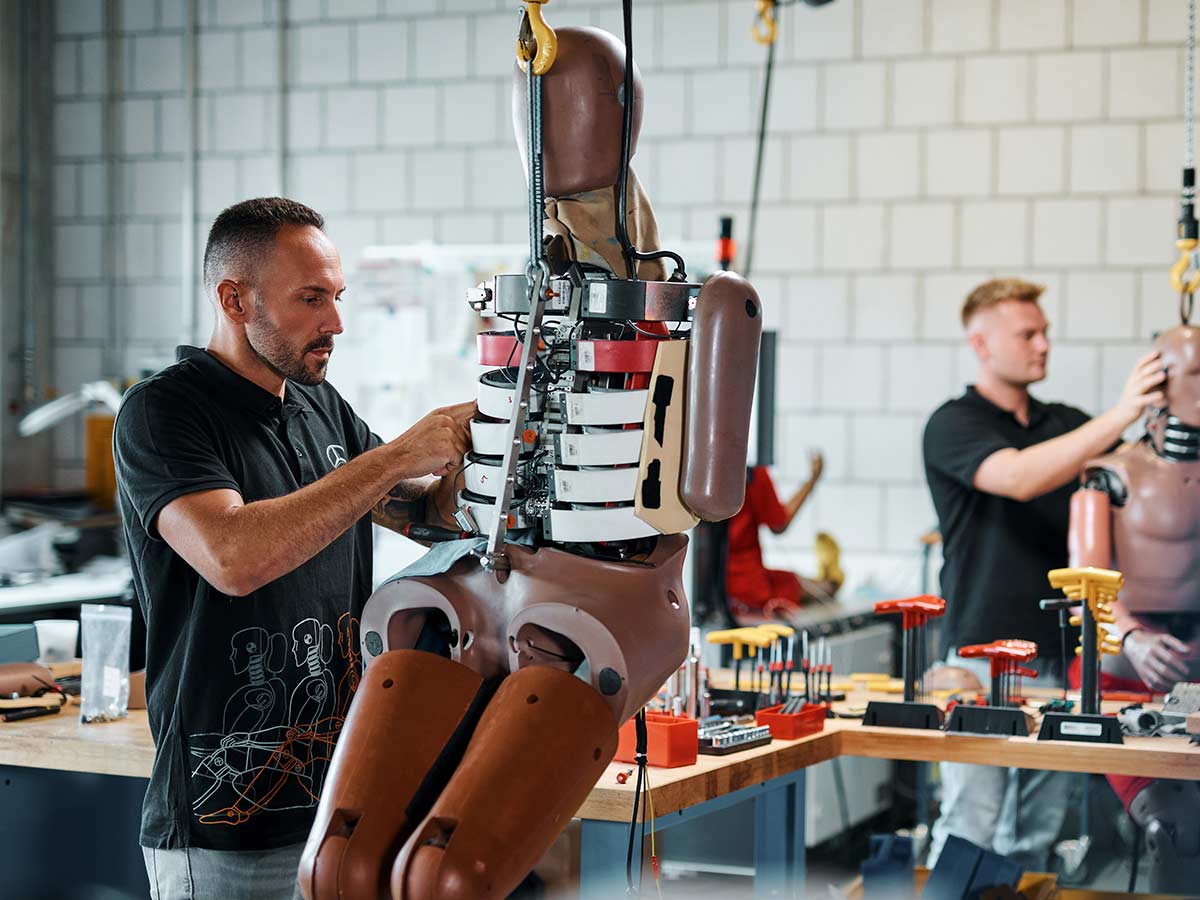
The physical condition of the vehicles was only part of the assessment. Mercedes-Benz also examined the measurements recorded by eight crash-test dummies, representing four adults and four children.
Crash-test dummies are instrumented devices designed to measure the forces and accelerations that occupants could experience during a collision. Depending on the dummy and the test configuration, sensors collect data from different parts of the body. Engineers use those readings to assess injury risk and determine whether the vehicle’s protective systems have performed as intended.
In the CLA test, each dummy provided data from as many as 150 measurement points. This allowed the company to examine occupant loading in detail rather than relying on a visual assessment of the damaged vehicles alone.
Mercedes-Benz reported that all eight dummies remained below the relevant biomechanical limits used in the automotive industry to assess occupant protection. The company said the results indicated a low risk of serious or life-threatening injuries to the occupants.
That finding is more informative than a simple statement that the cars survived the impact. A crash structure must do more than remain recognisable after a collision. It must manage energy and limit the forces transmitted to people inside the vehicle.
How restraint systems contribute to protection
Occupant protection is a coordinated process. Seat belts, airbags, vehicle structures and other safety systems are designed to work together, with each performing a different role during a crash.
The body structure helps manage the collision and preserve the passenger compartment. Seat belts restrain occupants and help control their movement, while airbags provide additional cushioning and protection where fitted and deployed. The timing and interaction of these systems matter because a collision unfolds over fractions of a second.
The CLA dummy measurements provide a way to assess the outcome of that coordinated response. Mercedes-Benz said the readings confirmed that the vehicles’ safety systems had worked as intended in the test.
It is worth distinguishing the meaning of this result from a guarantee of injury-free outcomes in every possible crash. The demonstration evaluated a specific collision configuration at a defined speed. Its findings are evidence of performance in that scenario, not proof that all accidents will produce the same result.
Even with that qualification, the combination of intact passenger compartments and dummy readings below the relevant limits makes the test a meaningful demonstration of the CLA’s occupant-protection engineering.
Electric CLA Battery Safety: Protecting More Than the Passenger Cell
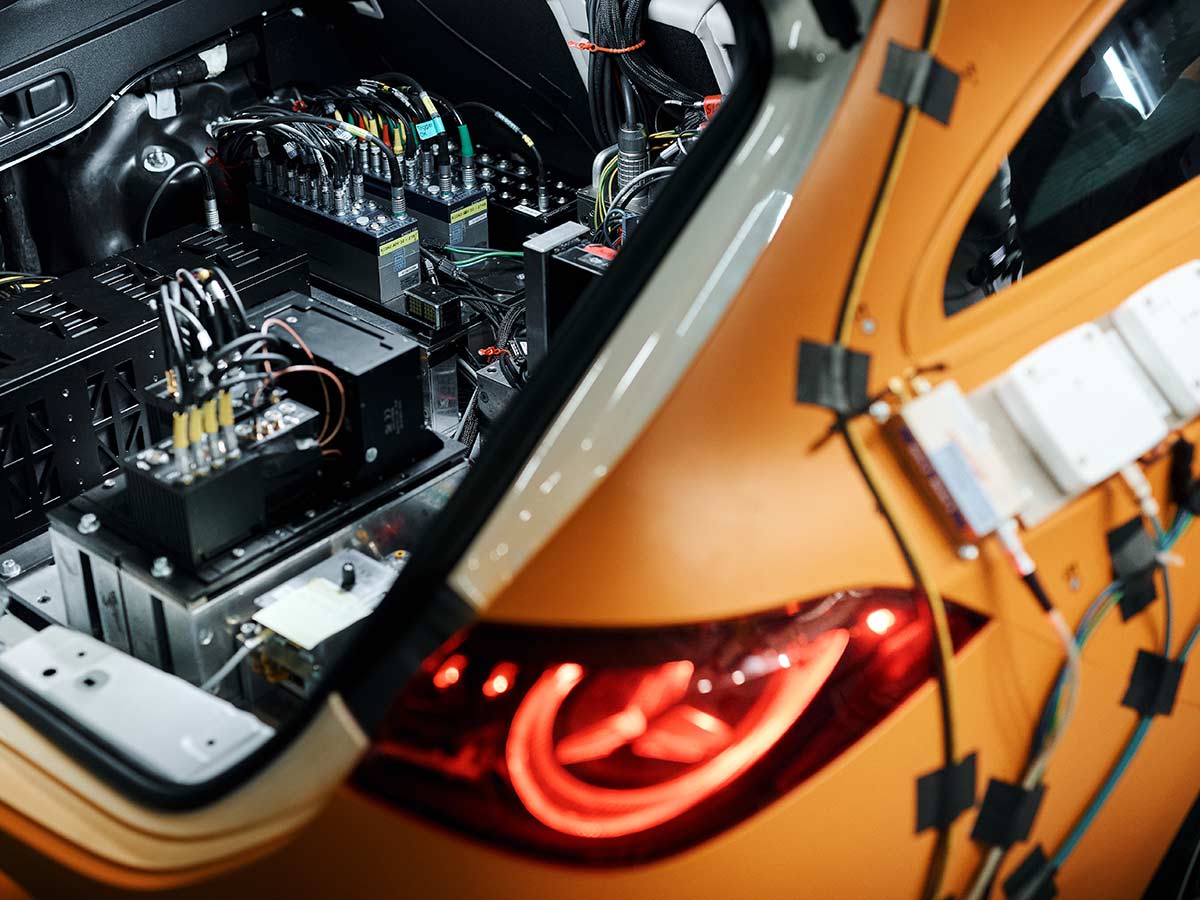
The fully electric CLA faced an additional engineering challenge. Its high-voltage battery is housed in the underbody, placing the battery system within the area that vehicle engineers must protect during a severe collision.
An electric vehicle’s battery is not merely another component to shield from cosmetic damage. It is a high-voltage energy-storage system, and its condition following a crash has implications for electrical safety and the subsequent handling of the vehicle by emergency responders.
The structure around the battery must therefore withstand the forces generated by a collision while helping protect the battery itself. This requirement sits alongside the familiar priorities of preserving the passenger compartment and limiting injury risks.
Mercedes-Benz reported that the electric CLA’s high-voltage battery remained intact and undamaged despite the direct side impact. The result is one of the most important findings from the demonstration because the test directed the other vehicle into the electric CLA’s side, challenging an area where the battery and passenger compartment both require protection.
Why battery integrity matters after an accident
In a conventional vehicle, a severe collision can damage fuel-system components, electrical equipment and other mechanical systems. In a battery-electric vehicle, emergency crews must also consider the high-voltage system and the condition of the traction battery.
A battery that remains undamaged after a severe collision presents a different post-crash situation from one that has sustained structural damage. Battery integrity is therefore a relevant element of electric-vehicle crash safety, alongside occupant injury measurements and the preservation of the passenger cell.
The CLA demonstration offers a specific finding: Mercedes-Benz said the battery remained intact and undamaged after this impact. It is a meaningful outcome under the conditions chosen for the test, especially given the direct side strike.
That does not make battery protection a single-component problem. The surrounding body structure, the way collision energy is managed and the electrical system’s condition all form part of the broader safety picture. A battery’s condition must also be assessed in the context of the actual incident, rather than assumed from the appearance of the vehicle alone.
For drivers considering an electric car, the distinction is useful. Battery safety is not measured simply by whether the vehicle can continue operating after an accident. The integrity of the battery and the protection of occupants are central considerations in how the vehicle performs during and after a collision.
What Makes This Test Different From Standard Crash Testing?
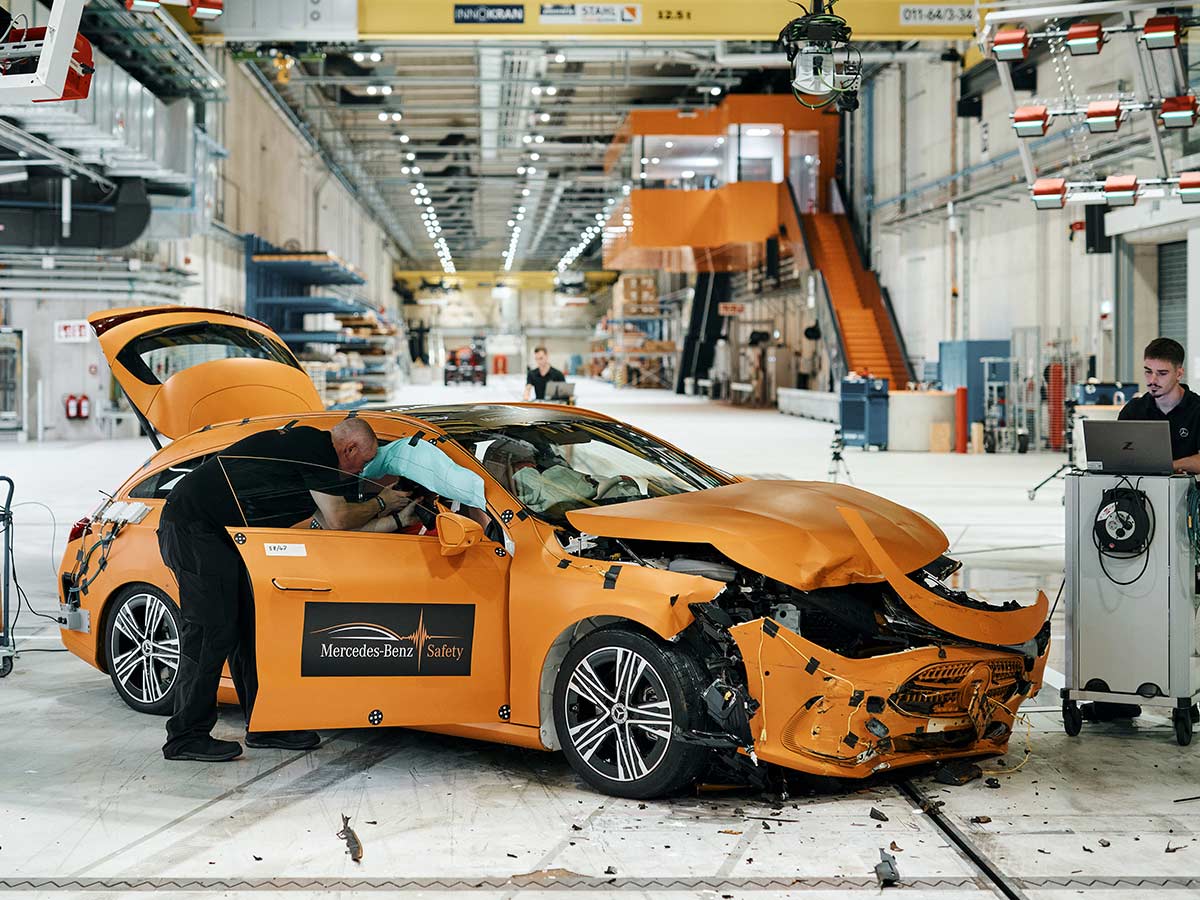
Mercedes-Benz made a clear distinction between its two-vehicle demonstration and established crash-test procedures. According to the company, no law or safety rating requires a side-impact test involving two real vehicles in this configuration.
Standardised crash tests generally use stationary barriers or specially designed impact vehicles under specified conditions. These controlled procedures allow manufacturers and assessment organisations to measure performance against defined criteria and compare results within the relevant test framework.
A collision between two moving production cars introduces a different set of conditions. Both vehicles are moving, and their structures interact directly. The angle and position of the impact, along with the properties of each vehicle, influence how the collision develops.
The Mercedes-Benz demonstration was designed to complement conventional testing by examining a scenario based on real-world accident data. The company cited its own research indicating that the selected speed represents the upper end of serious junction collisions.
Mercedes-Benz also stated that around a quarter of accidents resulting in personal injury are side-impact collisions. That figure underscores the relevance of examining this type of crash, although the specific circumstances of individual side impacts vary considerably.
What a public real-vehicle collision can demonstrate
The value of a test is determined partly by the question it is designed to answer. A standardised barrier test provides a controlled way to assess vehicle performance against a specified impact. A collision involving two production cars allows engineers to investigate a different configuration in which both vehicles participate dynamically in the event.
The CLA demonstration combined several factors that made the test particularly demanding:
- Two moving production vehicles: The collision involved real CLA models rather than a vehicle and a stationary barrier.
- A direct side impact: The CLA Shooting Brake struck the driver’s side of the fully electric CLA.
- A speed of 56 km/h for each vehicle: Mercedes-Benz selected a speed it describes as being at the upper end of serious real-world junction collisions.
- Vehicles weighing more than two tonnes each: The mass of both vehicles was part of the challenging test configuration.
- No prior braking: The vehicles entered the collision without braking beforehand, following the test procedure described by the manufacturer.
- Electric-vehicle battery protection: The impact tested the electric CLA’s passenger compartment and underfloor high-voltage battery in the same event.
These elements make the test a useful additional demonstration of the company’s safety approach. They do not replace established crash-test standards or create a directly interchangeable score with other safety assessments. Instead, the exercise shows how Mercedes-Benz has chosen to investigate a particularly demanding real-world accident scenario.
Real-Life Safety: How Mercedes-Benz Uses Accident Research
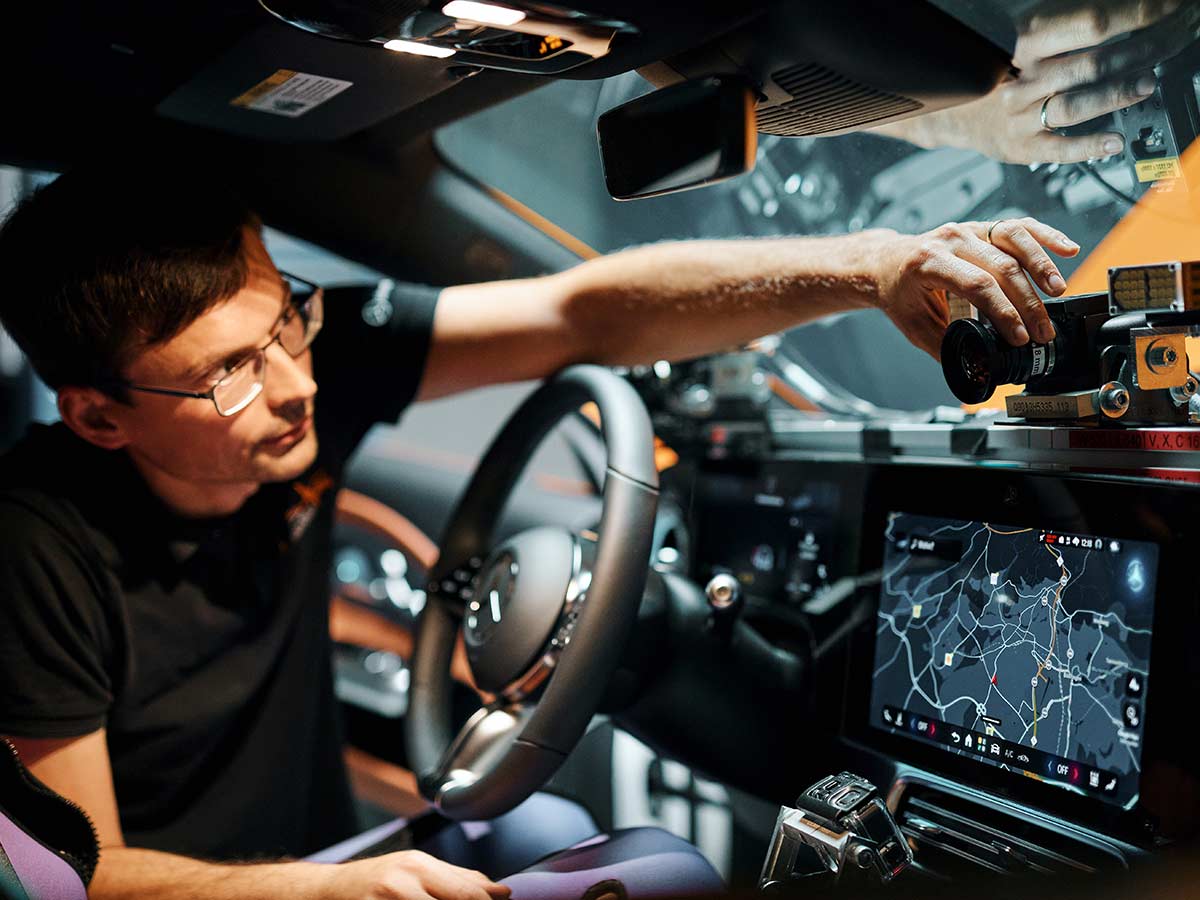
The public collision was the visible part of a much larger development process. Mercedes-Benz describes its philosophy as Real-Life Safety, an approach that incorporates findings from actual road accidents into vehicle engineering requirements.
According to the company, it has been investigating and reconstructing real-world accidents since 1969. Around 6,000 accidents have been analysed, with research teams in Germany, China and India contributing to the work.
The purpose of accident reconstruction is to understand what happened in a collision, how the vehicles responded and which factors influenced the outcome. These findings can inform decisions about body structures, restraint systems and the requirements used during vehicle development.
The process creates a connection between road incidents and laboratory engineering. Crash tests can evaluate defined scenarios, while investigations of actual accidents help identify the circumstances engineers need to consider when developing the next generation of protective systems.
Jörg Burzer, a member of the Board of Management of Mercedes-Benz Group AG and its Chief Technology Officer for Development and Purchasing, said the company’s ambition is to build the safest vehicles in the world and that the test demonstrates its focus on real-world traffic scenarios.
Paul Dick, Director of Vehicle Safety at Mercedes-Benz AG, similarly described the approach as using real-accident insights to inform development requirements. Both statements reflect the manufacturer’s stated safety philosophy rather than an independent ranking of the CLA against every competing vehicle.
From virtual simulations to physical crash tests
Before a new Mercedes-Benz model reaches the physical crash-test stage, it undergoes extensive virtual testing. The company says every new model completes around 15,000 crash simulations during development.
These simulations allow engineers to investigate how a vehicle might behave under different impact conditions. Computer models can be used to assess structural deformation and predict how the vehicle responds to a collision, helping engineers evaluate potential solutions before building and destroying physical prototypes.
Mercedes-Benz says artificial intelligence supports engineers in making these predictions more precise. In this context, AI is part of the simulation and prediction process. It supports engineering analysis rather than replacing the need to validate vehicle performance through physical testing.
The company also reports conducting around 150 physical crash tests for a new model, going beyond legal requirements in pursuit of its safety objectives.
The two methods serve complementary purposes. Virtual simulations provide a way to investigate numerous scenarios during development, while physical crash tests supply measurements from actual impacts. The findings from physical testing can help validate the models, and simulations can help engineers explore changes before committing to further physical tests.
The CLA demonstration illustrates how this broader programme can extend beyond the conditions required by regulations or formal safety ratings. Its purpose was to examine a particularly challenging collision involving two moving production vehicles.
Mercedes-Benz Rescue Intelligence: Giving Emergency Services a Head Start
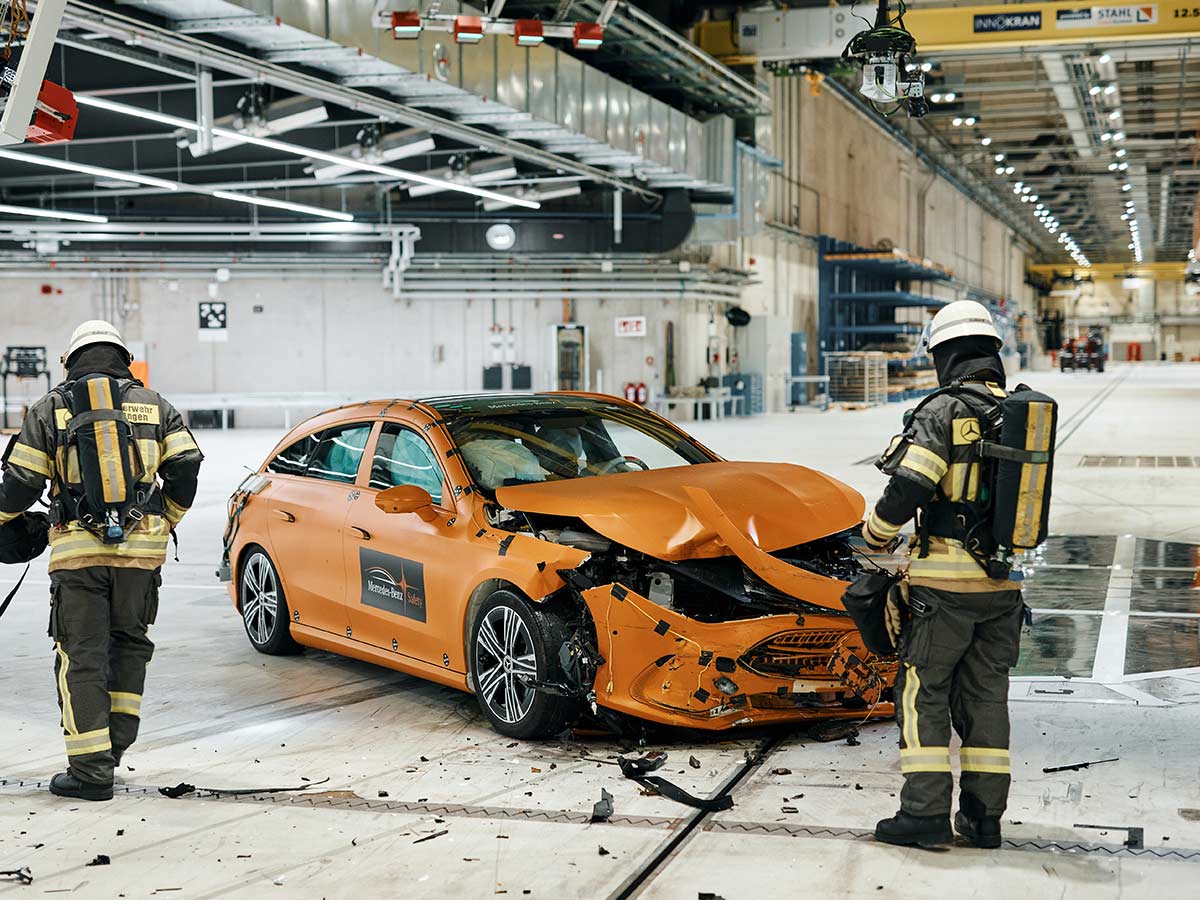
Crash protection is only one part of automotive safety. Once a collision has occurred, emergency services must establish what happened, identify hazards and decide how to reach and assist the occupants.
That process can be complicated when a damaged vehicle is difficult to access or when responders do not yet know how many people are inside. In an electric vehicle, understanding the condition of the high-voltage system and the battery can also help crews prepare for the situation they are about to encounter.
Mercedes-Benz introduced Rescue Intelligence as a system intended to provide emergency services with relevant accident information while they are still travelling to the scene. The company said the system is planned for gradual rollout from 2027 onwards.
Its central idea is straightforward: if emergency responders can receive useful information before arriving, they can begin preparing their response earlier rather than waiting until they reach the vehicle.
Depending on technical availability and the specific circumstances, the system is designed to provide information including:
- The number of occupants in the vehicle.
- The status of airbags and seat belts.
- Which doors are open.
- The battery temperature.
- The condition of the high-voltage system.
This information could help emergency crews build an initial picture of the incident and determine which equipment may be required. The system is intended to establish a direct link between vehicles involved in accidents and emergency services, allowing accident-related information to be made available while responders are en route.
Why information before arrival matters
After a serious collision, rescue teams may need to determine how many people require assistance, whether occupants are restrained or whether the vehicle presents additional hazards. Information about the vehicle’s systems can contribute to that assessment.
The condition of the high-voltage system is particularly relevant when responding to an accident involving an electric vehicle. Knowing the reported state of the system and battery temperature could help crews prepare for the rescue and consider the equipment required for the situation.
Door status can also provide useful context about access to the vehicle, while occupant information may help responders understand the scale of the incident before arriving.
Rescue Intelligence is designed to make that preliminary assessment more informed. Mercedes-Benz says the system can help emergency services select suitable rescue equipment sooner, with the aim of making the operation more effective when every second matters.
The distinction between information and intervention remains important. Rescue Intelligence is intended to support emergency services with accident-related data. It does not replace the on-scene assessment required to establish the vehicle’s actual condition and determine the appropriate rescue procedure.
How Rescue Intelligence fits into the CLA safety story
The system broadens the discussion beyond the forces experienced during the crash itself. Vehicle safety also involves the conditions that emergency crews face after an impact and the information available to them when deciding how to respond.
For the electric CLA, this has a direct connection to battery safety. Although Mercedes-Benz reported that the battery remained undamaged in the demonstration, real-world accidents can produce different outcomes. A system that provides information about battery temperature and high-voltage-system condition is intended to help responders prepare for those possibilities.
The planned rollout from 2027 onwards also places the technology in a different category from the physical crash test. The collision demonstrated a vehicle’s behaviour under a particular impact, while Rescue Intelligence is a system intended to support the emergency response after accidents.
Together, they represent two distinct parts of the safety process: reducing the risk of injury during a collision and helping emergency services manage the aftermath.
Can the CLA’s Driver Assistance Systems Prevent This Kind of Crash?
Mercedes-Benz says the CLA’s driver assistance systems are designed to help prevent this type of collision or reduce its severity in everyday traffic.
That statement is an important part of the company’s safety approach. Crash protection addresses what happens when a collision occurs, but driver assistance systems are intended to help drivers avoid hazards or mitigate the consequences of an accident.
These are complementary objectives. Avoiding a collision can eliminate the associated impact altogether, while reducing its severity may lessen the demands placed on the vehicle’s structure and occupant-restraint systems.
The crash demonstration itself was conducted without prior braking, so the collision was not a test of the assistance systems’ ability to intervene in that specific event. Instead, the test concentrated on the vehicles’ performance during the impact.
The distinction matters when interpreting the results. A demonstration of strong occupant protection does not mean that the vehicle is immune to crashes, and the presence of driver assistance systems does not remove the need for attentive driving.
Mercedes-Benz’s stated objective is to combine prevention and mitigation with structural protection. The CLA test focused on the latter, while the company’s description of its assistance systems explains how safety measures are intended to address the stages leading up to a collision.
What the CLA Crash Test Means for Electric-Car Safety
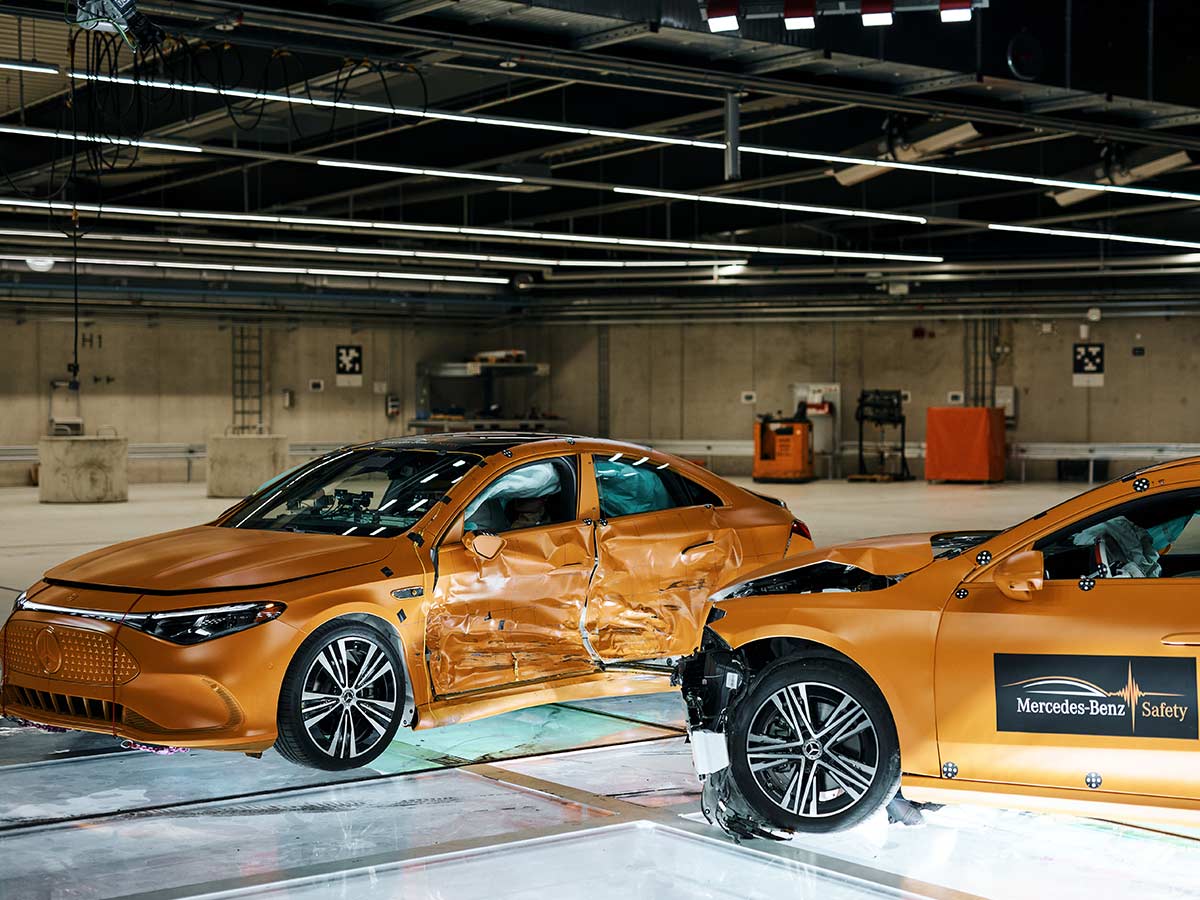
The demonstration has particular relevance for electric vehicles because it examines occupant protection and high-voltage battery integrity within the same collision.
Electric-car safety is sometimes discussed as though it were a single issue, but several different questions need to be considered. How well does the vehicle preserve its passenger compartment? What forces do occupants experience? How does the battery respond to an impact? What information is available to emergency responders afterwards?
The Mercedes-Benz test addressed these questions through a specific side-impact scenario. The company reported intact passenger compartments, dummy measurements below the relevant biomechanical limits and an undamaged high-voltage battery in the electric CLA.
Those findings provide a useful picture of how the vehicle performed in the chosen test. They also show why a battery-electric vehicle’s crash safety cannot be assessed solely by examining the battery, just as occupant protection cannot be judged solely by looking at external body damage.
The vehicle’s structural performance, restraint systems and electrical safety considerations need to be understood as connected parts of the overall design.
Rescue Intelligence adds another dimension by focusing on the information available to emergency services after an accident. In combination, these developments illustrate a safety strategy that extends from collision prevention through impact protection to post-crash response.
For prospective electric-car buyers, the key takeaway is not that every accident will produce the same outcome. It is that battery integrity, passenger-compartment protection and the ability to provide useful information to emergency crews are all relevant parts of a comprehensive safety assessment.
A Broader View of Mercedes-Benz Safety Engineering
The CLA demonstration also illustrates how manufacturers can use physical testing to explore scenarios beyond those required by formal regulations. Standardised procedures remain important because they establish repeatable conditions for assessment, but additional testing can investigate collision configurations that manufacturers consider particularly relevant to real-world road accidents.
Mercedes-Benz’s approach combines accident reconstruction, virtual simulations and physical crash tests. Its reported programme includes around 6,000 analysed accidents since its real-world accident research began in 1969, approximately 15,000 crash simulations for every new model and around 150 physical crash tests during development.
The figures describe a development process built around multiple sources of evidence. Accident research helps identify scenarios, simulations allow engineers to investigate vehicle behaviour and physical tests provide measurements from actual impacts.
The public two-vehicle collision gives that process a visible result. Two CLA models met in a deliberately severe side-impact scenario, and the manufacturer reported that both retained intact passenger compartments, with all eight crash-test dummies recording readings below the relevant biomechanical limits. The electric CLA’s battery also remained undamaged.
The demonstration does not replace formal safety assessments, nor does it establish an overall safety ranking for the model. Its significance lies in the particular question it addresses: how the CLA performs when two heavy production vehicles collide in a severe junction-style side impact.
Conclusion: Safety Extends Beyond the Moment of Impact
Mercedes-Benz’s high-speed CLA crash test brought three important aspects of vehicle safety into focus: the protection of occupants, the integrity of an electric vehicle’s high-voltage battery and the information available to emergency responders after a collision.
The results reported by the manufacturer were encouraging within the test’s defined conditions. Both passenger compartments remained intact, all eight crash-test dummies recorded readings below the relevant biomechanical limits, and the electric CLA’s battery was left undamaged.
The introduction of Rescue Intelligence adds a practical post-crash dimension to that work. Planned for gradual rollout from 2027, the system is intended to give emergency services useful information while they are still on their way to an accident.
Taken together, the developments show how the CLA’s safety story extends beyond the vehicle’s ability to withstand an impact. It encompasses efforts to prevent or reduce collisions, manage the forces experienced by occupants, protect the high-voltage battery and support the people who respond when an accident occurs.
Frequently Asked Questions About the Mercedes-Benz CLA Crash Test
Q: What happened in the Mercedes-Benz CLA crash test?
A: Mercedes-Benz conducted a public high-speed side-impact crash test involving two production CLA models. A CLA Shooting Brake with an electrified internal combustion engine struck the driver’s side of a fully electric CLA, with both vehicles travelling at 56 km/h.
Q: What were the results of the CLA crash test?
A: Mercedes-Benz reported that both passenger compartments remained intact, all eight crash-test dummies recorded readings below the relevant biomechanical limits, and the high-voltage battery in the electric CLA remained intact and undamaged.
Q: How fast were the two Mercedes-Benz CLA vehicles travelling?
A: Both vehicles were travelling at 56 km/h before the collision. Mercedes-Benz selected this speed because its accident research places it at the upper end of serious junction collisions encountered in real-world traffic.
Q: Was the electric CLA’s battery damaged in the crash?
A: No. Mercedes-Benz reported that the fully electric CLA’s high-voltage battery remained intact and undamaged despite the direct side impact.
Q: How many crash-test dummies were used?
A: The test used eight crash-test dummies representing four adults and four children. Mercedes-Benz reported that measurements from all eight remained below the relevant biomechanical limits.
Q: Why is a side-impact crash test particularly demanding?
A: A side-impact collision is challenging because there is considerably less space at the side of a vehicle to absorb crash energy than at the front. The structure must protect occupants while preserving the passenger compartment, and an electric vehicle must also protect its underfloor high-voltage battery.
Q: How is the Mercedes-Benz CLA test different from a standard crash test?
A: The demonstration involved two moving production vehicles rather than a vehicle striking a stationary barrier or a specially designed impact vehicle. Mercedes-Benz said no law or safety rating requires a side-impact crash test involving two real vehicles in this configuration.
Q: Does the crash test prove that the Mercedes-Benz CLA is safe in every accident?
A: No. The test demonstrates how the two CLA models performed in a specific, deliberately demanding collision scenario. The results reported by Mercedes-Benz do not guarantee the same outcome in every accident, since real-world collisions differ in speed, direction, impact location and other circumstances.
Q: What is Mercedes-Benz Rescue Intelligence?
A: Mercedes-Benz Rescue Intelligence is a system designed to provide emergency services with accident-related information while they are travelling to a collision scene. Depending on technical availability and the circumstances, the information may include occupant numbers, airbag and seat-belt status, door status, battery temperature and high-voltage-system condition.
Q: When will Mercedes-Benz Rescue Intelligence become available?
A: Mercedes-Benz plans to introduce Rescue Intelligence gradually from 2027 onwards. The system is intended to help emergency responders prepare for rescue operations before arriving at the scene.
Q: How many crash simulations does Mercedes-Benz conduct for a new model?
A: Mercedes-Benz says each new model undergoes around 15,000 crash simulations during development. Artificial intelligence supports engineers in making these predictions more precise.
Q: How many physical crash tests does Mercedes-Benz conduct for a new model?
A: Mercedes-Benz reports conducting around 150 physical crash tests for a new model, going beyond legal requirements as part of its vehicle-safety development programme.
Q: How long has Mercedes-Benz been investigating real-world accidents?
A: Mercedes-Benz says it has investigated and reconstructed real-world accidents since 1969. The company reports that around 6,000 accidents have been analysed by research teams in Germany, China and India, with findings incorporated into vehicle structures, restraint systems and development requirements.
Source: Mercedes-Benz