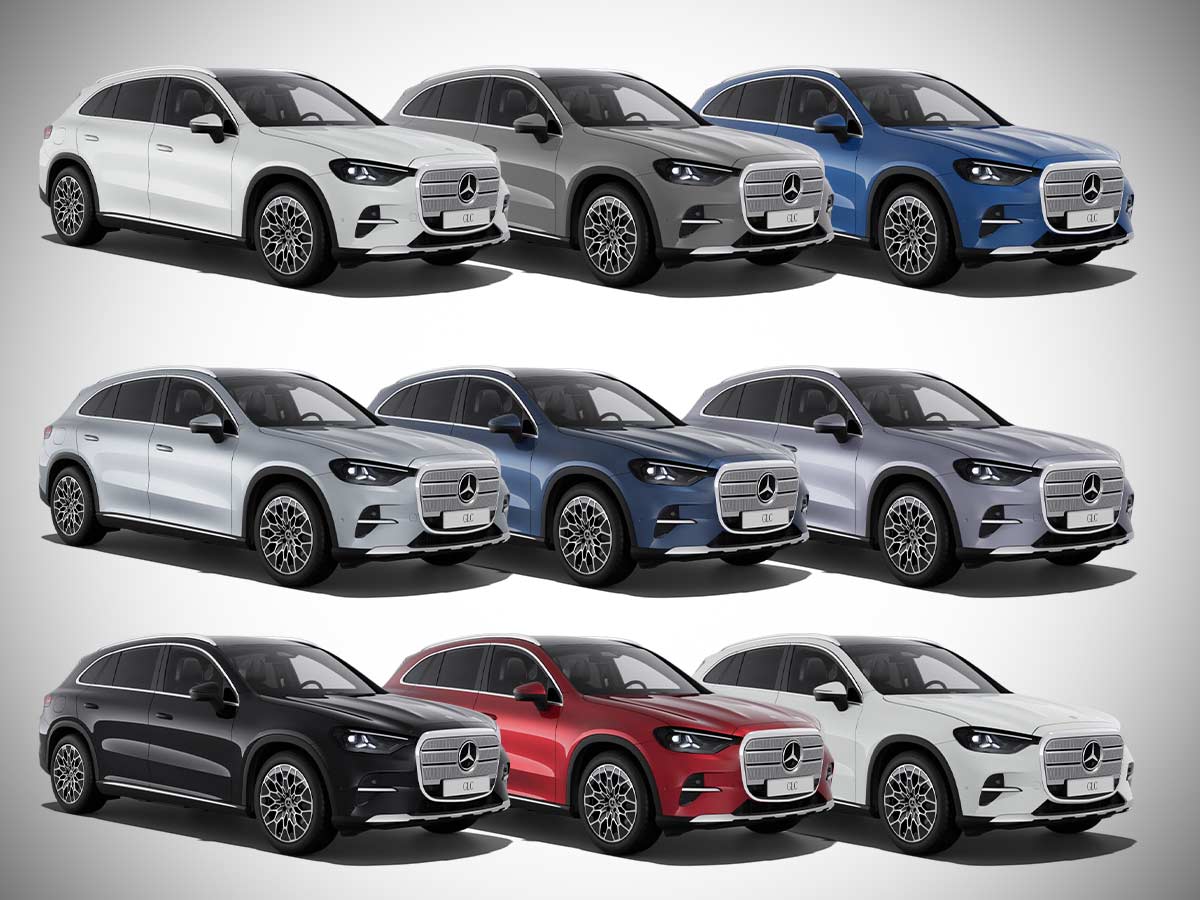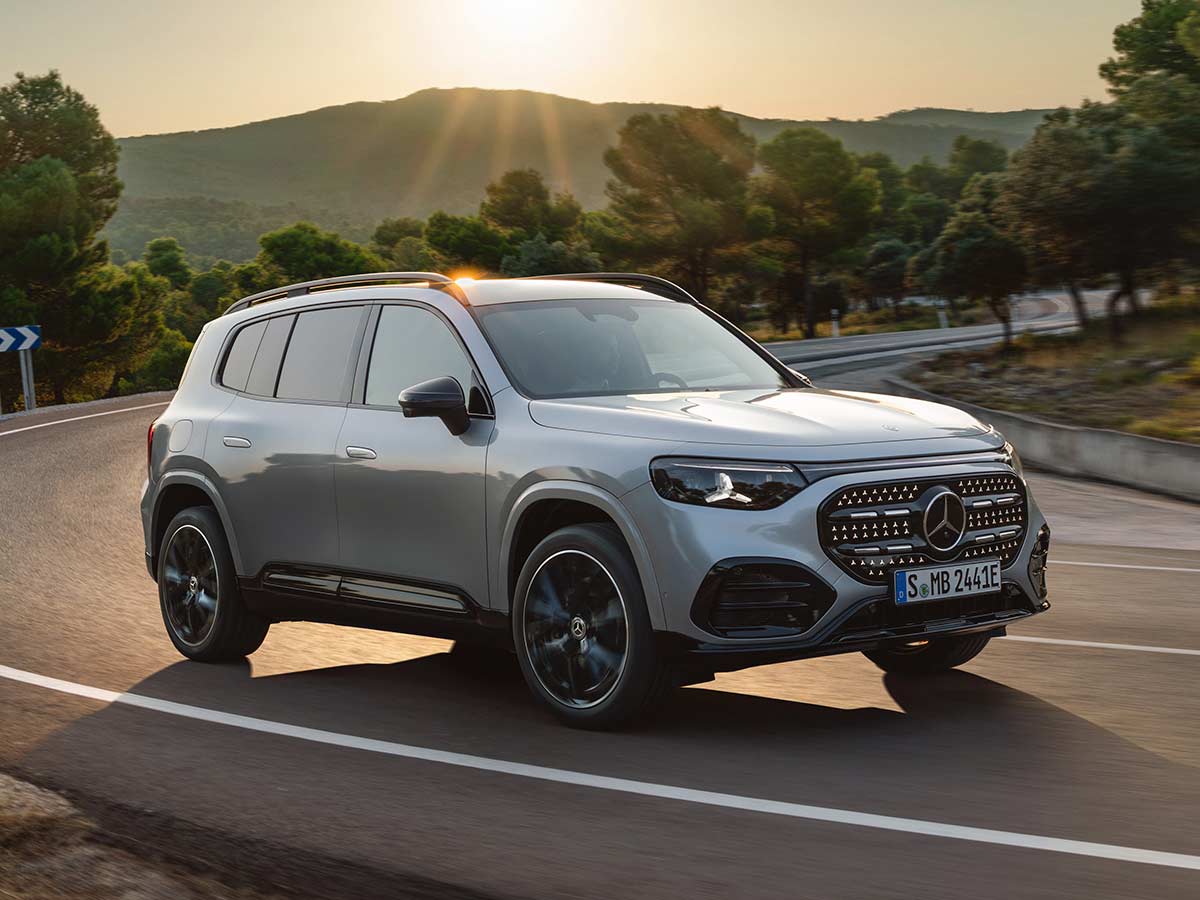









The Mercedes-Benz GLA has always occupied an interesting position within the brand’s portfolio. It isn’t the smallest Mercedes anymore, nor is it the most luxurious SUV wearing the three-pointed star. Instead, it has become something arguably more important: the gateway into Mercedes-Benz ownership for thousands of buyers around the world.
Now, Mercedes-Benz has given its best-selling compact SUV its most significant reinvention since the model was introduced.
And this isn’t simply another redesign.
The all-new GLA marks the beginning of a completely different philosophy for Mercedes-Benz’s entry-level SUV lineup. It is the first GLA engineered from the outset around Mercedes-Benz’s new Modular Architecture (MMA), making it an electric-first vehicle while continuing to offer advanced electrified combustion powertrains for customers who aren’t ready to make the jump to a fully electric vehicle.
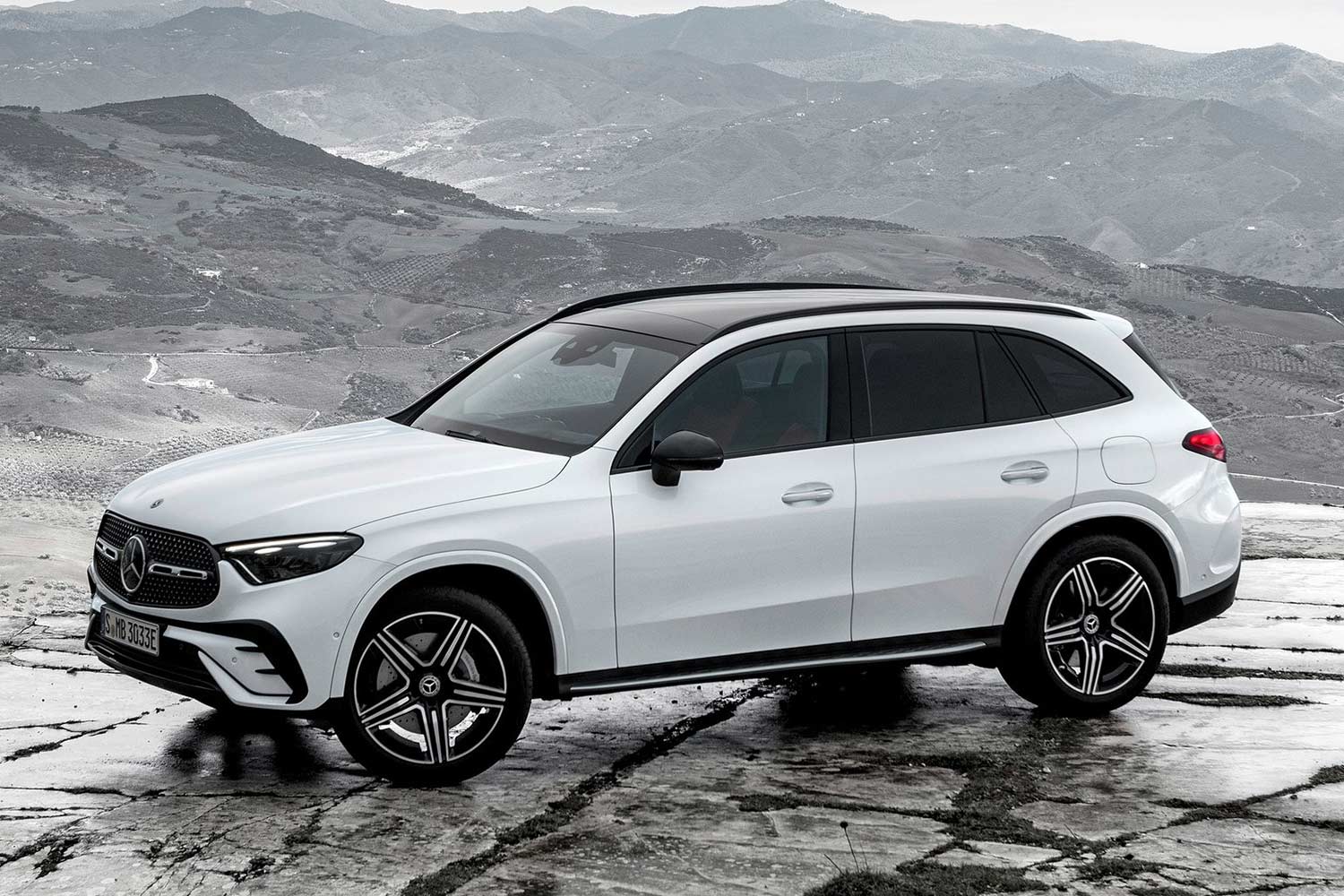
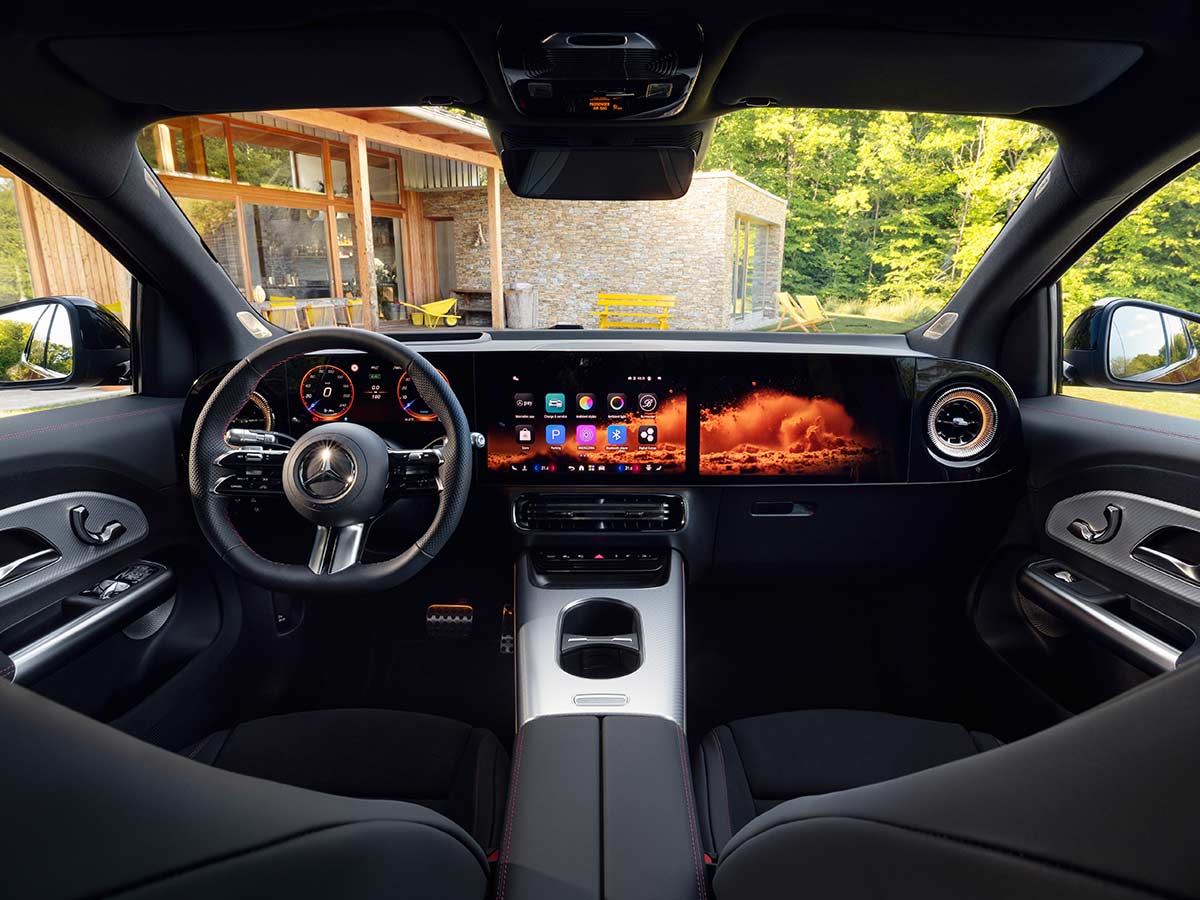
The result is a premium compact SUV that’s noticeably lower, longer and more athletic than before, yet more spacious inside. It introduces the brand’s latest illuminated grille, a futuristic MBUX Superscreen spanning almost the entire dashboard, generative AI integrated into everyday driving, and an electric drivetrain capable of delivering up to 657 km (WLTP) on a single charge.
For Mercedes-Benz, this isn’t just another new model. It represents the company’s vision of what everyday premium mobility should look like over the next decade.
And after studying every technical document released alongside the global reveal, one thing becomes clear: beneath its familiar GLA badge lies one of the most comprehensive engineering overhauls Mercedes-Benz has undertaken in recent years.
>>> Great Discounts on Car & Bike Accessories <<<
Before diving into the details, here’s what makes the new Mercedes-Benz GLA one of the most important compact SUV launches of 2026.
Key Highlights
- All-new generation built on Mercedes-Benz’s Modular Architecture (MMA)
- Electric-first platform with hybrid powertrains joining the lineup in 2027
- Up to 657 km (WLTP) electric driving range
- 800-volt electrical architecture
- Up to 320 kW DC fast charging
- Up to 270 km of additional range in just 10 minutes
- Three electric models available at launch
- New illuminated Mercedes-Benz iconic grille
- Longer wheelbase (+61 mm)
- Lower overall height (-20 mm)
- Larger cabin with increased legroom and headroom
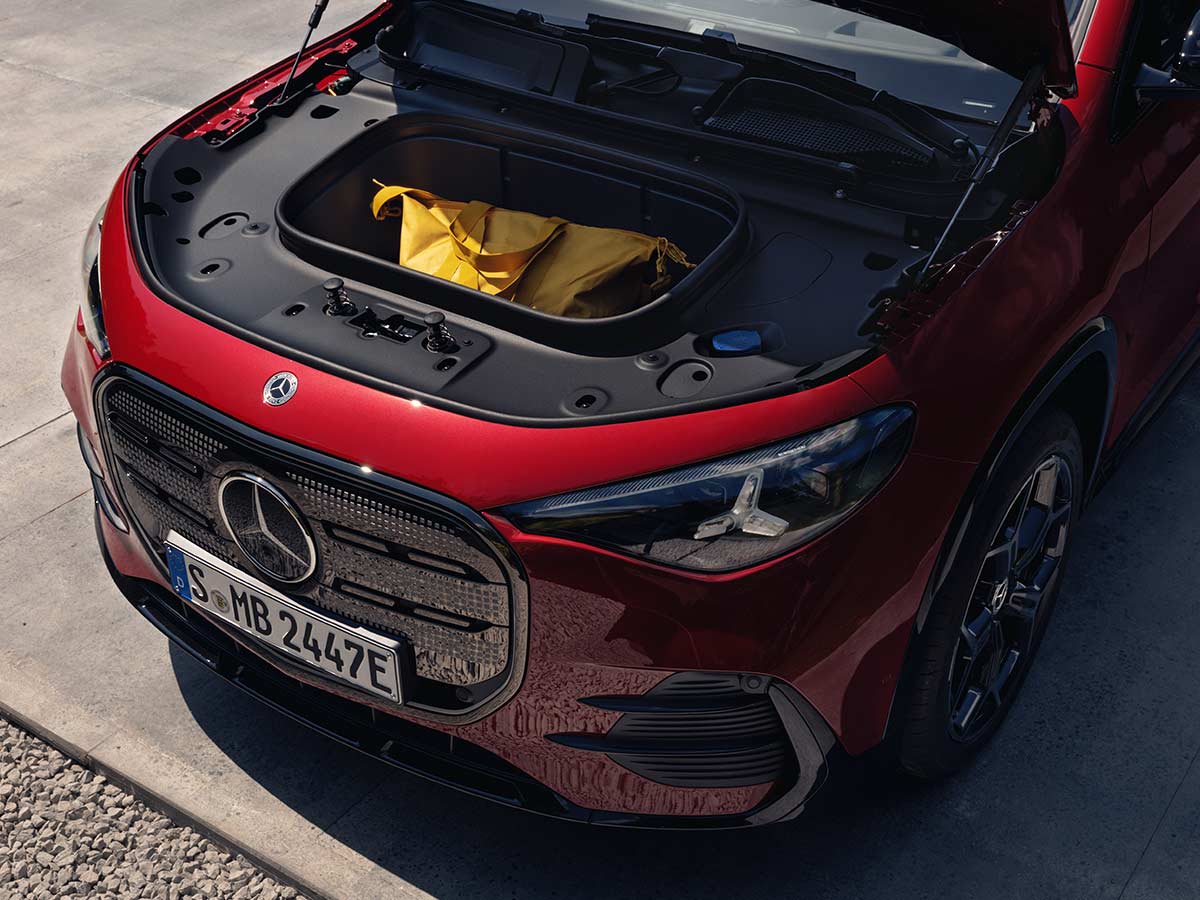
- 410-litre boot plus a 107-litre front trunk (frunk) on electric versions
- Up to 2-tonne towing capacity on 4MATIC electric models
- MBUX Superscreen with up to three displays
- AI-powered MBUX Virtual Assistant using ChatGPT, Google Gemini and Microsoft Bing
- Google Maps-based intelligent navigation
- More than 40 integrated entertainment apps
- New MB.DRIVE Level 2 driver assistance technologies
- Available AMG Line Plus for the first time
- Orders open from 30 July 2026
- German prices start at €48,599.60 including VAT for the GLA 200 electric
These numbers tell only part of the story. The real transformation becomes obvious the moment you look at the new GLA.
A Smaller SUV That Looks More Grown-Up
Designing a compact SUV is harder than it sounds.
Make it too aggressive and it alienates family buyers. Make it too practical and it risks looking anonymous. Mercedes-Benz appears to have found a sweet spot with the new GLA.
At first glance, the proportions seem subtly familiar. Spend more time with the car, however, and the differences become impossible to ignore.
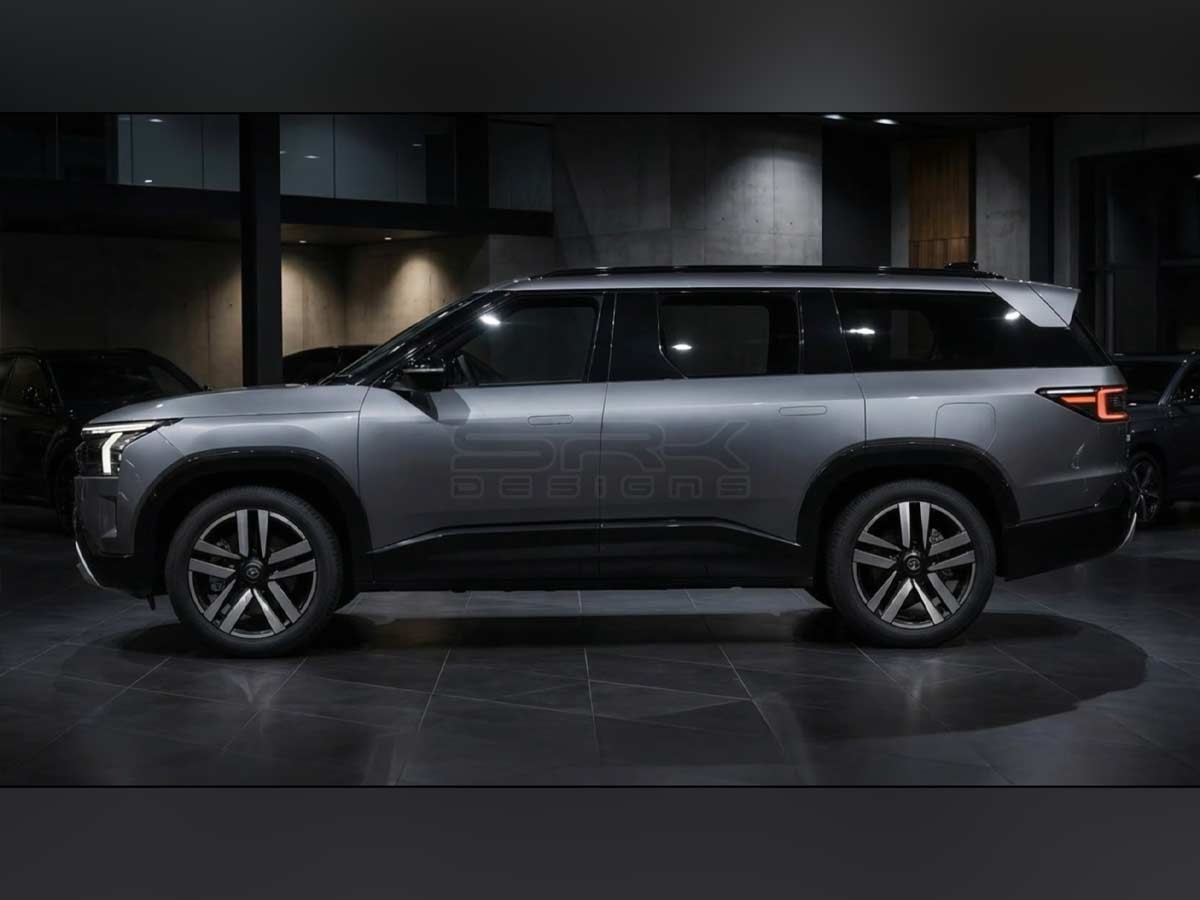
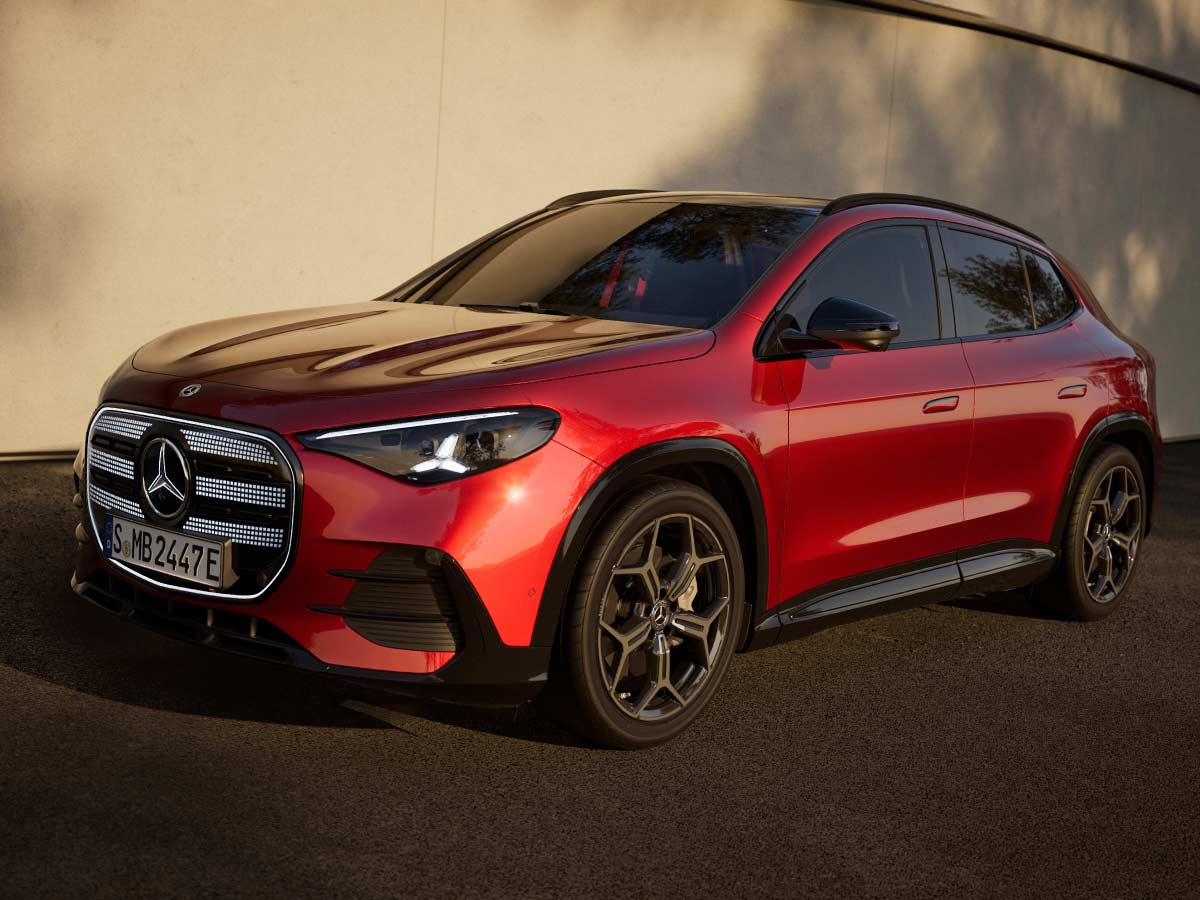
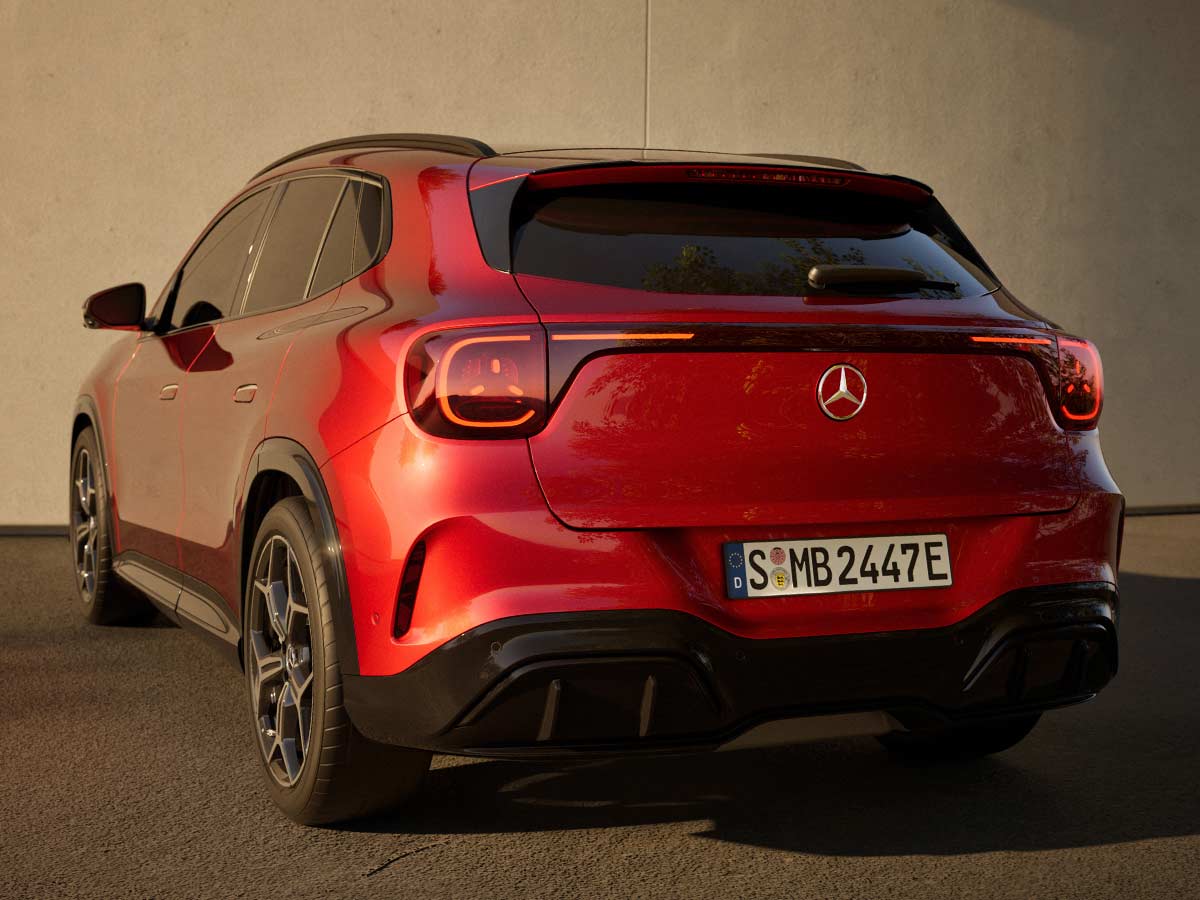
Compared with its predecessor, the new GLA sits 20 mm lower, while its wheelbase stretches by 61 mm. The rear track is also wider, creating a stance that’s noticeably more planted.
The effect is dramatic.
Rather than resembling a hatchback riding on stilts, the new GLA has genuine SUV presence without becoming bulky. The body appears longer, the roofline cleaner, and the wheels sit almost flush with the bodywork, giving the vehicle an athletic, confident posture that wasn’t as pronounced before.
Mercedes-Benz has also significantly simplified the surfacing.
Gone are many of the sharp creases traditionally associated with compact SUVs. Instead, broad uninterrupted panels create shifting reflections that change depending on lighting conditions. It’s a cleaner, more mature approach that echoes the latest design language already seen on Mercedes-Benz’s newest electric models.
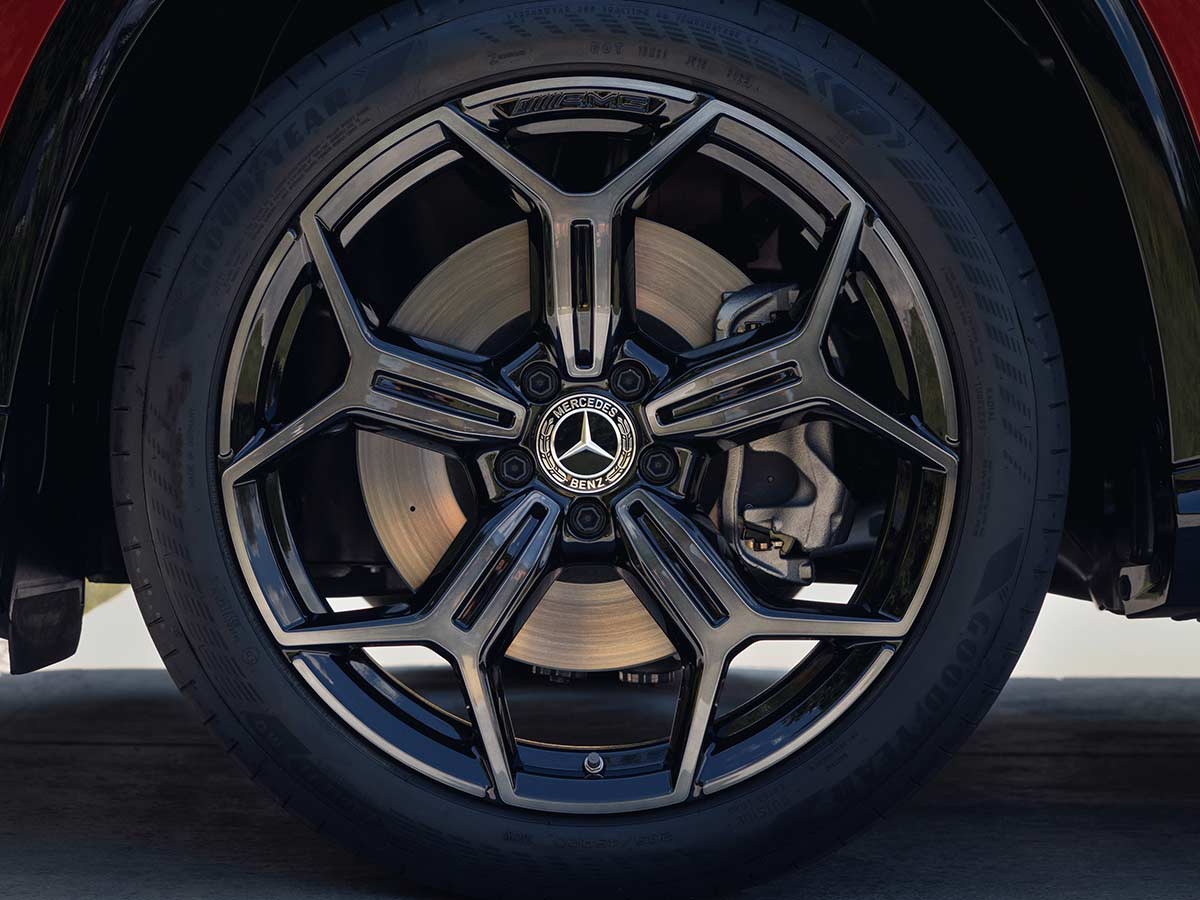
Muscular shoulders over the rear wheels reinforce the SUV stance, while substantial wheel arches accommodate alloy wheels ranging from 18 to 20 inches depending on specification.
Practical touches haven’t disappeared either.
Roof rails remain available for carrying bikes, skis or roof boxes, while front and rear underbody protection elements subtly remind buyers that the GLA hasn’t forgotten its SUV roots.
The Illuminated Grille Changes Everything
If there’s one feature guaranteed to divide opinion, it’s the grille.
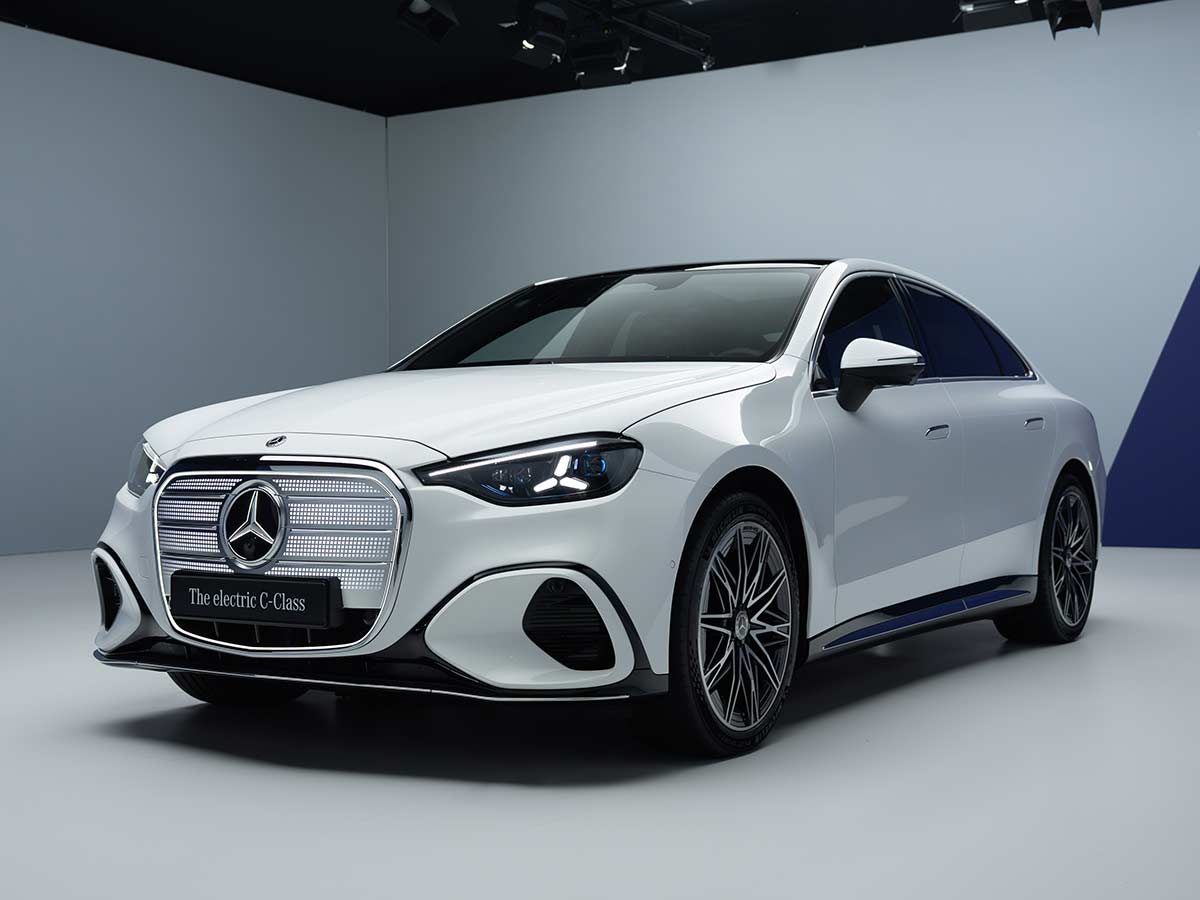
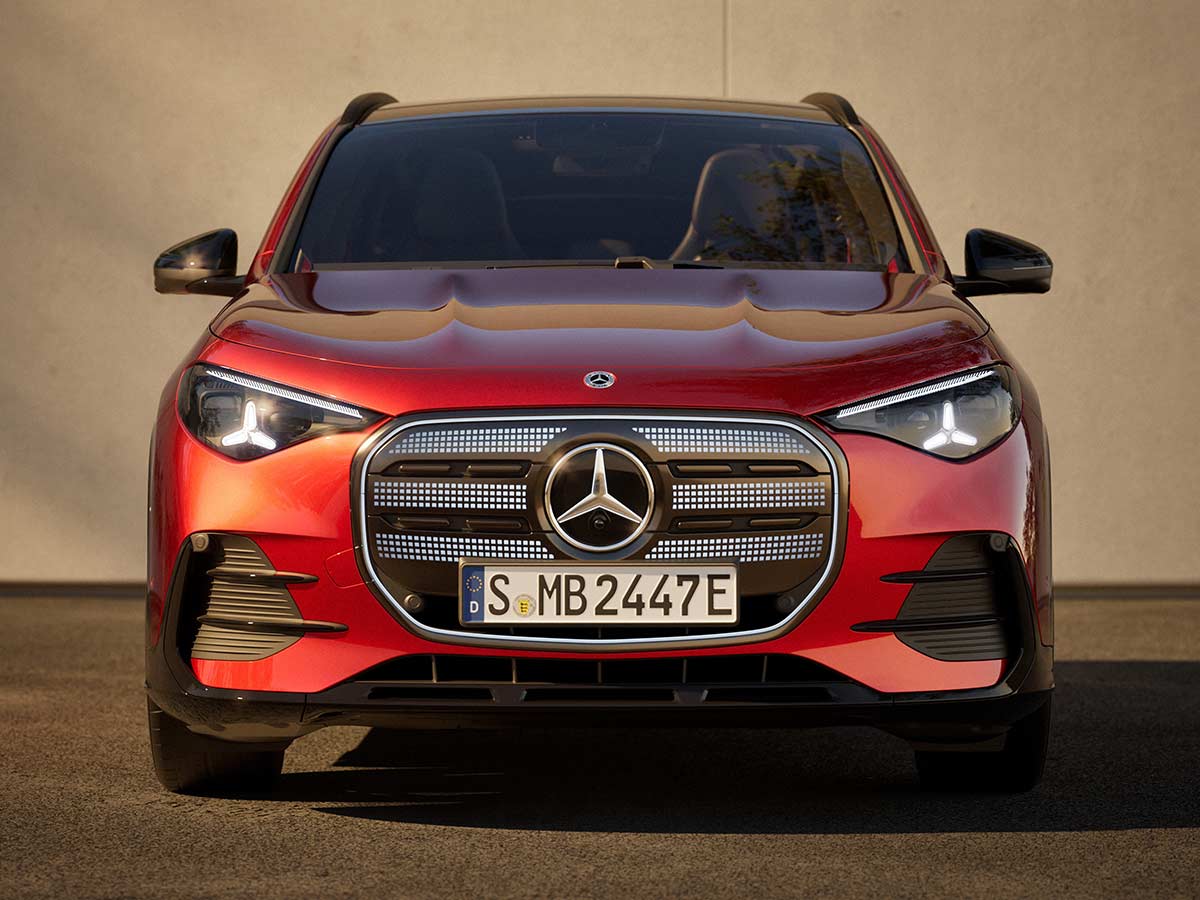
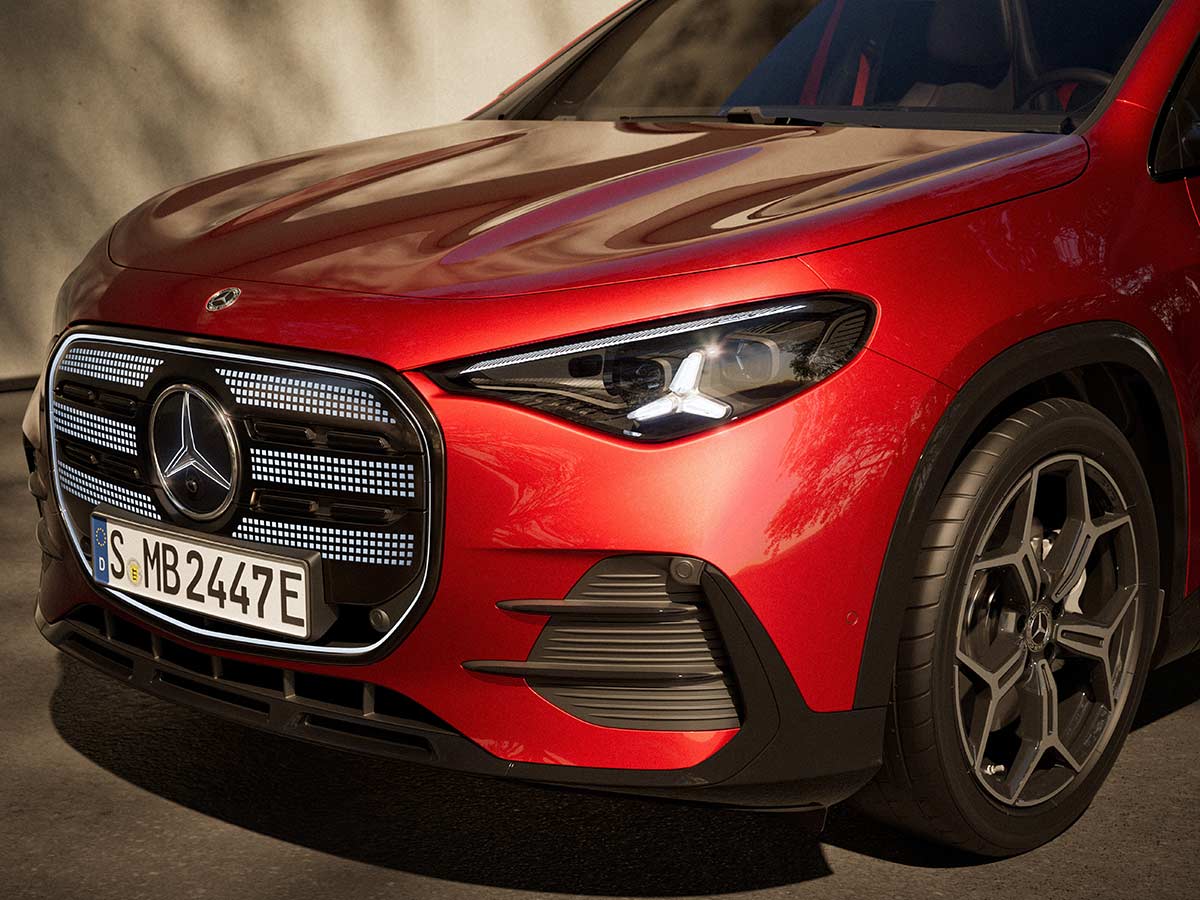
Mercedes-Benz calls it the Iconic Grille, and on the electric GLA it immediately becomes the defining visual signature.
Unlike conventional grilles that exist to cool an engine, this enclosed panel becomes a digital design canvas.
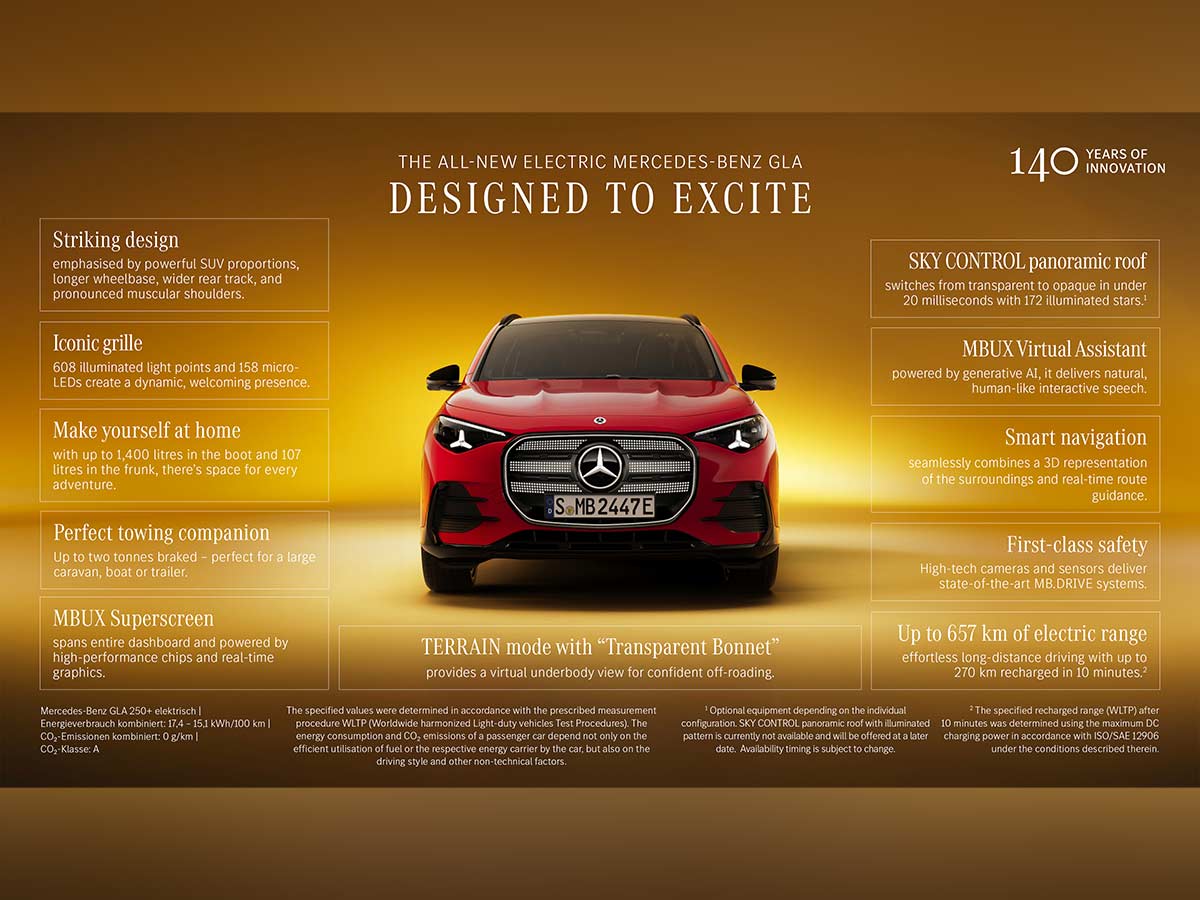
Depending on specification, the perimeter of the grille illuminates, while the smoked-glass panel itself can also light up. Embedded within it are 608 illuminated polycarbonate elements, backed by 158 micro-LEDs capable of producing animated welcome and goodbye sequences synchronized with the vehicle’s selected soundscape.
It’s theatrical without feeling gimmicky.
At night, the illuminated star and glowing grille ensure the GLA is unmistakably recognizable long before it reaches you.
Hybrid models take a different approach.
Rather than using the closed illuminated panel, they receive Mercedes-Benz’s new Star Grille, featuring 150 chrome stars arranged across the radiator grille. Higher trim levels also gain an illuminated LED surround, preserving a family resemblance between combustion and electric variants while giving each its own identity.
Lighting That Does More Than Illuminate
Mercedes-Benz has treated lighting almost as another design language.
Even the standard LED High Performance headlights incorporate subtle Mercedes star detailing.
Opting for the MULTIBEAM LED system adds another layer of sophistication. Here, the daytime running lights adopt the shape of the iconic Mercedes star, while animated lighting sequences connect visually with the illuminated grille.
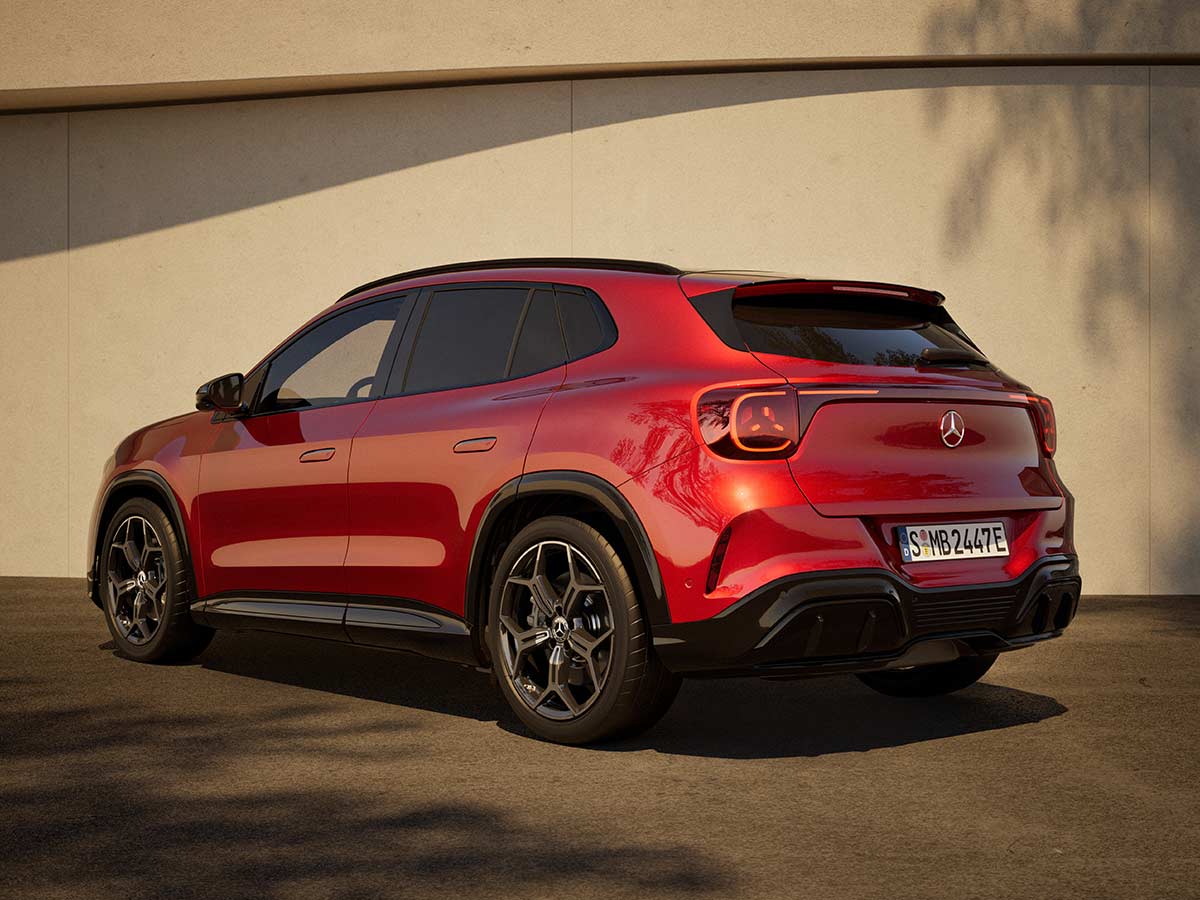
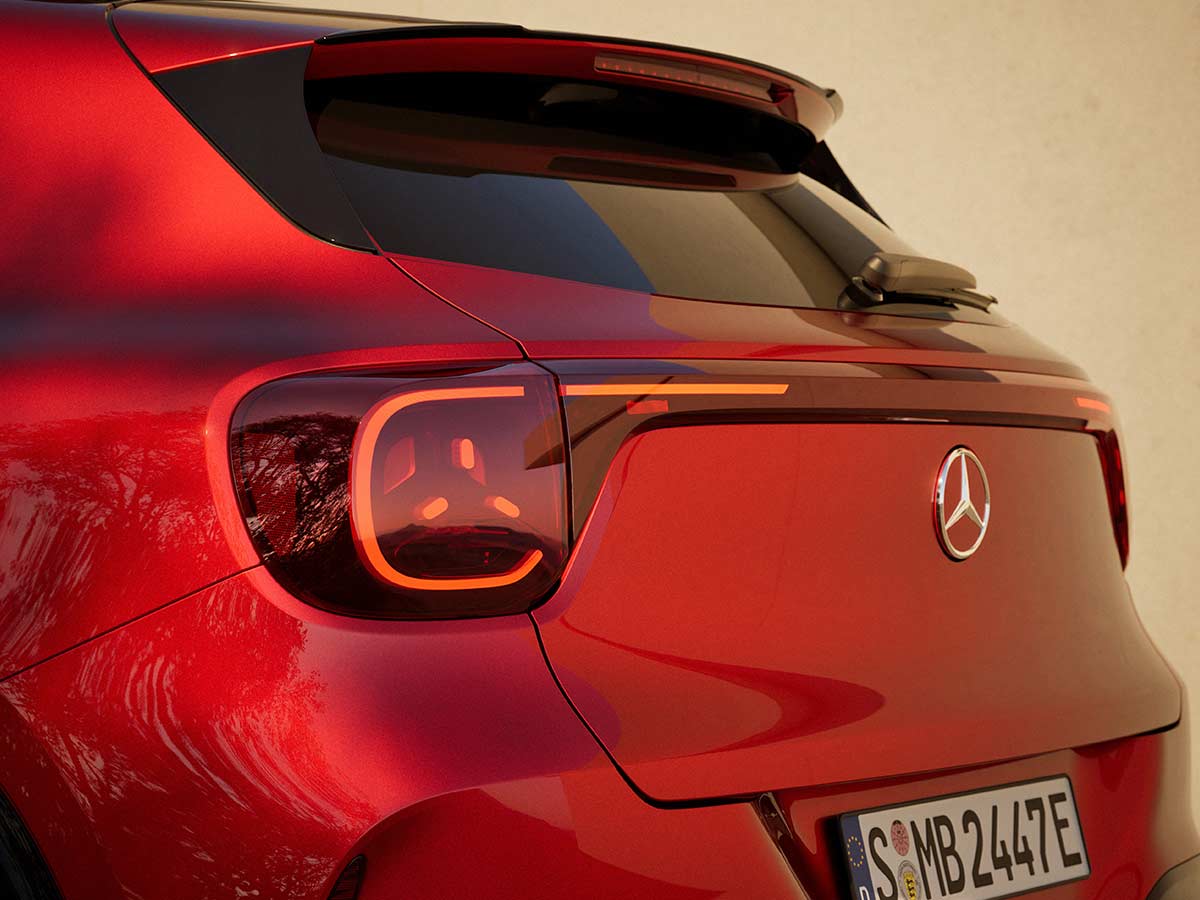
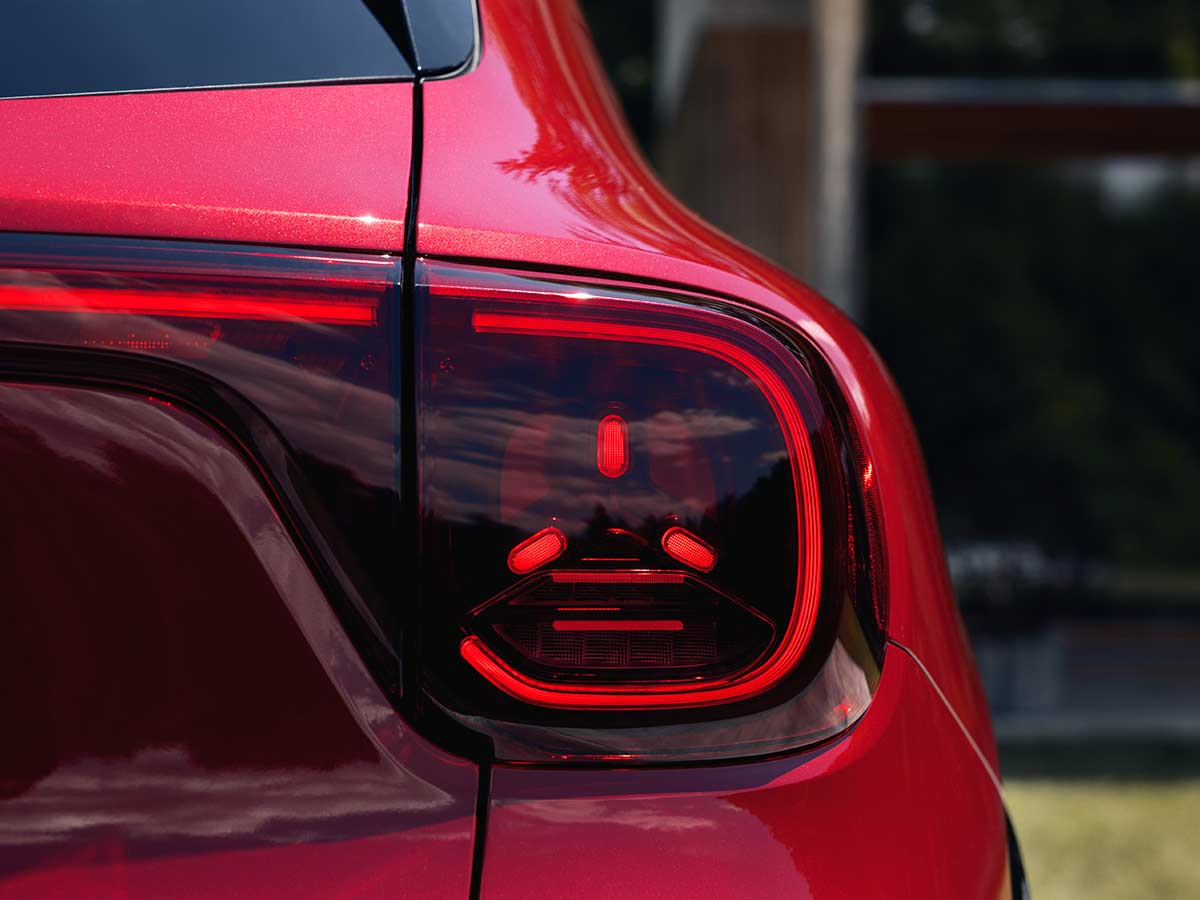
At the rear, a full-width lighting signature stretches across the tailgate, visually widening the SUV.
On models equipped with MULTIBEAM LED technology, these rear lighting elements can also perform animated sequences, creating a consistent front-to-rear digital identity.
It’s a small detail, but one increasingly becoming a hallmark of modern premium vehicles.
More Ways to Personalize Than Ever Before
Mercedes-Benz knows premium buyers increasingly want individuality rather than simply choosing a paint colour.
For the first time, the GLA offers four distinct equipment lines, each targeting a different type of customer.
The entry-level Style Line focuses on elegance with chrome detailing, polished aluminium accents, LED lighting and a leather-free interior featuring ARTICO upholstery options.
Moving up, the Progressive Line introduces illuminated grille surrounds, upgraded materials, larger wheels, heated seats and more luxurious upholstery choices.
The AMG Line injects genuine sporting character through more aggressive bumpers, body-coloured wheel arch cladding, exclusive alloy wheels, Nappa leather steering wheel, sports pedals and distinctive interior trim.
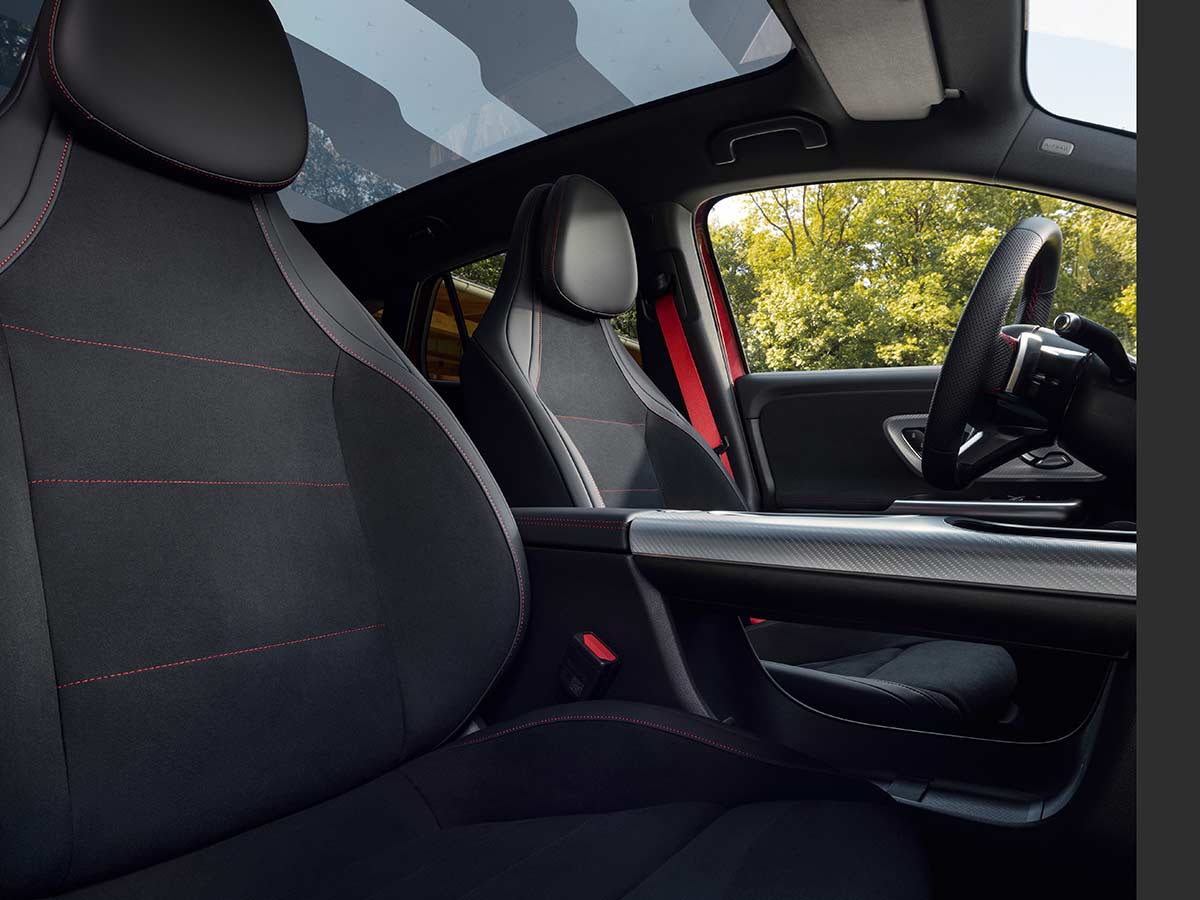
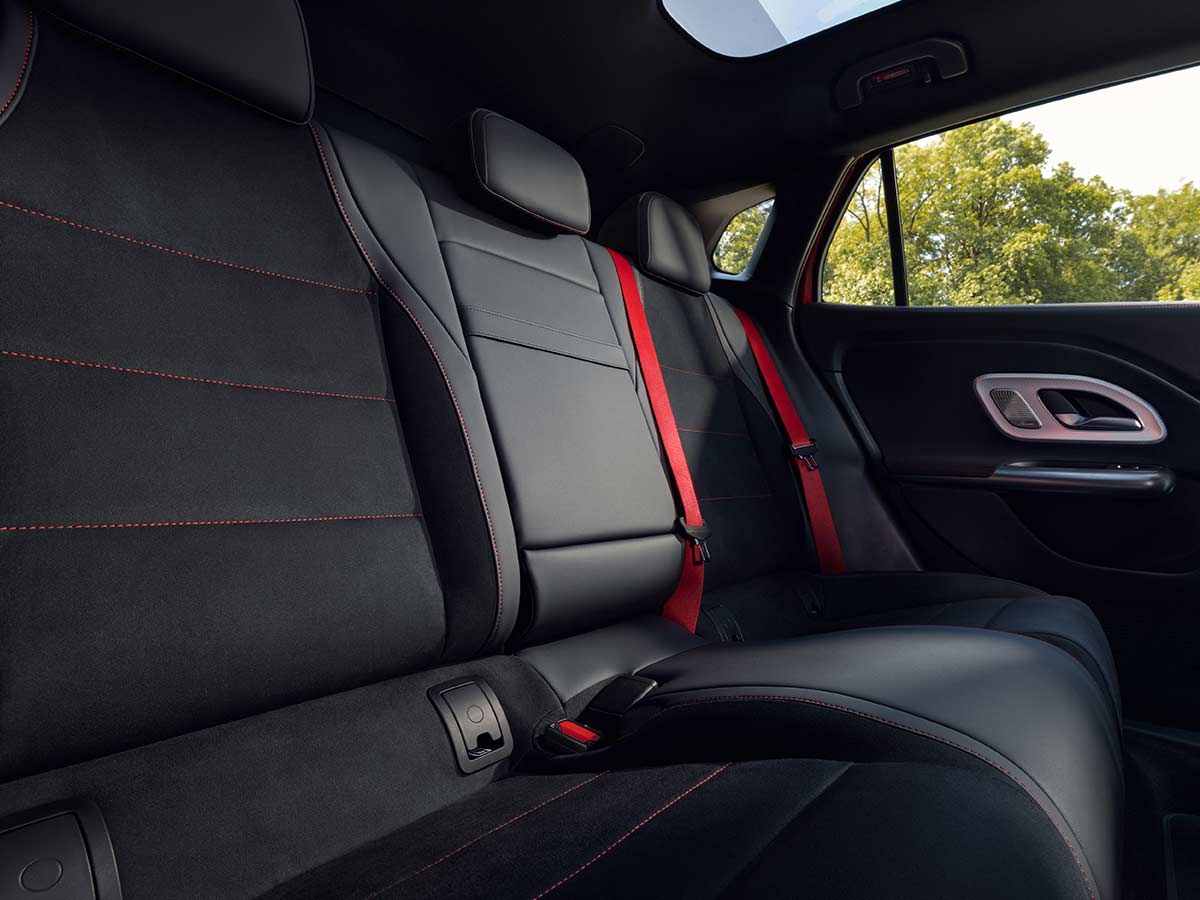
For buyers wanting even more visual drama, Mercedes-Benz introduces the AMG Line Plus for the first time on the GLA. Exclusive 20-inch wheels, gloss black exterior accents, sport seats, red seatbelts and illuminated door sills create a noticeably more focused personality without stepping into full AMG territory.
Then comes perhaps the boldest version.
The Night Edition combines AMG styling with extensive gloss black detailing, exclusive paint finishes, unique upholstery combinations and bespoke trim pieces, giving the compact SUV a far more premium appearance than its footprint might suggest.
It reflects a broader shift happening across the premium market.
Rather than expecting every customer to want the same luxury experience, Mercedes-Benz is allowing buyers to tailor the GLA around different lifestyles, whether understated, sporty or overtly expressive.
The Cabin That Thinks Ahead
If the exterior is about making a stronger first impression, the interior is where Mercedes-Benz has invested most heavily. This is where the new GLA distances itself not only from its predecessor but also from many rivals in the premium compact SUV segment.
Instead of merely refreshing the dashboard or adding a larger touchscreen, Mercedes-Benz has completely reimagined how occupants interact with the vehicle. The result is an interior that feels cleaner, more spacious and significantly more digital without becoming intimidating.
It’s also one of the first compact SUVs to fully showcase the next generation of the Mercedes-Benz User Experience (MBUX), powered by the company’s new MB.OS operating system and enhanced with generative AI.
Bigger Inside Despite a Lower Roofline
One of the biggest surprises about the new GLA is how much larger it feels from behind the wheel.
On paper, lowering an SUV by 20 mm would suggest reduced headroom. Instead, Mercedes-Benz’s engineers have managed the opposite.
Thanks to the 61 mm increase in wheelbase, smarter packaging and the new MMA architecture, the cabin grows in almost every meaningful direction.
Front-seat occupants gain an extra 7 mm of legroom, while rear passengers benefit from a substantial 38 mm increase. Headroom also improves, with an additional 23 mm in the front and 24 mm in the rear.
These numbers may appear modest individually, but together they transform the perception of space. Rear-seat passengers no longer feel like an afterthought, and the GLA begins to rival SUVs from the class above for day-to-day comfort.
The driving position also benefits from the classic SUV virtues buyers expect. The elevated seating position provides excellent outward visibility while making entry and exit easier than in a conventional hatchback.
Mercedes-Benz has clearly designed this interior around real-world usability rather than simply maximizing screen size.
A Dashboard Defined by Simplicity
Previous generations of the GLA featured sculpted dashboards with numerous layers and physical controls. The new model heads in the opposite direction.
Minimalism is the defining theme.
The dashboard is dominated by clean horizontal lines and floating architectural elements rather than decorative complexity. Instead of filling the cabin with visual clutter, Mercedes-Benz has focused attention on a handful of standout features.
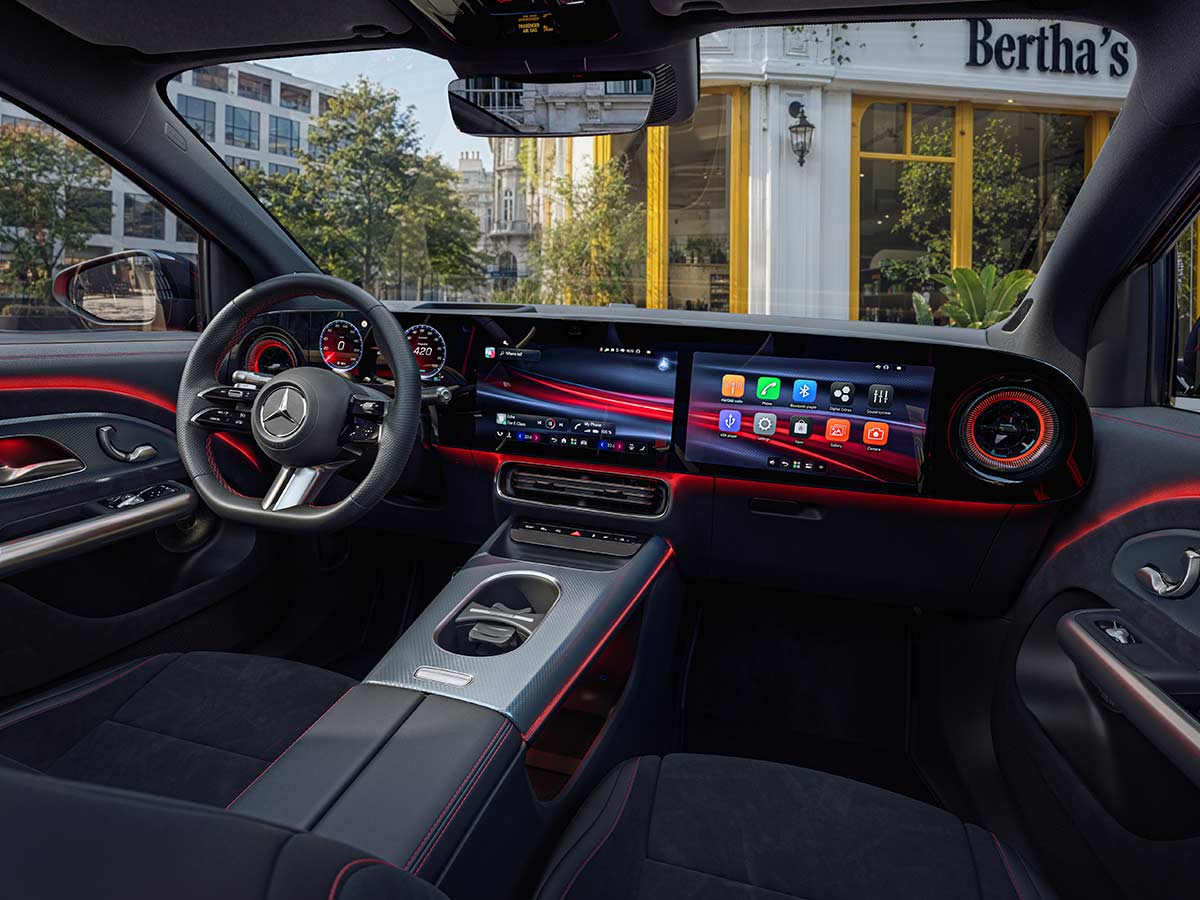
The centerpiece is the available MBUX Superscreen.
Stretching almost the entire width of the dashboard beneath a single pane of glass, it transforms the GLA into one of the most technologically advanced interiors in the premium compact SUV segment.
Behind that glass sit:
- a 10.25-inch digital instrument cluster,
- a 14-inch central infotainment display,
- and an optional 14-inch passenger display.
If buyers choose not to specify the passenger screen, Mercedes-Benz doesn’t simply leave an empty panel. Instead, the space is filled with a decorative star-pattern trim panel that continues the glass surface seamlessly across the dashboard. An illuminated version is also available, integrating beautifully with the cabin’s ambient lighting.
The result is an interior that looks sophisticated whether fitted with two screens or three.
Floating Architecture Creates More Space
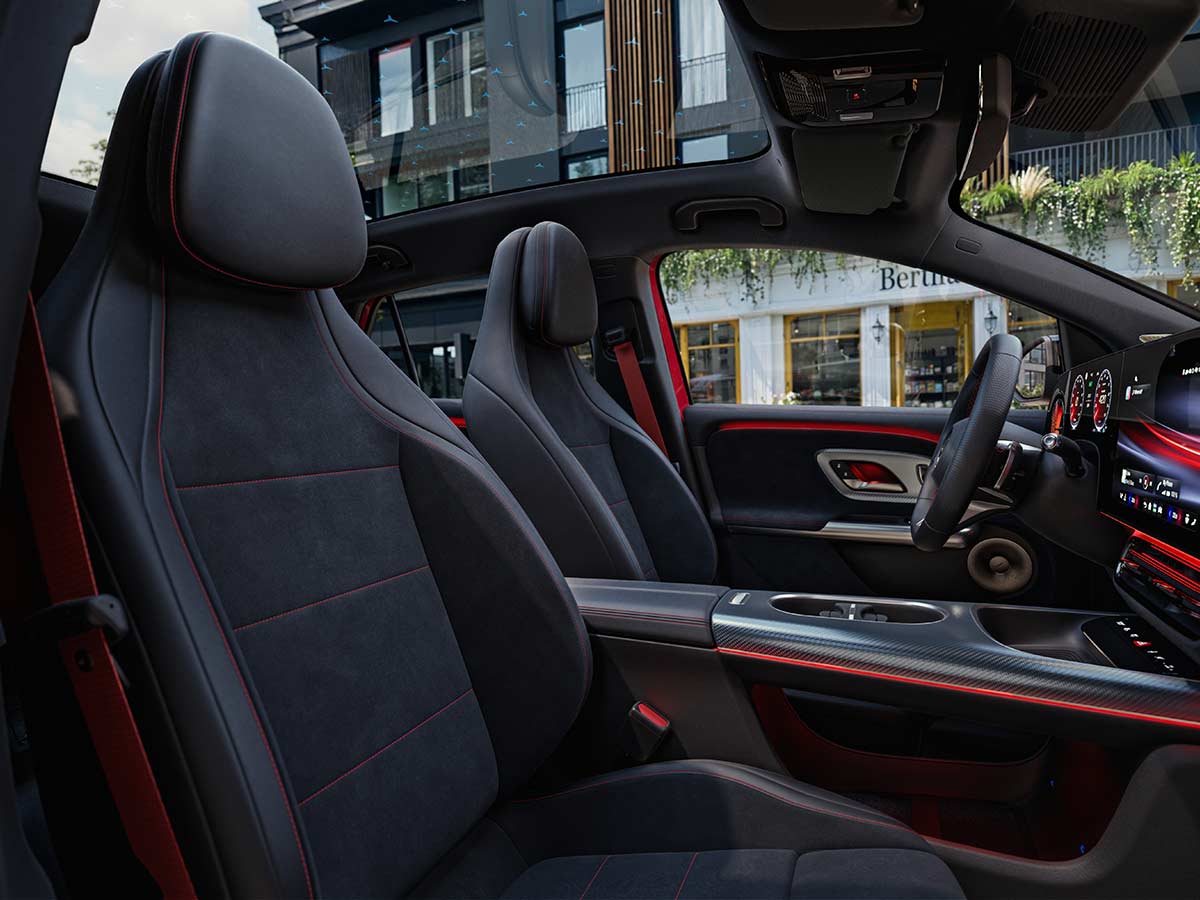
Another major departure from the previous model is the treatment of the centre console.
Rather than a bulky tunnel dominating the cabin, the new console appears suspended beneath the dashboard.
Its upper section houses a wireless smartphone charging pad and cupholders integrated beneath a large decorative trim panel available in finishes ranging from brushed aluminium and open-pore wood to anodised-look surfaces and innovative decorative paper materials.
Below that sits an open storage shelf, making everyday items easier to access while visually increasing the sense of openness throughout the cabin.
Even the doors follow this philosophy.
Their concave lower sections reduce visual bulk, while floating armrests and generously sized storage compartments create an airy appearance rarely found in compact SUVs.
More Cargo Space for Everyday Life
Mercedes-Benz hasn’t forgotten that the GLA remains a practical family SUV.
The boot grows to 410 litres, representing a 70-litre improvement over its predecessor.
Fold the standard 40:20:40 split rear seats, and total luggage capacity expands to 1,400 litres.
Because the electric drivetrain requires less packaging space beneath the bonnet, Mercedes-Benz has also introduced something entirely new for the GLA.
A 107-litre front trunk.
Large enough for charging cables, cabin luggage, a sports bag or even a drinks crate, the frunk frees up the rear cargo area for larger items.
The electric GLA also raises expectations for towing capability.
While many electric SUVs compromise on towing capacity, the dual-motor 4MATIC variants can pull up to two tonnes when equipped with the optional semi-electric tow bar.
That’s enough for larger caravans, horse trailers, jet skis or multiple motorcycles, making the GLA one of the most versatile electric SUVs in its class.
The Panoramic Roof Becomes an Experience
Nearly every premium SUV now offers a panoramic glass roof.
Mercedes-Benz wanted to do more than simply increase the amount of glass overhead.
Every new GLA comes standard with a panoramic roof featuring heat-insulating laminated safety glass, infrared-reflective coatings and a low-emissivity (Low-E) layer that helps reduce cabin temperatures during summer while retaining warmth during winter.
For buyers seeking something more dramatic, Mercedes-Benz introduces SKY CONTROL.
Rather than using a traditional sliding sunshade, SKY CONTROL electronically adjusts the transparency of the glass itself.
The roof is divided into seven independently controlled sections, allowing occupants to determine exactly how much light enters different areas of the cabin.
Passengers can choose complete transparency, complete opacity or anything in between within just milliseconds.
Then comes perhaps the most unexpected feature.
Integrated into the glass are 172 illuminated Mercedes-Benz stars.
Connected to the ambient lighting system, they glow in the selected interior colour after dark, turning the panoramic roof into what Mercedes-Benz describes as a personal starry sky.
It’s one of those features that may sound excessive on paper but is likely to become a talking point during every nighttime journey.
Ambient Lighting Goes Beyond Decoration
Mercedes-Benz has long been regarded as an industry leader in interior ambient lighting, and the GLA pushes that reputation even further.
The cabin offers:
- 64 colours,
- 10 lighting themes,
- 20 brightness levels,
- and three independently adjustable brightness zones.
Lighting extends across the dashboard, centre console, doors and even the optional SKY CONTROL roof.
Rather than simply illuminating surfaces, the system actively changes the mood of the cabin.
High-resolution graphical themes on the displays synchronize with ambient lighting colours, creating immersive visual environments that adapt to the chosen atmosphere.
Combined with premium trim materials and refined upholstery options, the effect is far more sophisticated than the colourful LED strips seen in many competitors.
An Interior Designed Around Conversation
The most significant technological leap inside the GLA isn’t the screens.
It’s how drivers interact with them.
Mercedes-Benz has fundamentally changed its philosophy.
Instead of forcing drivers to learn complicated menus and settings, the vehicle is increasingly expected to understand natural conversation.
That ambition begins with the next generation of MBUX.
An SUV That Talks, Learns and Thinks
There was a time when voice control in cars felt more like a novelty than a genuinely useful feature. Drivers had to memorize exact phrases, commands often failed to register, and even simple requests could end in frustration.
Mercedes-Benz believes those days are over.
With the new GLA, the company isn’t just updating MBUX – it’s fundamentally changing how drivers interact with their vehicle. Instead of acting like a digital menu controlled by voice, the latest MBUX behaves more like a knowledgeable passenger capable of holding natural conversations, understanding context and even remembering previous interactions.
For a compact SUV, it’s a remarkably ambitious leap.
The New MBUX Is Powered by MB.OS
At the heart of the new GLA sits Mercedes-Benz Operating System, better known as MB.OS.
Unlike previous generations that relied on multiple software layers from different suppliers, MB.OS gives Mercedes-Benz much greater control over everything from infotainment and navigation to charging, driver assistance and over-the-air updates.
The result is a platform designed not just for today’s technology but for continuous improvement throughout the vehicle’s lifetime.
Much like a smartphone receives new features through software updates, the GLA can continue evolving long after it leaves the showroom.
That future-proofing matters because software increasingly defines the ownership experience as much as horsepower or handling.
Meet the MBUX Virtual Assistant
The biggest talking point inside the new GLA is undoubtedly the next-generation MBUX Virtual Assistant.
Visually, it appears as a constantly evolving Mercedes-Benz star displayed on the central screen.
But unlike traditional digital assistants, this one is designed to communicate through both conversation and emotion.
The star changes colours and animations depending on the dialogue, providing subtle visual feedback as it listens, thinks and responds. It can also recognize when someone is speaking, making interactions feel surprisingly personal rather than robotic.
Mercedes-Benz has clearly focused on reducing the friction that often exists between drivers and technology.
Instead of requiring specific commands, conversations become far more natural.
Drivers can ask follow-up questions without repeating themselves, change topics midway through a conversation, or request multiple actions within a single sentence.
The assistant understands context rather than simply recognizing keywords.
Three AI Systems Working Together
Mercedes-Benz hasn’t placed all its faith in a single artificial intelligence platform.
Instead, the new GLA combines the strengths of multiple leading AI systems.
The MBUX Virtual Assistant integrates:
- ChatGPT
- Google Gemini
- Microsoft Bing
Rather than competing with one another, these technologies complement each other behind the scenes.
The result is an assistant capable of answering general knowledge questions, providing contextual information, assisting with navigation, explaining vehicle functions and carrying on conversations that feel considerably more natural than conventional in-car voice systems.
Imagine asking:
“Is there a good Italian restaurant near my destination that has charging stations nearby?”
Instead of treating that as several unrelated commands, the assistant understands it as a single request.
It searches for restaurants, considers your destination, evaluates charging infrastructure and presents relevant suggestions.
The technology fades into the background.
And that’s exactly the point.
Navigation Becomes Predictive
Navigation systems have become remarkably sophisticated over the past decade, but Mercedes-Benz believes there’s still room for improvement.
The new GLA’s navigation system is built on Google Maps, bringing one of the world’s most comprehensive mapping platforms directly into the vehicle.
Yet this isn’t simply Google Maps transplanted onto a dashboard.
Mercedes-Benz layers its own intelligence on top.
For electric models, navigation continuously evaluates battery charge, elevation changes, weather conditions, traffic, average speed and charging infrastructure to determine the fastest overall journey rather than merely the shortest distance.
If charging is required, the system automatically selects suitable charging stations while also preparing the battery before arrival.
That last detail is crucial.
Battery preconditioning ensures the battery reaches its ideal temperature before reaching a fast charger, allowing the vehicle to accept maximum charging power immediately rather than wasting valuable minutes warming or cooling the battery after plugging in.
For drivers covering long distances, those saved minutes accumulate over the course of a journey.
Charging Without the Guesswork
Range anxiety hasn’t disappeared simply because batteries have become larger.
What many drivers actually worry about is charging uncertainty.
Will the charger work?
Will it be available?
Will payment be complicated?
Mercedes-Benz attempts to remove much of that uncertainty through MB.CHARGE Public.
The system brings together one of the world’s largest public charging networks under a single service.
Instead of maintaining multiple charging apps, membership cards and payment systems, drivers can access numerous charging providers through one account.
Even more impressively, the navigation system can dynamically incorporate charging stops into the journey while estimating charging duration based on current battery conditions.
Rather than treating charging as an inconvenience, the system aims to make it feel like a natural part of travel planning.
Entertainment Moves Beyond Streaming Music
The digital experience inside the new GLA extends well beyond navigation.
Mercedes-Benz has dramatically expanded its entertainment ecosystem, offering more than 40 integrated apps directly through the infotainment system.
Passengers can access music streaming services, podcasts, video platforms, gaming applications, productivity tools and communication services without relying exclusively on smartphone mirroring.
It’s a recognition that modern buyers increasingly expect their cars to function as connected digital spaces rather than isolated machines.
The optional passenger display also plays an important role.
While the driver remains focused on the road, the front passenger can independently access entertainment features without interfering with navigation or vehicle controls.
Mercedes-Benz has carefully designed the system to prevent driver distraction, ensuring video content remains visible only from the passenger’s viewing angle while the vehicle is moving.
Burmester Turns the Cabin Into a Concert Hall
Technology alone doesn’t create a premium experience.
Sound matters just as much.
That’s why buyers can specify the latest Burmester 3D Surround Sound System, transforming the compact cabin into an unexpectedly immersive listening environment.
Multiple strategically positioned speakers create three-dimensional sound staging that places instruments and vocals around occupants rather than simply in front of them.
Combined with active ambient lighting, certain audio modes synchronize visual effects with music playback, creating an atmosphere that feels closer to a private lounge than a compact SUV.
It’s another reminder that Mercedes-Benz increasingly views the cabin as a living space rather than simply somewhere to sit while driving.
Over-the-Air Updates Keep the GLA Current
One of the most significant but least visible changes introduced with MB.OS is the ability to receive extensive over-the-air software updates.
Historically, adding major features often required dealership visits.
With the new GLA, Mercedes-Benz can introduce improvements remotely.
That includes:
- infotainment enhancements,
- navigation improvements,
- charging optimizations,
- new digital services,
- interface refinements,
- and selected vehicle functions.
This approach not only extends the vehicle’s technological relevance but also allows Mercedes-Benz to respond more quickly to customer feedback after launch.
Digital Luxury Without Digital Overload
Perhaps the most impressive aspect of the GLA’s interior technology is that it rarely feels overwhelming.
Many manufacturers equate innovation with adding more screens, more menus and more complexity.
Mercedes-Benz has taken a noticeably different approach.
Frequently used functions remain easily accessible.
Physical steering-wheel controls are thoughtfully integrated.
Voice interaction reduces the need to navigate multiple menus.
Artificial intelligence works quietly in the background instead of constantly demanding attention.
For many buyers, that balance could prove just as important as the technology itself.
The goal isn’t to impress during the first five minutes of ownership.
It’s to remain intuitive five years later.
By the time you step out of the new GLA, it’s clear that Mercedes-Benz isn’t simply building another connected SUV. It’s building one that anticipates how people will interact with cars over the next decade – where conversations replace commands, software evolves continuously, and the vehicle becomes an intelligent companion rather than just another machine.
Beneath the Skin – The Engineering That Could Redefine the Compact Luxury SUV
Design may draw buyers into a showroom, and technology may convince them to sign on the dotted line, but engineering is what determines whether a car remains enjoyable long after the novelty wears off.
That’s where the new Mercedes-Benz GLA makes perhaps its strongest statement.
Instead of adapting an existing combustion platform for electrification, Mercedes-Benz started with a clean sheet of paper. The result is the Mercedes-Benz Modular Architecture (MMA), a platform developed from the outset for an electric-first future while retaining the flexibility to accommodate highly efficient hybrid powertrains.
It sounds like a simple architectural change.
In reality, it influences almost every aspect of how the new GLA drives, charges, accelerates and even how spacious it feels inside.
The MMA Platform Changes Everything
Most car platforms are compromises.
Some are designed primarily for combustion engines before being adapted for electric vehicles. Others are built exclusively for EVs, making it difficult to offer traditional powertrains without sacrificing packaging.
Mercedes-Benz wanted neither.
The Modular Architecture allows the company to produce battery-electric and electrified combustion variants on the same basic architecture, giving buyers genuine choice without creating two completely different vehicles.
That flexibility is important.
Markets around the world are electrifying at different speeds. While some regions are rapidly embracing EVs, others still rely heavily on hybrid technology. Rather than forcing one solution on every customer, Mercedes-Benz has engineered the GLA to meet both demands.
Yet despite accommodating multiple powertrains, the platform remains unmistakably electric-first.
Why 800-Volt Technology Matters
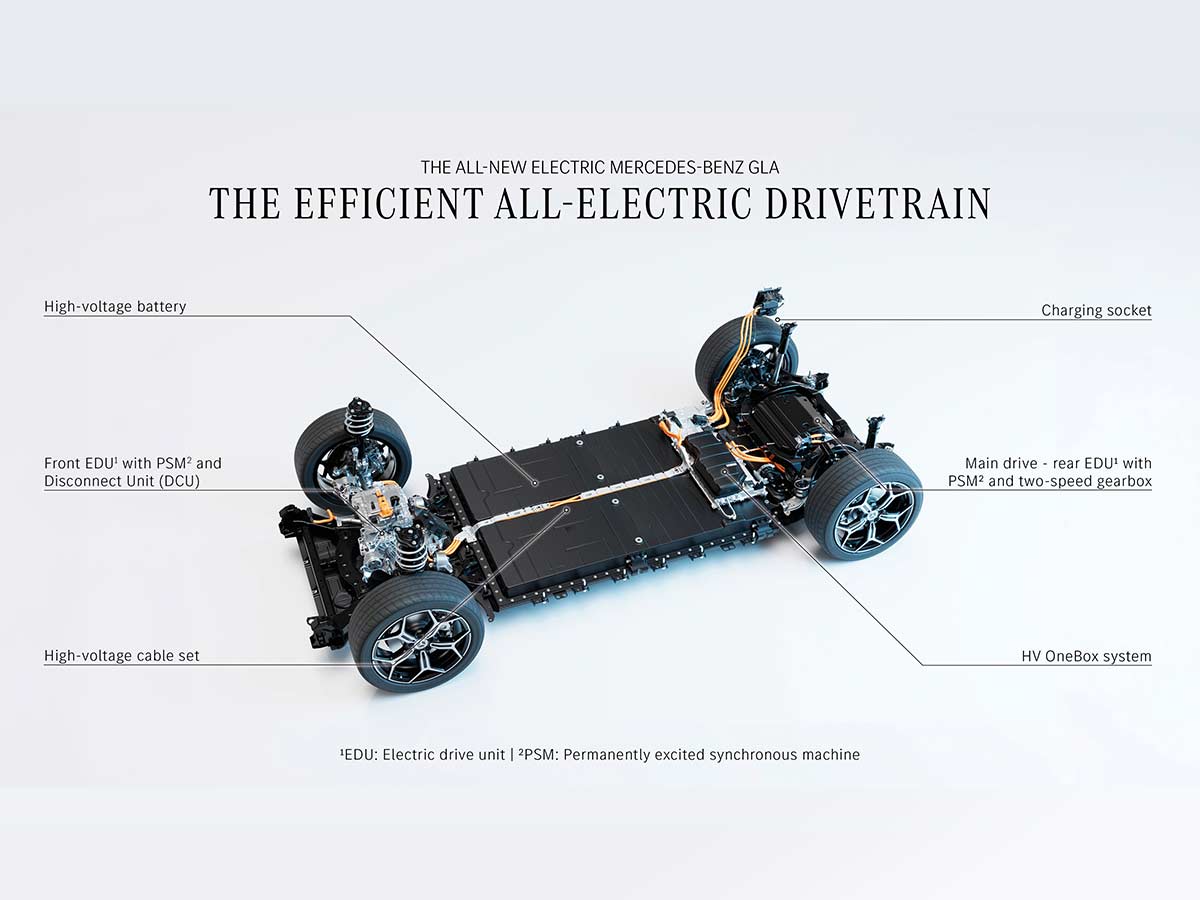
One of the biggest headlines surrounding the new GLA is its adoption of an 800-volt electrical architecture.
Until recently, systems like these were largely reserved for high-performance electric cars costing well into six figures.
Now Mercedes-Benz is bringing the technology to one of its most accessible SUVs.
But why does voltage matter?
Think of electricity flowing through a cable like water flowing through a pipe.
Higher voltage allows the same amount of power to travel with less current, reducing heat generation and improving efficiency. That means thinner cables, lower energy losses and, perhaps most importantly for drivers, dramatically faster charging.
The benefits extend beyond charging alone.
An 800-volt architecture also improves thermal management, enables more efficient power delivery and contributes to better long-distance performance.
In everyday driving, the driver may never notice the electrical system directly.
They will notice the shorter charging stops.
Efficiency Rather Than Just Bigger Batteries
Many manufacturers chase range by fitting ever-larger batteries.
Mercedes-Benz has taken a different route.
Rather than simply increasing battery capacity, engineers have focused on making every kilowatt-hour travel further.
The company claims battery-to-wheel efficiency of approximately 93 percent for the rear electric drive unit.
That figure is remarkably high.
It means that almost all of the energy leaving the battery actually reaches the road instead of being lost through heat, friction or electrical inefficiencies.
It’s an engineering philosophy that mirrors Mercedes-Benz’s Formula One experience.
Efficiency matters just as much as outright power.
Perhaps even more.
A Motor Developed Entirely In-House
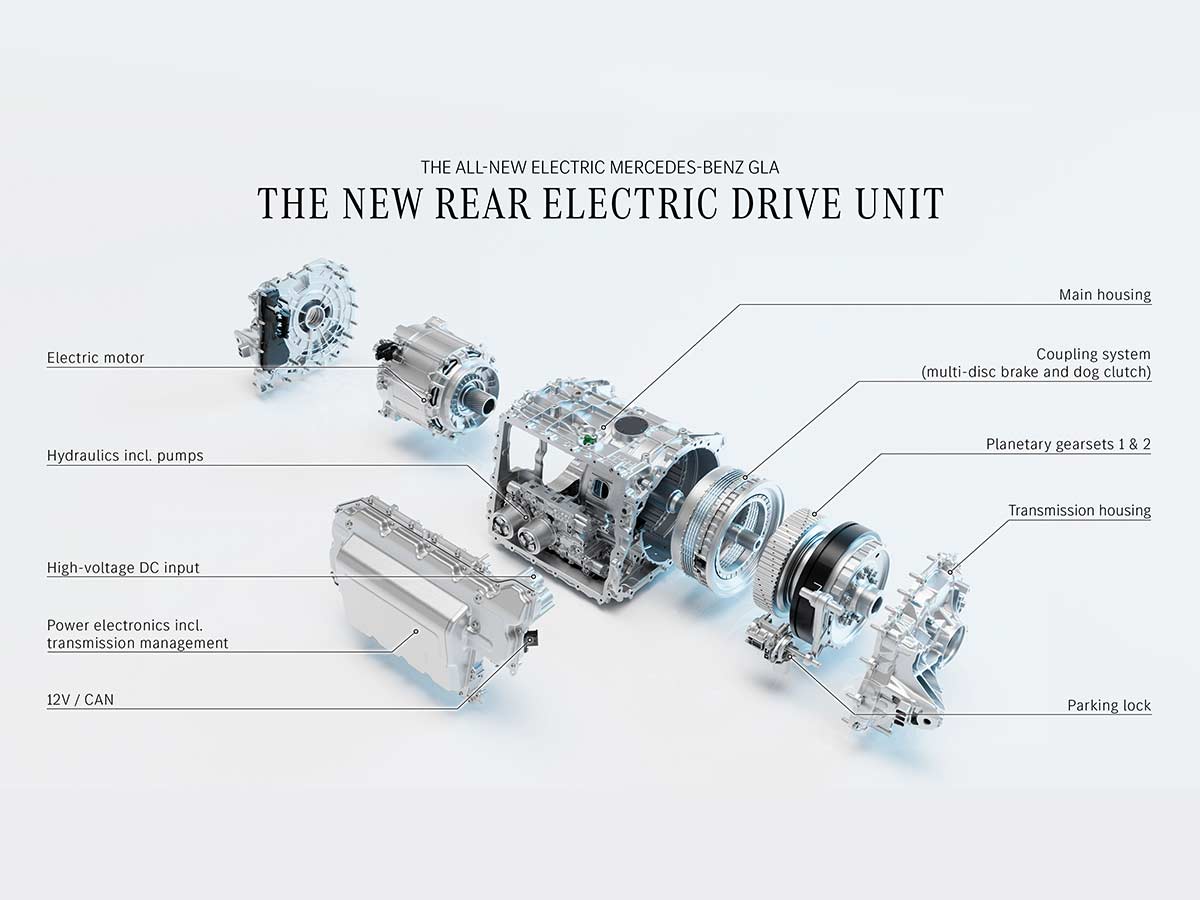
Powering the rear axle is a permanently excited synchronous motor (PSM) developed entirely by Mercedes-Benz.
Unlike many manufacturers that source electric motors from suppliers, Mercedes-Benz engineered this unit specifically for the MMA platform.
Its design incorporates several innovations intended to improve both refinement and efficiency.
The rotor features magnets arranged in a double-V configuration, helping generate strong magnetic fields while minimizing energy losses.
Meanwhile, the stator employs hairpin windings, a manufacturing technique that improves electrical conductivity while also contributing to quieter operation.
The result isn’t simply more efficiency.
It’s a smoother and more refined driving experience.
Electric vehicles are naturally quiet, which means occupants become more aware of subtle mechanical noises that would normally be masked by an engine.
Mercedes-Benz has clearly spent considerable effort ensuring the GLA remains exceptionally refined.
Silicon Carbide Makes a Difference
Another component hidden beneath the bodywork is the silicon carbide (SiC) inverter.
It doesn’t sound particularly exciting.
Yet it plays a vital role in the vehicle’s overall efficiency.
The inverter converts direct current from the battery into alternating current for the electric motor.
Using silicon carbide rather than conventional silicon reduces electrical losses, improves heat resistance and allows the system to operate more efficiently under heavy loads.
The benefits become particularly noticeable during motorway driving and repeated high-power acceleration.
Again, it’s another example of Mercedes-Benz pursuing efficiency through engineering rather than marketing headlines.
Why Mercedes-Benz Didn’t Follow Everyone Else
Most electric vehicles use a single-speed reduction gearbox.
It’s simple, reliable and perfectly adequate for most driving situations.
Mercedes-Benz decided that wasn’t enough.
Instead, the new GLA introduces an innovative two-speed transmission.
At first glance, adding gears to an electric vehicle might seem unnecessary.
In reality, it solves one of the biggest compromises facing EVs.
A gearbox optimized for rapid acceleration isn’t always ideal for sustained motorway cruising.
Likewise, gearing designed for efficiency at high speed can blunt low-speed responsiveness.
Mercedes-Benz’s solution is elegantly simple.
First Gear: Built for Everyday Driving
The first ratio features a relatively short 11:1 reduction.
This allows the GLA to launch with impressive urgency from a standstill while also improving towing capability and urban efficiency.
Whether pulling away from traffic lights, navigating steep gradients or manoeuvring through city traffic, the electric motor remains firmly within its most efficient operating range.
The result is immediate throttle response without wasting energy.
Second Gear: Designed for Long Distances
Once speeds increase, the transmission shifts into its taller 5:1 second ratio.
Here, the priorities change.
Instead of maximizing acceleration, the focus shifts towards reducing motor speed, improving efficiency and extending range during sustained motorway driving.
The shift itself is controlled electronically according to driving conditions, battery state, selected drive mode and even real-time data analysed by the vehicle’s online optimisation system.
Unlike a conventional automatic transmission, the driver is unlikely to notice the change.
What they will notice is quieter cruising and lower energy consumption.
It’s a sophisticated solution that few manufacturers have attempted in the compact EV segment.
Dual Motors Only When You Need Them
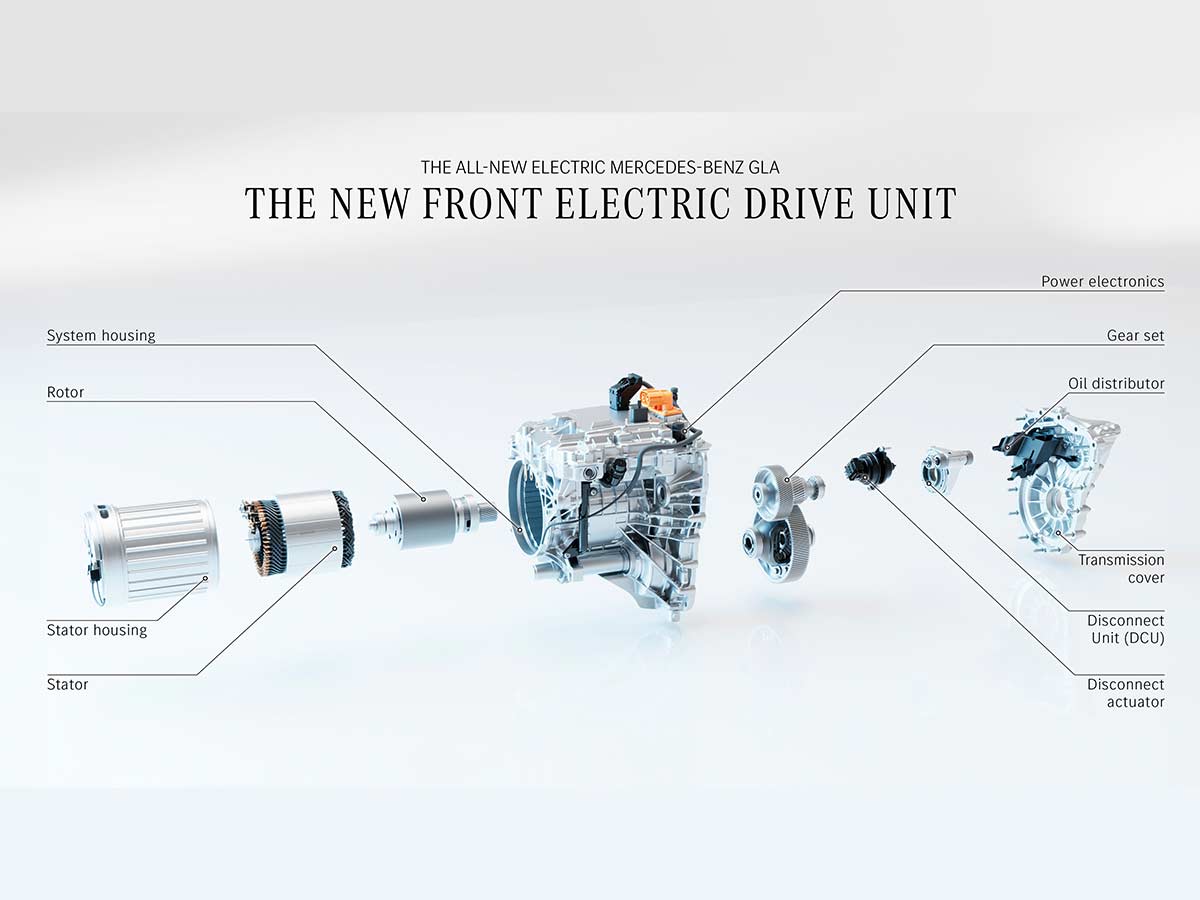
Buyers choosing the GLA 350 4MATIC electric receive an additional permanently excited synchronous motor on the front axle.
Interestingly, this motor isn’t permanently engaged.
Instead, Mercedes-Benz has developed a Disconnect Unit (DCU).
During normal driving, when extra traction isn’t required, the front motor disconnects almost instantly and comes to a complete stop.
This significantly reduces energy losses associated with spinning unused drivetrain components.
Mercedes-Benz says the system cuts front-axle losses by up to 90 percent.
When additional traction or performance is required, the front motor reconnects almost instantaneously.
The driver experiences seamless all-wheel drive without carrying the efficiency penalty typically associated with permanent AWD systems.
It’s an elegant balance between performance and range.
Intelligent Recuperation Does Most of the Braking
Mercedes-Benz has also rethought how the GLA slows down.
Rather than relying primarily on conventional friction brakes, the SUV uses a newly developed One-Box braking system.
In most situations, braking energy is recovered and fed back into the battery.
Only when stronger stopping power is required do the hydraulic brakes contribute.
The transition between regenerative and friction braking is designed to be virtually imperceptible.
That consistency matters because one of the criticisms often levelled at electric vehicles is inconsistent brake pedal feel.
Mercedes-Benz claims drivers should experience the same confident pedal response regardless of how much regeneration is occurring.
The system can recover up to 200 kW of braking energy and, remarkably, continues recuperating even during ABS interventions or on slippery surfaces whenever conditions permit.
In many situations, the GLA can bring itself to a complete stop using electric regeneration alone.
Four Levels of Energy Recovery
Drivers can tailor regenerative braking using steering-column-mounted controls.
Four modes are available:
- D+ – Free coasting with virtually no regeneration, allowing the vehicle to glide efficiently.
- D – Standard regeneration for everyday driving.
- D- – Strong regeneration, enabling frequent one-pedal-style driving in urban environments.
- D Auto – Intelligent automatic recuperation.
The final setting is arguably the most impressive.
Using navigation data, onboard cameras and multiple sensors, the system analyses the road ahead.
Approaching a junction?
The GLA begins recovering energy.
Descending a hill?
Regeneration increases.
Entering slower traffic?
The vehicle adapts automatically.
Rather than forcing the driver to constantly choose the most efficient setting, the car quietly optimises energy recovery in the background.
Engineering That Serves the Driver
What becomes increasingly apparent throughout the GLA’s technical specification is that Mercedes-Benz hasn’t pursued innovation for its own sake.
Every component, from the two-speed gearbox to the Disconnect Unit and One-Box braking system, addresses a specific real-world challenge.
Faster charging.
Longer range.
Better motorway refinement.
Greater efficiency.
Improved towing capability.
More natural braking.
Individually, each improvement may appear incremental.
Collectively, they represent one of the most comprehensive engineering packages yet seen in the premium compact electric SUV segment.
And this is only half the story.
Because impressive engineering ultimately needs impressive performance.
In the next section, we’ll explore the three electric variants, their outputs, acceleration figures, driving ranges, charging capabilities and why Mercedes-Benz believes the new GLA is as comfortable crossing continents as it is navigating city streets.
Performance, Range and Charging – Mercedes-Benz Wants the GLA to Go the Distance
The biggest question surrounding any new electric vehicle is no longer whether it’s fast.
Most EVs are.
The real question is whether it can comfortably replace a combustion-engined car for every type of journey, from the daily commute to a cross-country road trip.
Mercedes-Benz believes the new GLA finally reaches that point.
Instead of chasing headline acceleration figures alone, the company has focused on creating an SUV that feels equally at home navigating city streets, cruising on unrestricted autobahns or covering hundreds of kilometres in a single day.
The result is a three-model electric lineup that caters to very different buyers while sharing the same engineering philosophy: maximise efficiency first, then deliver performance where it matters.
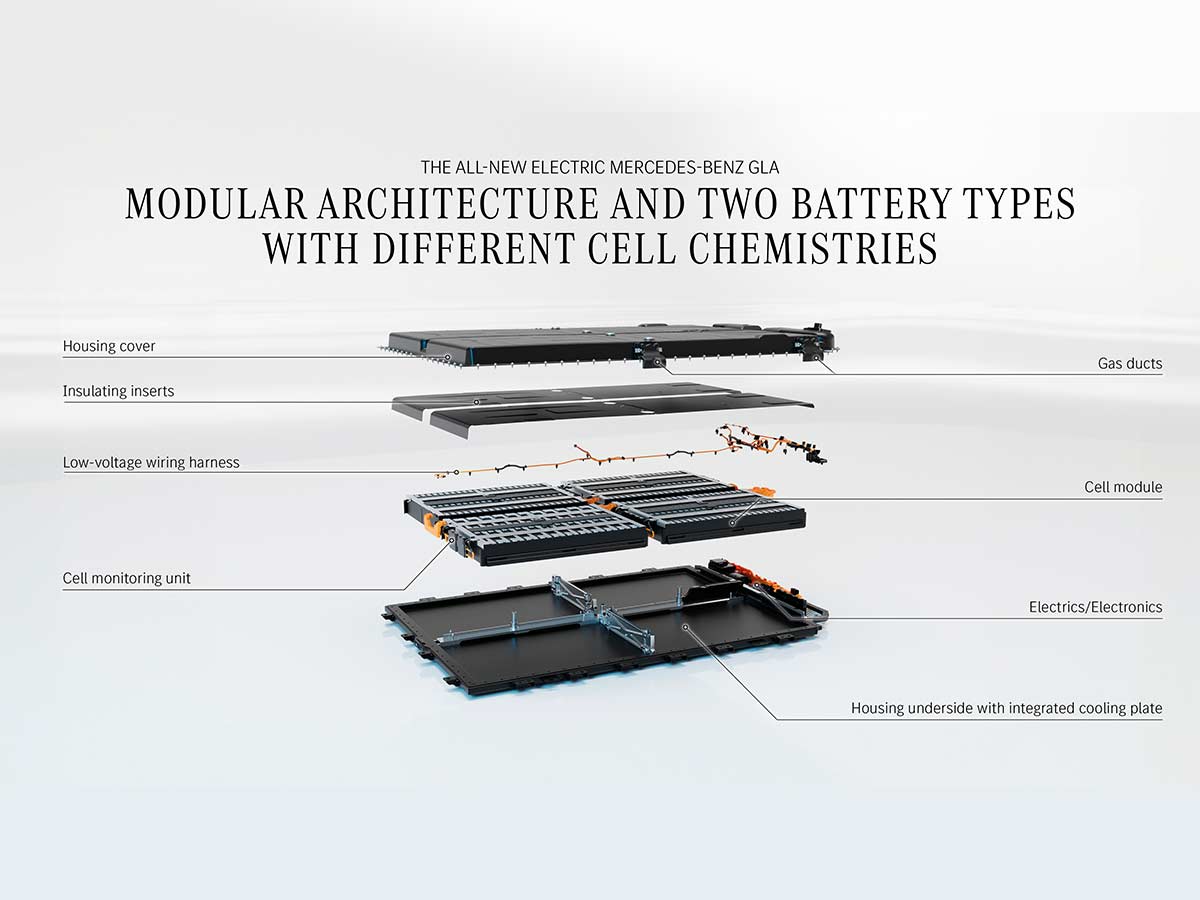
Three Electric Models from Day One
Unlike many manufacturers that launch a single electric variant before gradually expanding the range, Mercedes-Benz is introducing three distinct electric GLA models from the outset.
Each targets a different customer profile.
The GLA 200 Electric serves as the entry point into the lineup, prioritising affordability and efficiency.
Above it sits the GLA 250+ Electric, the long-distance specialist with the highest driving range in the family.
At the top of the range is the GLA 350 4MATIC Electric, combining dual-motor all-wheel drive with the strongest performance.
Rather than dramatically altering the design or cabin between variants, Mercedes-Benz allows buyers to choose primarily based on their driving habits.
GLA 200 Electric: The Smart Choice
For many buyers, the GLA 200 Electric is likely to be the sweet spot.
Its rear-mounted electric motor produces 165 kW and 335 Nm of torque, more than enough for confident overtaking and effortless urban driving.
Acceleration from 0 to 100 km/h takes 8.1 seconds, while top speed is electronically limited to 210 km/h.
Those numbers may not sound extraordinary in today’s performance-focused EV market, but they comfortably exceed what most premium compact SUV buyers require.
The emphasis here is efficiency.
Power comes from a 58 kWh usable lithium iron phosphate (LFP) battery, chosen for its durability, thermal stability and lower reliance on scarce raw materials.
Mercedes-Benz quotes a WLTP driving range of 394 to 447 kilometres, depending on specification and equipment.
That comfortably covers several days of commuting for many owners before charging becomes necessary.
GLA 250+ Electric: Built for Long Journeys
If one model best represents Mercedes-Benz’s engineering ambitions, it’s the GLA 250+ Electric.
Using the larger 85 kWh usable nickel manganese cobalt (NMC) battery, it delivers an impressive 577 to 657 kilometres of WLTP range.
That places it among the longest-range electric SUVs in its segment.
Power also increases to 200 kW, while torque remains at 335 Nm.
The sprint to 100 km/h falls to 7.3 seconds, making motorway merging and overtaking effortless without sacrificing efficiency.
It’s the kind of range that fundamentally changes how owners perceive electric mobility.
Rather than planning every journey around charging infrastructure, many drivers will simply use the GLA as they would a conventional petrol or diesel SUV.
For Mercedes-Benz, that’s precisely the point.
GLA 350 4MATIC Electric: Performance Without Compromise
At the top of the range sits the GLA 350 4MATIC Electric.
This version combines the rear-mounted motor with an additional front motor, increasing total output to 260 kW and delivering a substantial 515 Nm of torque.
Performance is predictably brisk.
Mercedes-Benz quotes a 0-100 km/h time of just 5.4 seconds, placing the SUV firmly within hot hatch territory.
Despite the additional motor and all-wheel-drive hardware, efficiency remains remarkably competitive.
The official WLTP range stands between 555 and 643 kilometres, meaning buyers don’t sacrifice long-distance usability in exchange for stronger acceleration.
For customers living in regions with demanding winters or frequently towing trailers, the dual-motor setup also provides the additional traction expected from a premium SUV.
Range Numbers That Matter
Manufacturers often highlight maximum WLTP figures, but real-world ownership depends on consistency rather than laboratory testing.
Mercedes-Benz has therefore focused on improving efficiency across a broad range of driving conditions.
Several technologies contribute to those impressive range figures:
- The highly efficient permanently excited synchronous motor.
- The two-speed transmission.
- Silicon carbide power electronics.
- Intelligent thermal management.
- Aerodynamic optimisation.
- Predictive energy recuperation.
- The Disconnect Unit on all-wheel-drive models.
None of these innovations alone would transform the vehicle.
Together, they allow the GLA to extract significantly more usable distance from every kilowatt-hour stored inside the battery.
Fast Charging That Fits Around Your Life
Perhaps the most significant benefit of the new GLA’s 800-volt electrical architecture becomes apparent when charging.
All models support 22 kW AC charging (where available), allowing convenient overnight charging at home or the workplace.
It’s on DC fast charging, however, that the GLA makes its strongest statement.
The GLA 200 Electric accepts up to 200 kW of DC charging power.
The larger-battery GLA 250+ and GLA 350 4MATIC increase that figure to an impressive 320 kW.
Those are numbers normally associated with premium executive EVs rather than compact SUVs.
The practical benefit is immediately obvious.
Mercedes-Benz claims the GLA 250+ can recover between 240 and 270 kilometres of WLTP range in just 10 minutes under optimal charging conditions.
Even the entry-level GLA 200 can add 145 to 165 kilometres over the same period.
In real-world terms, that’s roughly the amount of time many drivers already spend grabbing a coffee during a motorway break.
Aerodynamics That You Don’t Notice – But Always Benefit From
Electric range isn’t determined by battery size alone.
At motorway speeds, aerodynamics become one of the biggest influences on efficiency.
Mercedes-Benz has therefore devoted considerable effort to reducing drag.
The new GLA achieves a drag coefficient of just 0.27, making it noticeably more aerodynamic than its predecessor.
A smoother roofline, carefully shaped mirrors, optimised wheel designs, underbody aerodynamic panels and precisely managed airflow all contribute to the figure.
The benefits extend beyond range.
Reduced aerodynamic drag also lowers wind noise, helping create the remarkably quiet cabin that becomes immediately apparent on long journeys.
It’s one of those engineering achievements that occupants rarely notice directly, yet appreciate throughout every drive.
Built for the Long Haul
One of the recurring themes throughout the new GLA’s development is long-distance usability.
Mercedes-Benz hasn’t engineered this SUV solely for urban mobility.
Everything from the larger battery options to predictive navigation, battery pre-conditioning, intelligent recuperation and ultra-fast charging has been designed with road trips in mind.
Combined with the comfortable seating, spacious interior and quiet cabin, the GLA begins to blur the distinction between compact SUV and grand tourer.
That’s a notable achievement for a vehicle positioned near the entry point of the Mercedes-Benz SUV lineup.
Pricing and Model Line-up
At launch, Mercedes-Benz offers three fully electric variants:
| Model | Power | Battery | WLTP Range |
|---|---|---|---|
| GLA 200 Electric | 165 kW | 58 kWh (usable) | 394-447 km |
| GLA 250+ Electric | 200 kW | 85 kWh (usable) | 577-657 km |
| GLA 350 4MATIC Electric | 260 kW | 85 kWh (usable) | 555-643 km |
Orders opened on 30 July 2026, with the GLA 200 Electric starting from €48,599.60 (including German VAT).
Electrified petrol models will follow in 2027, broadening the lineup for markets where hybrid demand remains strong.
Not Ready for Full Electric? Mercedes-Benz Has Another Answer
While the electric GLA may represent the future, Mercedes-Benz recognises that not every market is transitioning to battery-electric mobility at the same pace.
That’s why the new GLA also introduces an all-new generation of electrified combustion models.
And these aren’t mild updates.
They’re powered by an entirely new 1.5-litre turbocharged engine paired with an advanced 48-volt hybrid system that enables electric driving, energy recuperation and even electric coasting at motorway speeds.
Rather than treating the hybrid as a compromise, Mercedes-Benz has engineered it to deliver many of the refinement and efficiency benefits associated with an EV while retaining the familiarity of a petrol engine.
Not Just Electric – The New Hybrid GLA Proves Mercedes-Benz Isn’t Leaving Anyone Behind
While the all-electric GLA will grab the headlines, Mercedes-Benz knows that the transition to electric mobility isn’t happening at the same pace everywhere. Infrastructure, regulations and buyer preferences still vary dramatically across global markets.
That’s why the company hasn’t treated the combustion-engined GLA as an afterthought.
Instead, it has developed an entirely new electrified petrol powertrain that borrows many lessons from its electric sibling. The objective is clear: deliver smoother performance, lower fuel consumption and a more refined driving experience without asking buyers to change the way they use their cars.
For many markets, this version may ultimately become the volume seller.
A Brand-New Engine for a New Generation
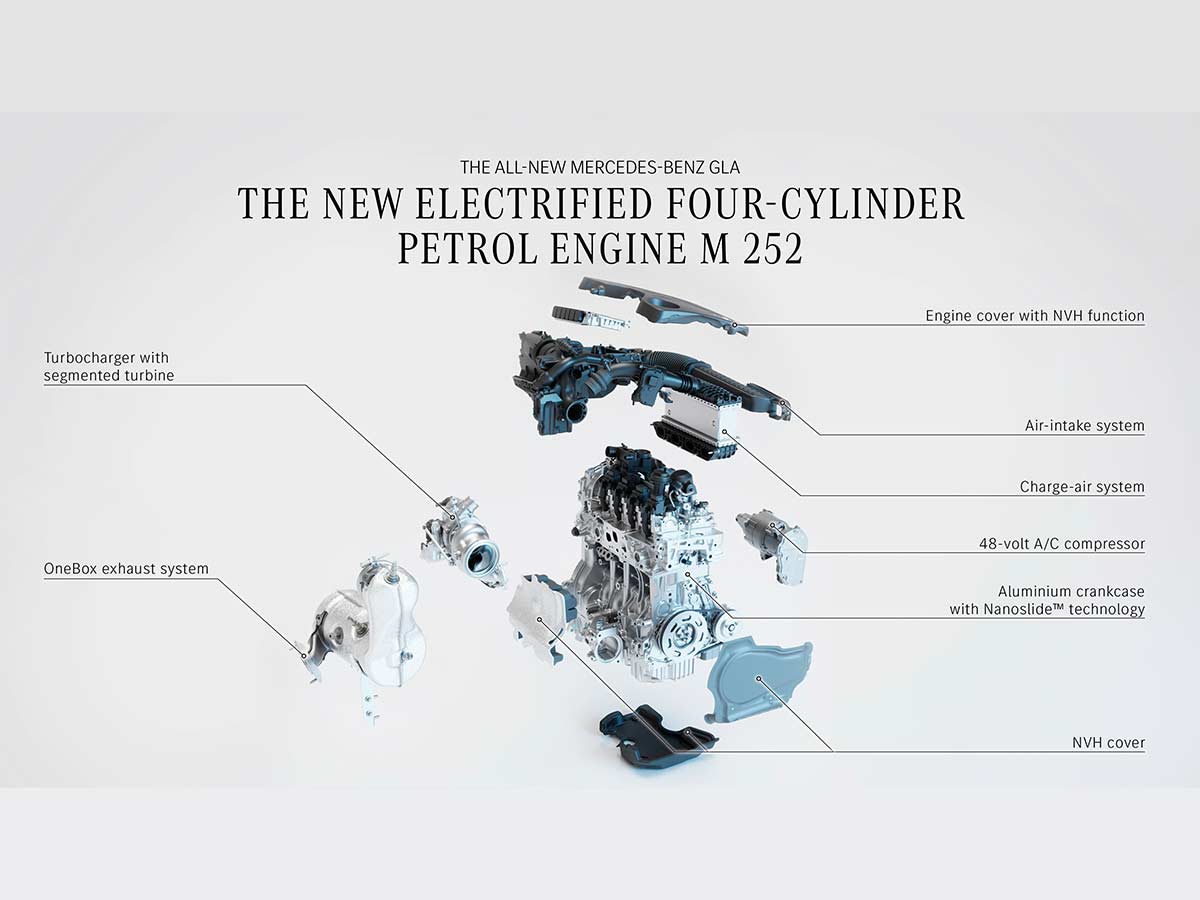
Powering the hybrid GLA is Mercedes-Benz’s newly developed 1.5-litre four-cylinder turbocharged petrol engine, internally known as the M 252.
This isn’t an updated version of an existing engine.
It’s an all-new member of the company’s Family of Modular Engines (FAME), developed with efficiency as the primary objective.
Rather than relying on outright displacement or turbocharger pressure, Mercedes-Benz has focused on extracting more usable performance from every drop of fuel.
The engine employs a Miller-cycle combustion process, a technology increasingly adopted by manufacturers seeking greater thermal efficiency.
By closing the intake valves earlier than in a conventional petrol engine, pumping losses are reduced and the engine can operate with a high 12:1 compression ratio. The result is improved fuel economy, particularly during partial-load driving – exactly the type of driving most owners experience every day.
The design also contributes to lower nitrogen oxide (NOx) emissions, helping prepare the engine for increasingly stringent global emissions standards.
A Hybrid That Actually Drives Like One
Many mild hybrids simply use a small electric motor to assist during acceleration.
Mercedes-Benz has gone considerably further.
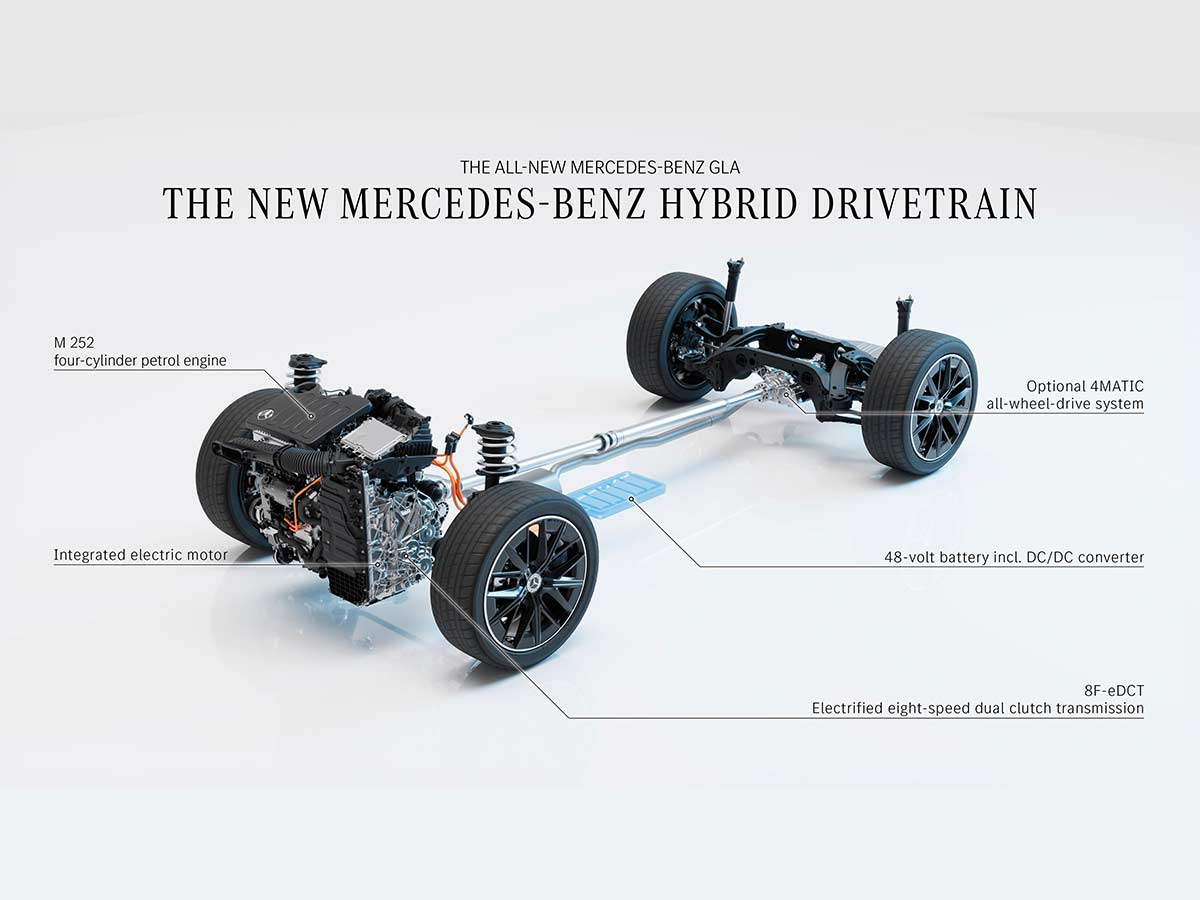
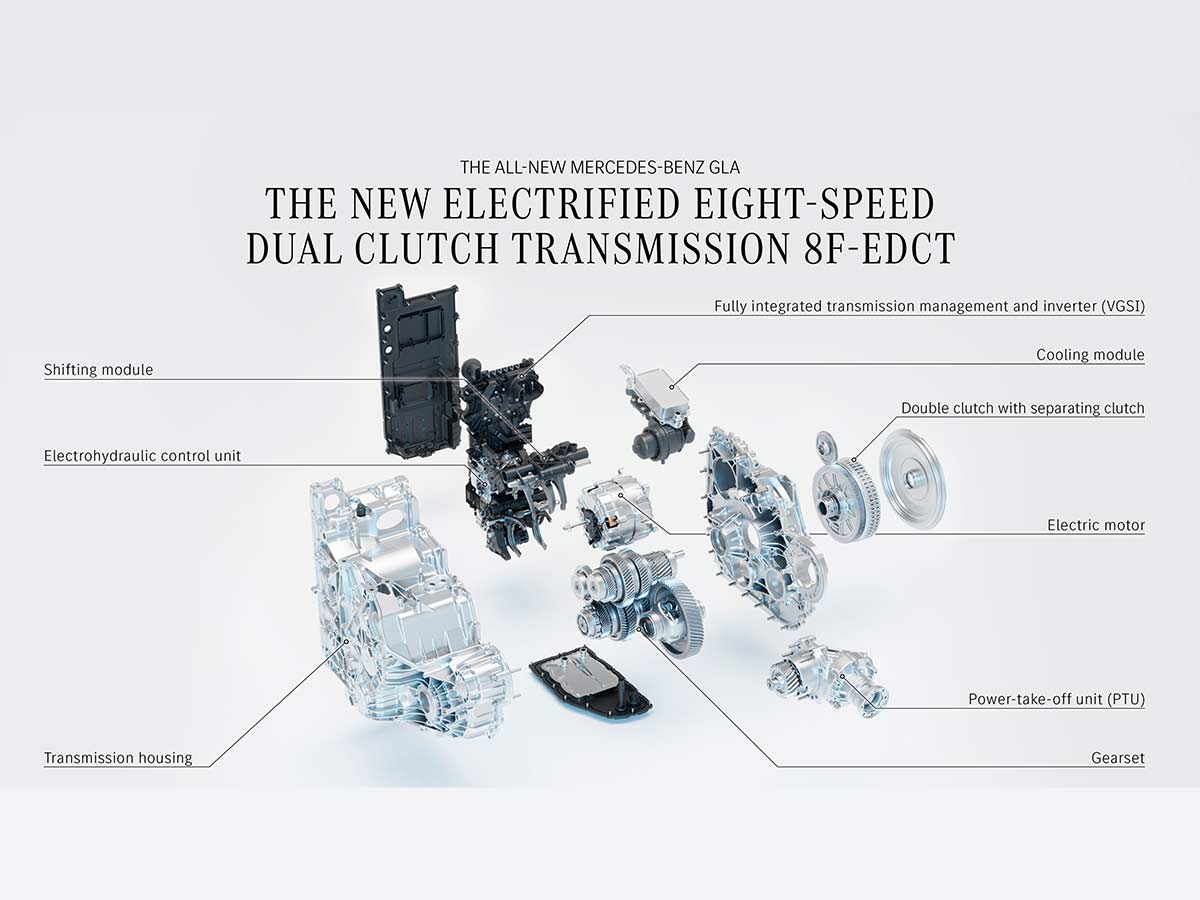
The new GLA features a 48-volt lithium-ion battery with an energy capacity of up to 1.3 kWh, feeding an electric motor integrated directly into a newly developed eight-speed electrified dual-clutch transmission (8F-eDCT).
Integrating the motor inside the transmission offers several advantages.
It keeps the overall package compact, reduces drivetrain complexity and enables the electric motor to contribute across all eight gears.
The system can provide additional torque during acceleration, recover energy while decelerating and even propel the vehicle using electric power alone under certain driving conditions.
Most importantly, the transitions between petrol and electric operation are designed to be almost imperceptible.
For drivers, the technology works quietly in the background, delivering a smoother experience without constantly reminding them that they’re driving a hybrid.
Electric Driving Without Plugging In
Perhaps the most interesting aspect of Mercedes-Benz’s hybrid system is that it allows the GLA to travel using electric power alone in specific situations.
At urban speeds, when power demand remains below approximately 22 kW, the petrol engine can shut down completely while the electric motor handles propulsion.
That means crawling through traffic, manoeuvring in parking lots or rolling through residential areas can often happen without the combustion engine operating.
The experience naturally isn’t comparable to a dedicated battery-electric vehicle, but it still reduces fuel consumption and local emissions during the type of driving that dominates daily commuting.
Electric Coasting at Motorway Speeds
The hybrid’s cleverness doesn’t stop in the city.
One feature that deserves more attention is its ability to coast electrically at speeds above 100 km/h.
Under light throttle loads, again requiring less than 22 kW, the transmission disconnects the petrol engine entirely.
The vehicle continues gliding using minimal electrical assistance while eliminating engine drag.
It’s a subtle feature that many drivers may never consciously notice.
Yet over thousands of kilometres, these small moments of reduced fuel consumption add up to meaningful efficiency gains.
Smarter Energy Recovery
Like the electric GLA, the hybrid also recovers energy during deceleration.
Its integrated electric motor can recuperate up to 25 kW of power, converting braking energy into electricity that is stored inside the 48-volt battery for later use.
Unlike older hybrid systems that recovered energy only under specific circumstances, Mercedes-Benz allows recuperation across all eight gears.
That flexibility improves efficiency regardless of driving style or road conditions.
The recovered energy is then used to support acceleration, smooth engine restarts and power onboard electrical systems.
Engineering Details Buyers Will Never See
The M 252 engine incorporates several advanced technologies that remain invisible to owners but contribute significantly to refinement and efficiency.
These include:
- An all-aluminium crankcase.
- Mercedes-Benz’s NANOSLIDE cylinder coating, reducing internal friction.
- A cylinder head with a partially integrated exhaust manifold.
- A turbocharger featuring a segment turbine and switchable scroll connection.
- A compact charge-air path to improve responsiveness.
- A close-coupled “one-box” exhaust system designed to meet future emissions regulations.
One particularly clever feature is the 48-volt electrically driven air-conditioning compressor.
Unlike conventional belt-driven systems, it continues operating even when the petrol engine switches off.
That means occupants continue enjoying full climate control while coasting or driving electrically, something that wasn’t always possible with earlier hybrid systems.
Refinement Was Clearly a Priority
Spend enough time analysing the new GLA and a consistent engineering philosophy begins to emerge.
Mercedes-Benz hasn’t pursued electrification simply to reduce emissions.
The company has used it to improve refinement.
Electric assistance fills in torque at low engine speeds, reducing hesitation.
Engine stop-start events become almost imperceptible.
Electric coasting lowers engine noise on the motorway.
The integrated transmission smooths every power transition.
These improvements may never appear in a specification table, yet they’re exactly the details owners appreciate every day.
Ride Comfort Meets SUV Practicality
Mercedes-Benz has also refined the GLA’s chassis to suit its broader range of powertrains.
The lower centre of gravity, particularly in electric models where the battery sits beneath the floor, contributes to greater stability through corners.
Meanwhile, the wider rear track improves plantedness without sacrificing manoeuvrability in urban environments.
The suspension continues to prioritise comfort, absorbing poor road surfaces with the composure expected from a premium SUV.
Yet there’s enough body control to ensure the GLA doesn’t feel detached when the road becomes more demanding.
Rather than chasing outright sportiness, Mercedes-Benz has aimed for confidence and predictability.
That’s exactly what many compact luxury SUV buyers want.
Quietness Becomes a Luxury Feature
One of the less obvious but most impressive achievements of the new GLA is its refinement.
Mercedes-Benz has paid close attention to aerodynamic optimisation, resulting in a drag coefficient of just 0.27.
While that benefits efficiency, it also significantly reduces wind noise at motorway speeds.
Combined with improved insulation, carefully engineered electric motors and advanced drivetrain integration, the cabin remains remarkably serene.
It’s a reminder that genuine luxury isn’t always about adding more equipment.
Sometimes it’s simply about removing unnecessary noise.
The GLA Grows Up
If previous generations of the GLA occasionally felt like raised hatchbacks wearing premium badges, this latest model feels altogether more mature.
The hybrid versions retain the familiar flexibility of a combustion-powered SUV while borrowing many of the smoothness and sophistication traditionally associated with electric vehicles.
The electric models push the technology even further, but the hybrid ensures Mercedes-Benz isn’t forcing buyers into one path.
Instead, the company is allowing customers to choose the powertrain that best fits their lives, without compromising the overall experience.
And that may ultimately become one of the new GLA’s greatest strengths.
Safety, Sustainability and the Bigger Picture
Every new Mercedes-Benz is expected to deliver cutting-edge technology, premium craftsmanship and effortless performance. But the new GLA carries another responsibility. As the entry point into the brand’s SUV lineup, it also has to demonstrate where Mercedes-Benz is heading over the next decade.
That vision extends well beyond electric motors and digital dashboards.
The new GLA represents a holistic rethink of how a modern premium SUV should be engineered, manufactured and supported throughout its lifecycle. From AI-powered driver assistance to responsibly sourced raw materials and digitally managed production, Mercedes-Benz is attempting to reduce its environmental impact without compromising the luxury experience that defines the brand.
Safety That Works Quietly in the Background
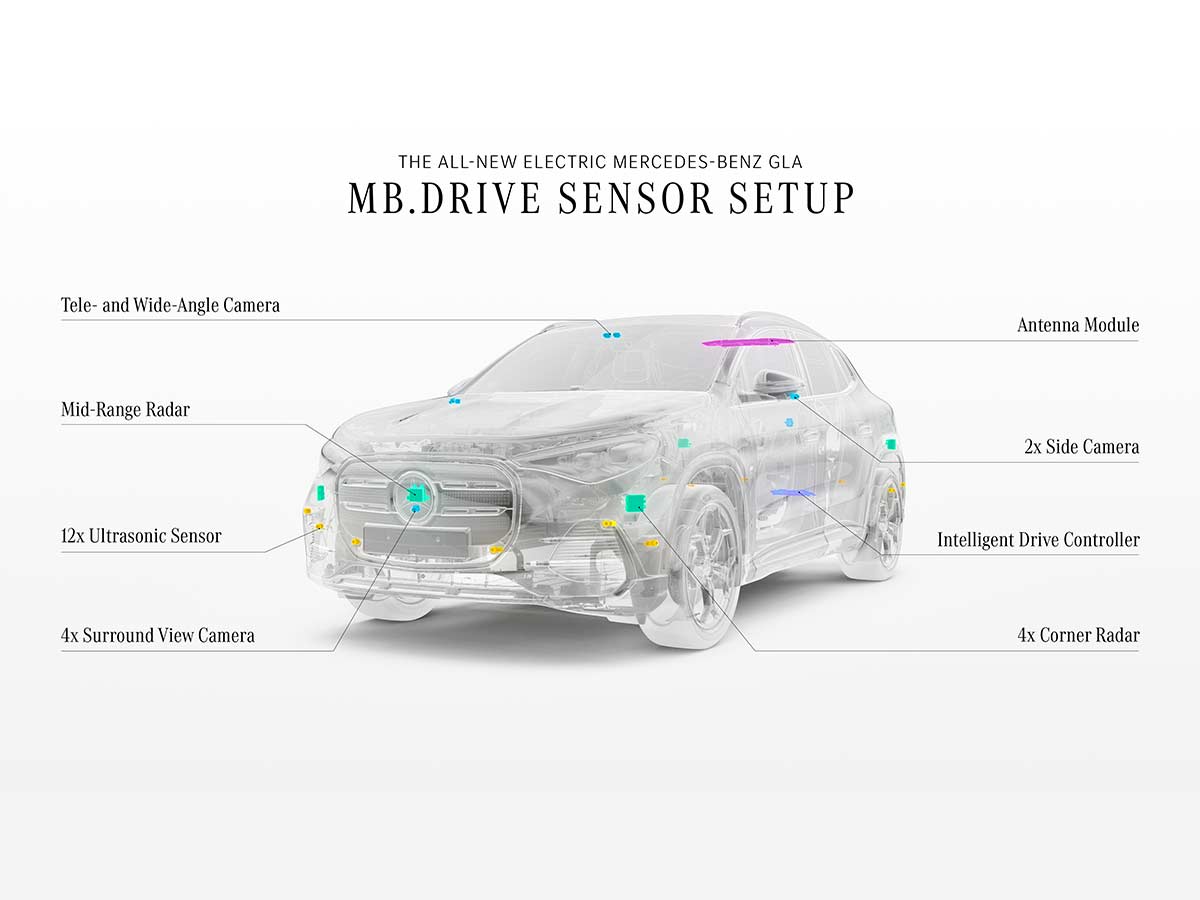
The latest GLA introduces a new generation of driver assistance systems grouped under the MB.DRIVE umbrella.
Rather than overwhelming drivers with alerts and interventions, Mercedes-Benz has refined these systems to work more naturally, stepping in only when genuinely needed.
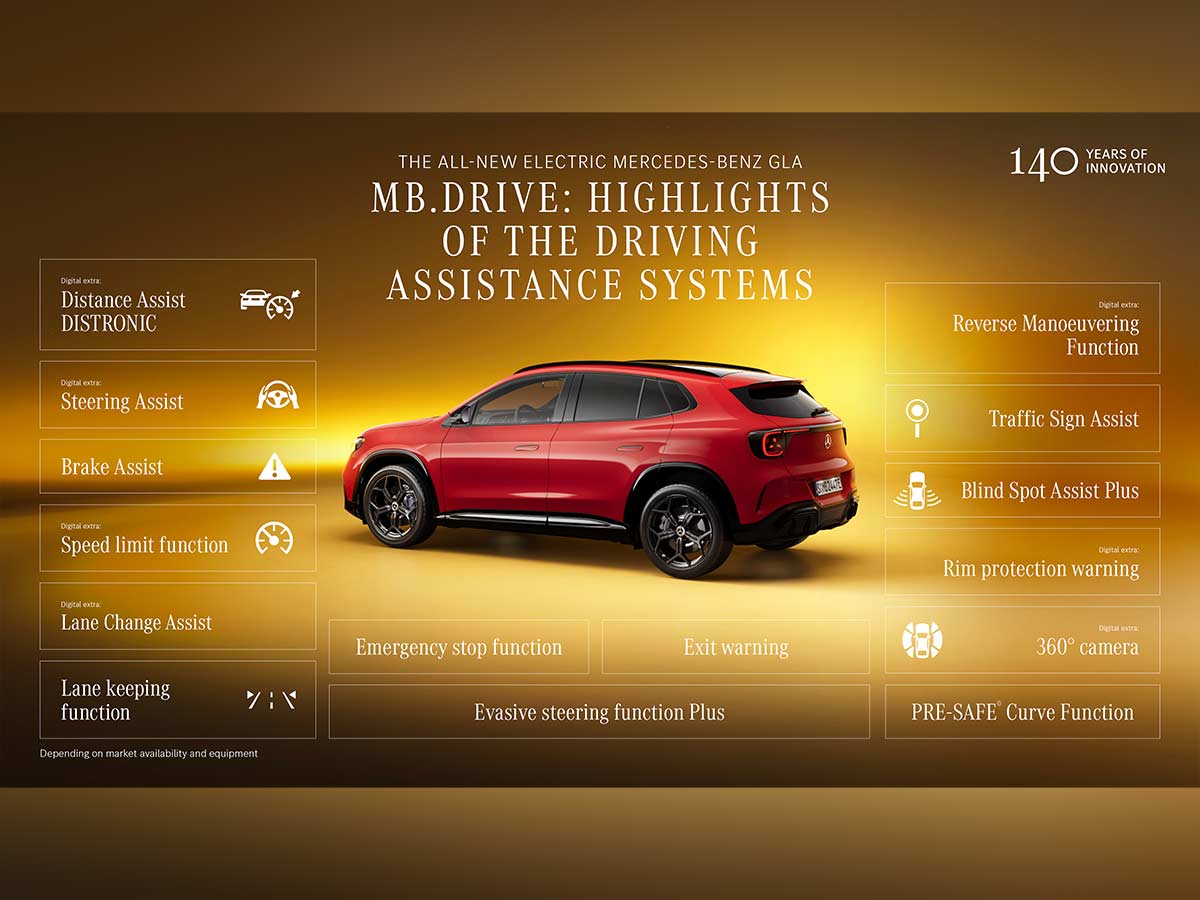
Depending on specification and market availability, the GLA can be equipped with a comprehensive suite of assistance technologies, including:
- Adaptive Distance Assist DISTRONIC
- Active Steering Assist
- Active Brake Assist
- Lane Keeping Assist
- Blind Spot Assist
- Traffic Sign Assist
- Active Speed Limit Assist
- Parking Assist with advanced camera systems
Together, these systems provide SAE Level 2 assisted driving capability, meaning the vehicle can support acceleration, braking and steering under certain conditions while the driver remains fully responsible for the vehicle.
Mercedes-Benz has also improved the interaction between the navigation system and driver assistance technologies.
Rather than reacting only after reaching a bend, junction or speed limit, the GLA can anticipate upcoming road conditions using navigation data and onboard sensors, allowing smoother speed adjustments and more natural interventions.
The result is assistance that feels less intrusive and more intuitive.
Built Around Everyday Confidence
Safety isn’t only about electronic systems.
The GLA’s new platform contributes to occupant protection through a highly rigid body structure designed to better manage impact forces while supporting the additional weight of battery-electric models.
Electric versions also incorporate extensive battery protection measures integrated into the vehicle’s structure, ensuring the high-voltage battery remains protected in a variety of collision scenarios.
Combined with Mercedes-Benz’s long-standing expertise in passive safety, the GLA aims to provide the reassuring sense of security buyers expect from the three-pointed star.
Sustainability Starts Long Before Production
One of the most interesting aspects of the new GLA isn’t something customers will ever see.
It’s the way Mercedes-Benz has approached the sourcing of raw materials.
Increasingly, sustainability is measured not only by what comes out of a vehicle’s tailpipe but by the emissions generated throughout its entire lifecycle.
Mercedes-Benz says the all-electric GLA has been developed with this broader perspective in mind.
According to the company, the vehicle’s overall carbon footprint across the value chain is around 40 percent lower than that of the current combustion-engine GLA.
Achieving that reduction required far more than replacing the engine with a battery.
Lower-Carbon Materials Throughout the Vehicle
Mercedes-Benz has worked closely with suppliers to reduce emissions associated with key materials, including:
- Aluminium
- Steel
- Battery cells
- Plastics
The new generation of battery cells reduces the carbon footprint per cell by around 30 percent compared with the previous battery generation.
Approximately 40 percent of the aluminium used in the vehicle comes from electrolysis plants powered by renewable electricity.
Mercedes-Benz estimates these measures alone reduce emissions by roughly 400 kg of CO₂ per vehicle.
The company has also increased the use of lower-carbon steel, with approximately 39 kg of steel components produced using electric arc furnaces powered by renewable electricity.
Recycled Materials Become Mainstream
Luxury has traditionally been associated with new materials.
Mercedes-Benz is attempting to redefine that perception.
The new GLA uses more than four times as much recycled material as its predecessor.
Some examples include:
- The front bumper carrier contains almost 22 percent recycled material.
- The rear bumper carrier incorporates up to 55 percent recycled content.
- The washer fluid reservoir is made entirely from recycled plastics.
- Textile seat fabrics include significant proportions of recycled fibres.
- A leather-free interior option is available.
- Carpets are produced using 100 percent recycled ECONYL yarn.
Importantly, these materials aren’t presented as compromises.
Mercedes-Benz integrates them into the cabin without sacrificing perceived quality, demonstrating how sustainable materials can meet premium expectations.
Responsible Sourcing Matters Too
Mercedes-Benz has also placed significant emphasis on improving transparency within its supply chain.
Raw materials such as:
- Lithium
- Cobalt
- Nickel
are systematically traced back through smelters and refiners, helping improve visibility throughout the battery supply chain.
The company continues working with international initiatives focused on responsible mining while increasing the share of materials sourced from operations audited under the Initiative for Responsible Mining Assurance (IRMA) standard.
Mercedes-Benz has additionally expanded its own supplier audit programme, conducting dozens of deeper-tier battery supply chain audits in recent years to identify and reduce environmental and human-rights risks.
Looking Beyond the Battery
The sustainability strategy extends well beyond battery materials.
Mercedes-Benz is also working to improve transparency within the leather and natural rubber supply chains.
Leather used in the new GLA is sourced under stricter sustainability requirements, including improved traceability throughout processing stages and increased use of Leather Working Group Gold-certified suppliers.
For genuine leather interiors, Mercedes-Benz has also shifted to chrome-free and GDA-free tanning processes, reducing the environmental impact associated with leather production.
Built in Rastatt – A Factory Ready for the Future
The new GLA is produced at Mercedes-Benz’s Rastatt plant in Germany, one of the company’s most advanced manufacturing facilities and the competence centre for its compact vehicle lineup.
Rastatt doesn’t simply assemble vehicles.
It has become a showcase for Mercedes-Benz’s digital manufacturing strategy.
Before production of the new GLA began, engineers created a complete digital twin of the assembly hall, allowing production lines to be configured and optimised virtually before physical installation.
This “Digital First” approach significantly reduced construction time and costs while improving manufacturing efficiency.
Artificial intelligence also plays a growing role inside the factory.
AI-controlled paint shop processes have reduced energy consumption in topcoat application by approximately 20 percent, demonstrating how digital technologies can improve sustainability beyond the vehicle itself.
Renewable Energy Becomes Central to Production
Mercedes-Benz’s long-term production strategy is equally ambitious.
The company aims to source more than 70 percent of production energy from renewable sources by 2030, while working toward operating all production facilities worldwide using renewable energy without direct CO₂ emissions by 2039.
Rastatt already contributes to that vision.
The plant operates photovoltaic installations with a combined capacity exceeding 8 MWp while using highly efficient combined heat and power systems that achieve overall efficiencies of around 86 percent.
It’s a reminder that the environmental impact of an electric vehicle begins long before it reaches the customer.
Verdict: Mercedes-Benz Has Rewritten the Compact Luxury SUV Rulebook
The previous GLA was successful because it introduced buyers to the Mercedes-Benz brand.
The new one aims to keep them there.
This isn’t simply a compact SUV that’s been electrified. It’s a complete rethink of what an entry-level Mercedes-Benz should be.
The new GLA blends elegant design with genuinely useful technology, impressive long-distance capability with everyday practicality, and cutting-edge engineering with familiar usability. Whether it’s the AI-powered MBUX experience, the sophisticated two-speed electric drivetrain, the advanced hybrid system or the painstaking attention to sustainability, every element feels part of a larger vision rather than an isolated feature.
Perhaps most importantly, Mercedes-Benz hasn’t fallen into the trap of designing a car around marketing headlines.
Instead, the GLA focuses on the details that owners experience every day: a quieter cabin, more comfortable seats, intuitive software, faster charging, better efficiency, improved practicality and seamless integration of technology into daily life.
In a segment that’s becoming increasingly crowded with capable electric SUVs, those everyday improvements may ultimately matter more than any single specification.
If the CLA marked the beginning of Mercedes-Benz’s new compact-car era, the GLA proves the strategy extends well beyond one model. It demonstrates that the company is serious about creating premium electric vehicles that don’t ask buyers to compromise, while still recognising that hybrid technology has an important role to play.
For buyers searching for a compact luxury SUV that combines premium quality, cutting-edge technology and genuine long-distance usability, the new Mercedes-Benz GLA isn’t merely another contender.
It sets a new benchmark.
Frequently Asked Questions about the new Mercedes-benz GLA
Q: When will the new Mercedes-Benz GLA go on sale?
A: Orders for the all-electric GLA opened on 30 July 2026, with customer deliveries beginning shortly afterwards depending on market.
Q: How far can the electric GLA travel on a charge?
A: The flagship GLA 250+ Electric offers up to 657 km (WLTP), while the dual-motor GLA 350 4MATIC Electric delivers up to 643 km (WLTP).
Q: How quickly can the GLA charge?
A: The larger-battery models support up to 320 kW DC fast charging, allowing 240-270 km of WLTP range to be added in approximately 10 minutes under optimal conditions.
Q: Will there still be petrol-powered versions of the new GLA?
A: Yes. Mercedes-Benz will introduce electrified 48-volt hybrid petrol models in 2027 alongside the electric range.
Q: Where is the new GLA built?
A: The new Mercedes-Benz GLA is manufactured at the company’s Rastatt plant in Germany, alongside other compact Mercedes-Benz models.
Source: Mercedes-Benz