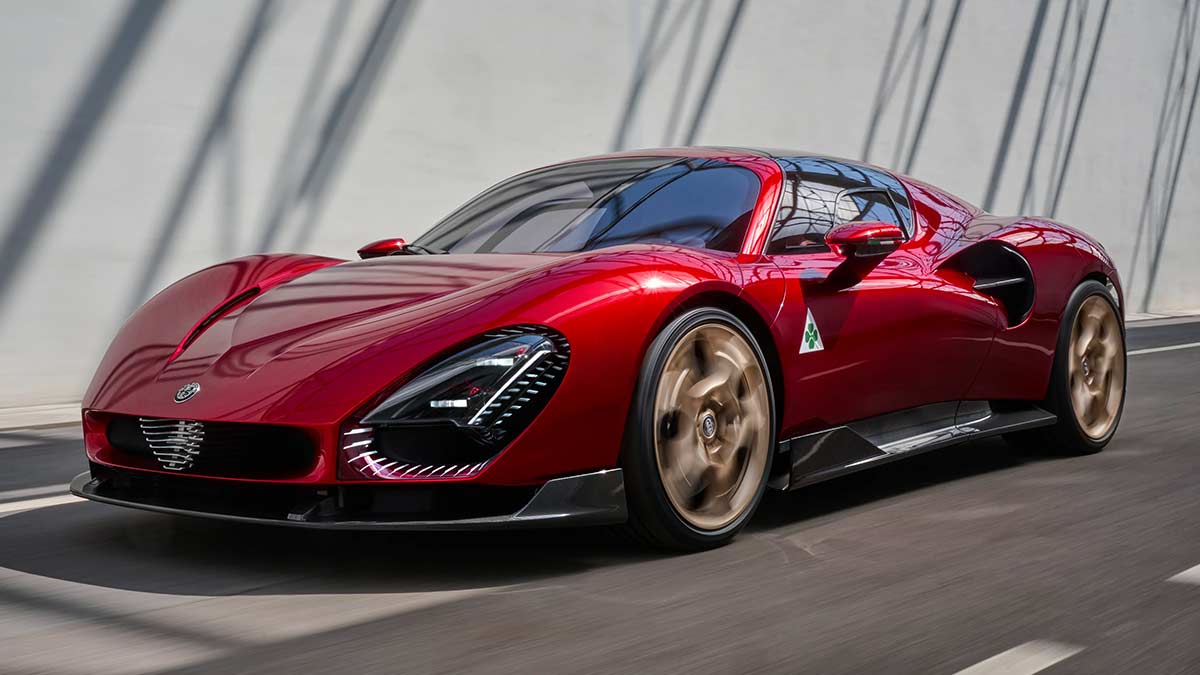


















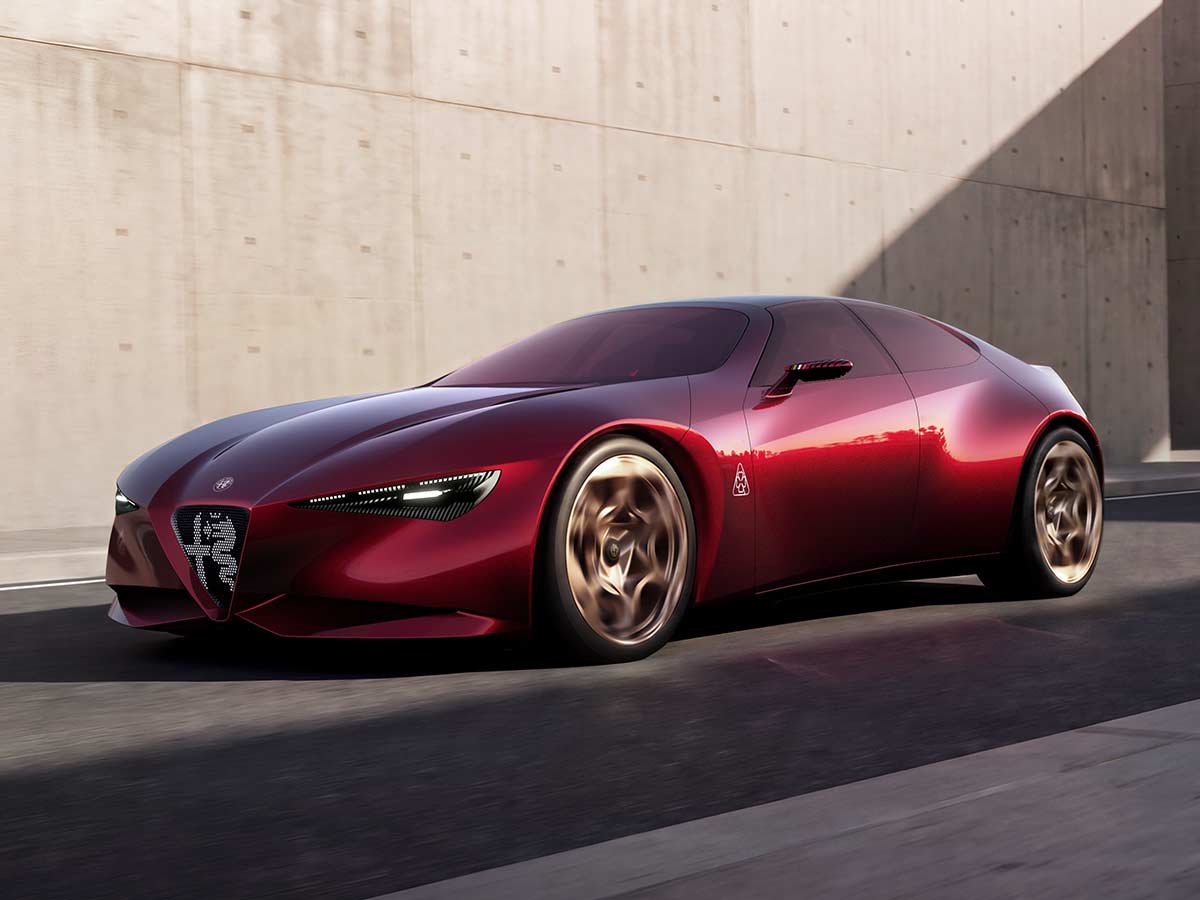
Alfa Romeo has unveiled the Cuorerosso concept at the 2026 Paris Motor Show, presenting a striking vision of how Italian sports-car design, electrification and driver engagement could coexist in future models. With a sculptural red body, a 2+2 coupé configuration and an interior built around an evolving digital interface, the concept offers a detailed look at the principles the brand intends to carry into its next chapter.
The Alfa Romeo Cuorerosso is not a preview of a specific production car. Instead, it serves as a design and technology manifesto, exploring how the brand can adapt to different powertrain technologies without losing the emotional character that has defined its cars. Its significance lies in the relationship between form, function and driving pleasure, rather than in a single headline performance figure.
Measuring 4,700 mm long, 1,980 mm wide and 1,331 mm high, the Cuorerosso combines the proportions of a grand touring coupé with the visual drama of a supercar. Its technical features include air suspension, carbon-ceramic brakes, steer-by-wire steering and an instrument display that physically changes configuration according to the driver’s needs.
The concept also outlines Alfa Romeo’s intended approach to electrification. The brand envisions a future range spanning fully electric, plug-in hybrid, mild-hybrid and full-hybrid powertrains, with models up to 4.7 metres long and the potential for Quadrifoglio performance variants.
At the centre of this vision is a principle Alfa Romeo calls Bellezza Necessaria, or Necessary Beauty. It is an approach that seeks to remove the unnecessary, give every component a clear purpose and bring design, engineering, technology and material quality together in a coherent whole.
>>> Great Discounts on Car & Bike Accessories <<<
Alfa Romeo Cuorerosso: What the Concept Represents
The Cuorerosso marks a new expression of Alfa Romeo’s identity, bringing together three themes that the brand considers fundamental to its character: Italy, sportiness and red.
Each theme has a distinct role. Italy represents the cultural and artisanal foundations of the design, sportiness expresses the pursuit of dynamism and driving pleasure, and red connects the concept to Alfa Romeo’s longstanding association with performance and passion.
Rather than treating these elements as separate styling references, the design team has integrated them into the car’s proportions, surfaces, materials, lighting and cockpit architecture.
The name Cuorerosso reinforces the idea. Combining cuore, the Italian word for heart, with rosso, meaning red, it represents the relationship between emotional engagement and sporting character. That relationship is central to Alfa Romeo’s argument that a car should offer more than efficient transportation.
The concept also reflects the brand’s position within Stellantis as a premium sports brand. Its challenge is to accommodate changing powertrain technologies while preserving a recognisable design identity and a direct relationship between the driver and the machine.
Alfa Romeo and Maserati CEO Santo Ficili described the concept as an expression of an identity that remains open to different energy solutions, with technology, function and quality serving driving pleasure rather than dictating the character of the car.
That distinction matters because the Cuorerosso is not presented as an argument for one particular propulsion technology. It instead explores how the brand’s values might translate across different technical architectures.
Bellezza Necessaria: The Design Philosophy Behind Cuorerosso
Designing the car as a sculptural form
Bellezza Necessaria is Alfa Romeo’s term for a design philosophy that removes superfluous elements and concentrates on what is essential. A component should have a defined purpose, while its form, materials and finish should contribute to the overall character of the vehicle.
The concept applies this principle from the earliest stages of development. According to Alfa Romeo, the Centro Stile spent only a week or two on initial sketches before moving directly into three-dimensional modelling.
The designers initially treated Cuorerosso as a solid block, without wheels, glazing, lighting or other automotive details. This unconventional starting point allowed them to focus on the fundamental relationships between proportions, volumes and surfaces before introducing the elements that make the object recognisably a car.
The process draws on the Italian sculptural tradition, in which the final form is revealed by progressively removing material or unnecessary detail. In Cuorerosso, that idea translates into a body that appears to flow continuously from front to rear.
Its surfaces merge with minimal visual interruption, creating the impression of a single sculpted object rather than a collection of separate panels. The result is intended to communicate movement even when the car is stationary.
This is more than an exercise in visual minimalism. By establishing the fundamental form first, the design philosophy places a premium on proportion and the integration of individual components into the whole.
Why simplicity matters in automotive design
Reducing visual clutter can make a car easier to read as a coherent shape. It can also provide opportunities to integrate functional elements into the bodywork rather than treating them as additions.
Cuorerosso illustrates this approach through its flush glazing, integrated logos, concealed door handles and carefully shaped aerodynamic features. The aim is to preserve the continuity of the body while ensuring that necessary functions remain available.
The same thinking extends to the cabin, where information and controls are intended to appear only when needed. In place of an interface dominated by permanently visible displays and controls, the concept explores a more selective presentation of information.
The principle is consistent across both exterior and interior design: simplicity should come from thoughtful integration, not from removing features without considering their purpose.
For future Alfa Romeo models, Bellezza Necessaria provides a design framework in which aesthetics and engineering are expected to support each other. It is not simply about creating a clean silhouette, but about making the overall design feel deliberate and internally consistent.
Exterior Design: A 2+2 Coupé With Gran Turismo Proportions
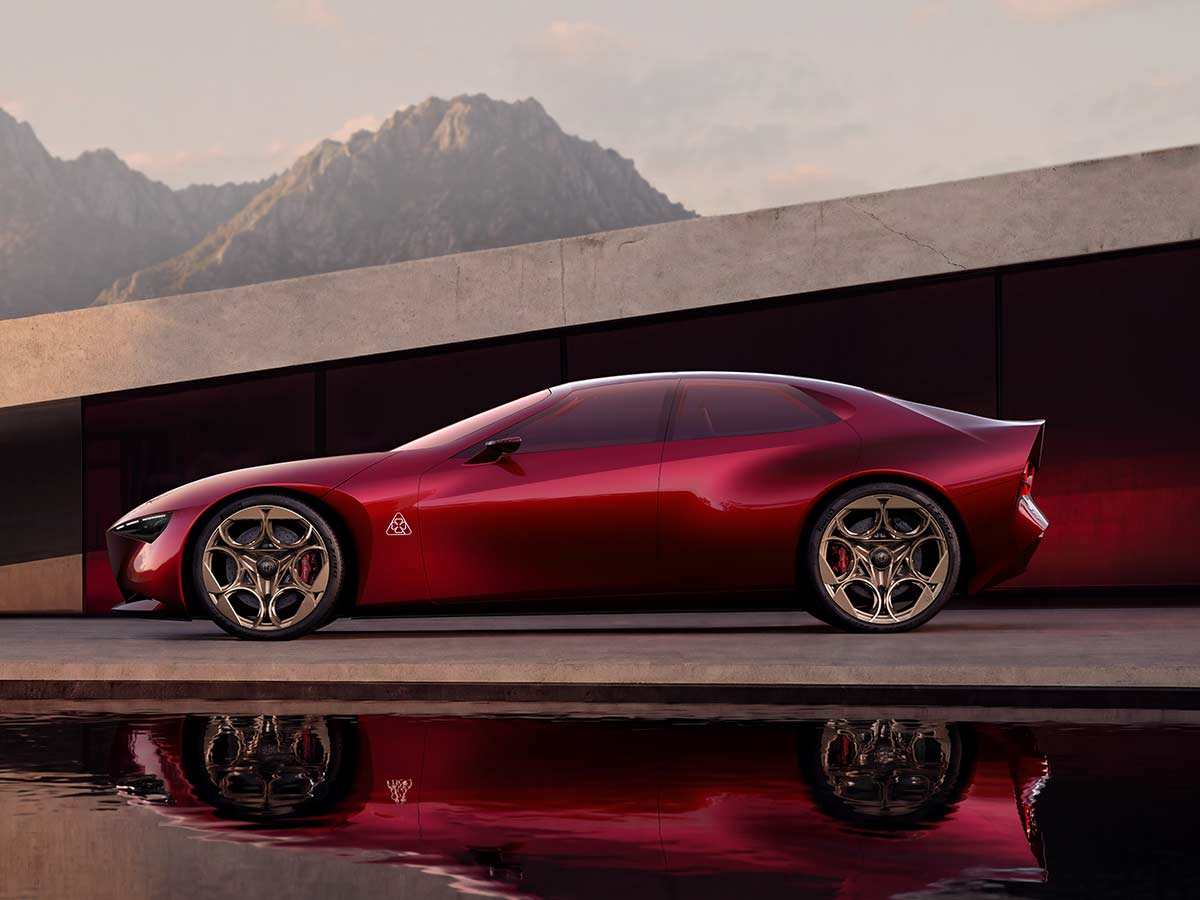
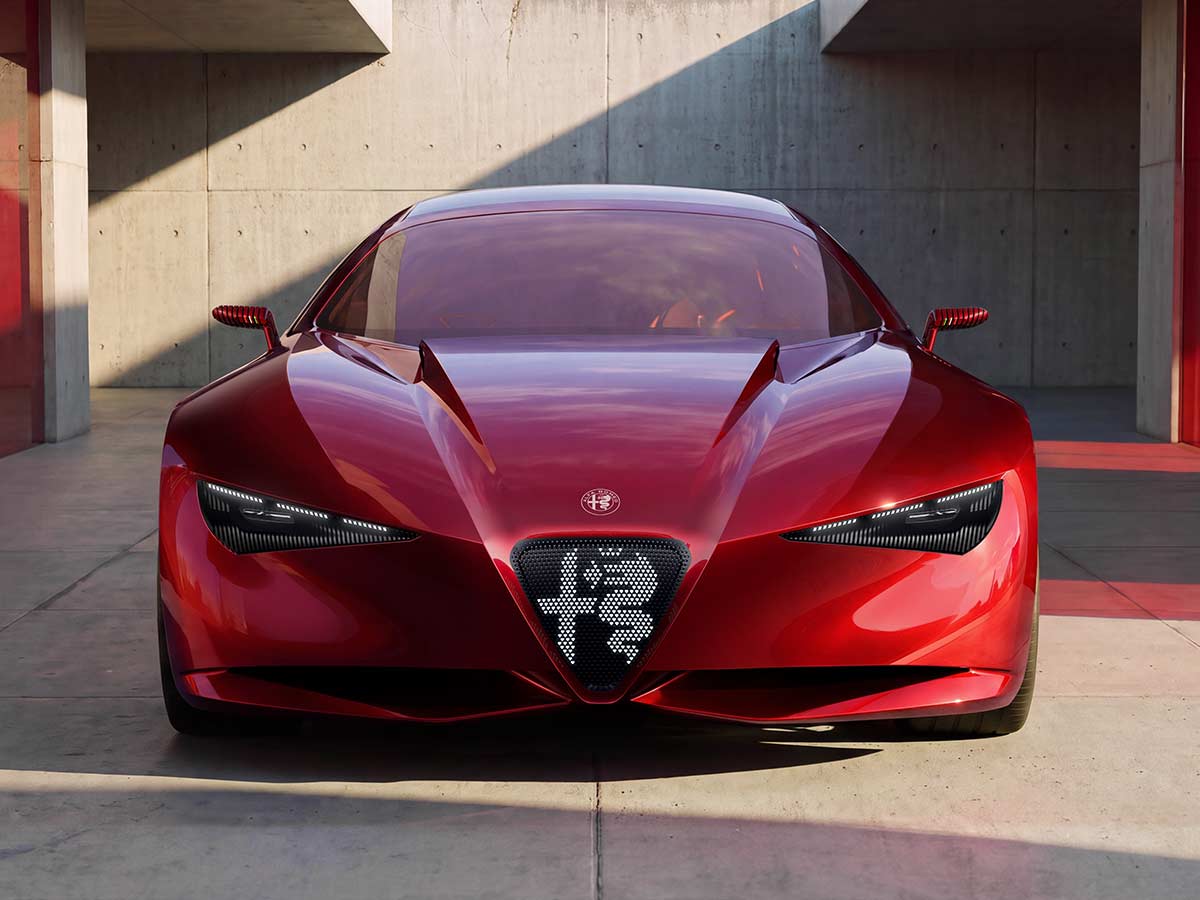
The Alfa Romeo Cuorerosso is a 2+2 coupé that combines sporting proportions with the elegance associated with a grand touring car. Its low roof, elongated body and uninterrupted surfaces give it a strong road presence, while the overall form draws on the visual drama of supercars.
Its principal dimensions establish the scale of the concept:
| Specification | Alfa Romeo Cuorerosso |
|---|---|
| Body style | 2+2 coupé |
| Length | 4,700 mm |
| Width | 1,980 mm |
| Height | 1,331 mm |
| Wheelbase | 2,930 mm |
| Weight | 1,750 kg |
| Aerodynamic drag coefficient (Cx) | 0.28 |
The wedge-shaped profile and Coda Tronca
One of Cuorerosso’s defining exterior features is its wedge-shaped side profile. A characteristic line runs from the front towards the rear, creating visual tension and making the body appear to push forward.
That line culminates in the Coda Tronca, or truncated tail, a design feature associated with Alfa Romeo’s aerodynamic heritage. Instead of tapering into a long, rounded rear end, the body finishes with a more abruptly cut profile.
The truncated-tail treatment is paired with a low diffuser integrated into the bodywork. Together with the car’s clean overall shape, these elements contribute to the reported drag coefficient of 0.28.
The drag coefficient, commonly represented by Cx in European automotive specifications, describes a vehicle’s aerodynamic resistance in relation to its reference frontal area. It is not a direct measure of total aerodynamic drag on its own, because the vehicle’s frontal area also matters.
The figure nevertheless illustrates the importance Alfa Romeo has placed on aerodynamic development. The design is intended to communicate speed and dynamism while limiting unnecessary visual complexity.
The Trilobo and Scudetto define the front end
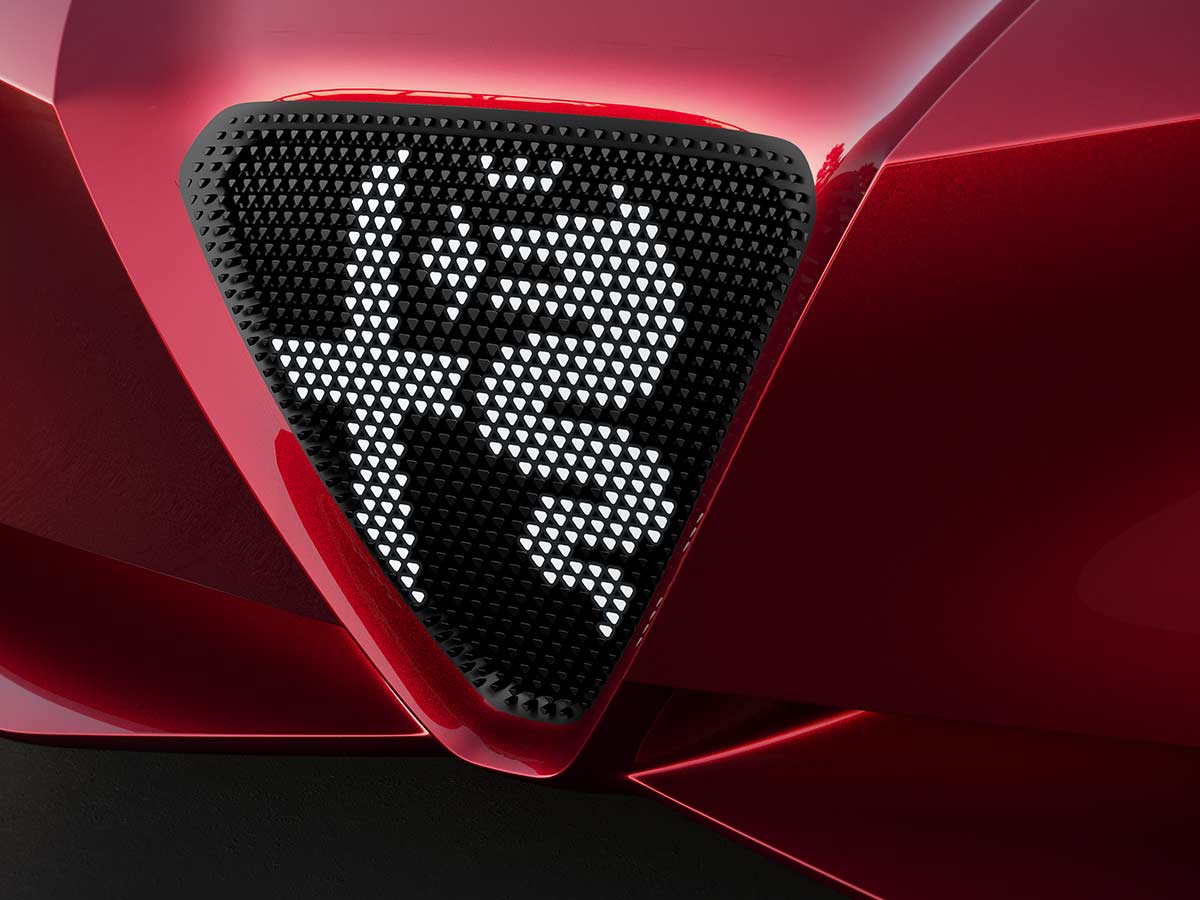
At the front, Cuorerosso reinterprets two familiar Alfa Romeo design elements: the Scudetto, the central shield-shaped grille, and the Trilobo, the broader arrangement of the central grille and surrounding front-end forms.
The combination creates a distinctive face. The headlights are positioned like a pair of eyes, giving the concept what Alfa Romeo describes as a concentrated and self-confident expression.
The Scudetto emerges from the sculpted bodywork and extends into the bonnet, with a form inspired by the wake of a boat moving through water. This treatment helps integrate the grille into the overall surface rather than presenting it as a separate piece of trim.
Small, backlit triangular elements form the grille’s distinctive pattern. Their arrangement references the Cross and Biscione, two historic symbols associated with Alfa Romeo.
The resulting illumination is designed to pulse like a heartbeat. A related lighting sequence is used for the driver’s welcome lighting, extending the Cuorerosso theme into the way the car responds to its occupants.
This is a notable example of the concept’s attempt to combine visual identity and interaction. Lighting is not treated exclusively as decoration, but as a means of establishing a recognisable relationship between the vehicle and the person approaching it.
A distinctive rear design
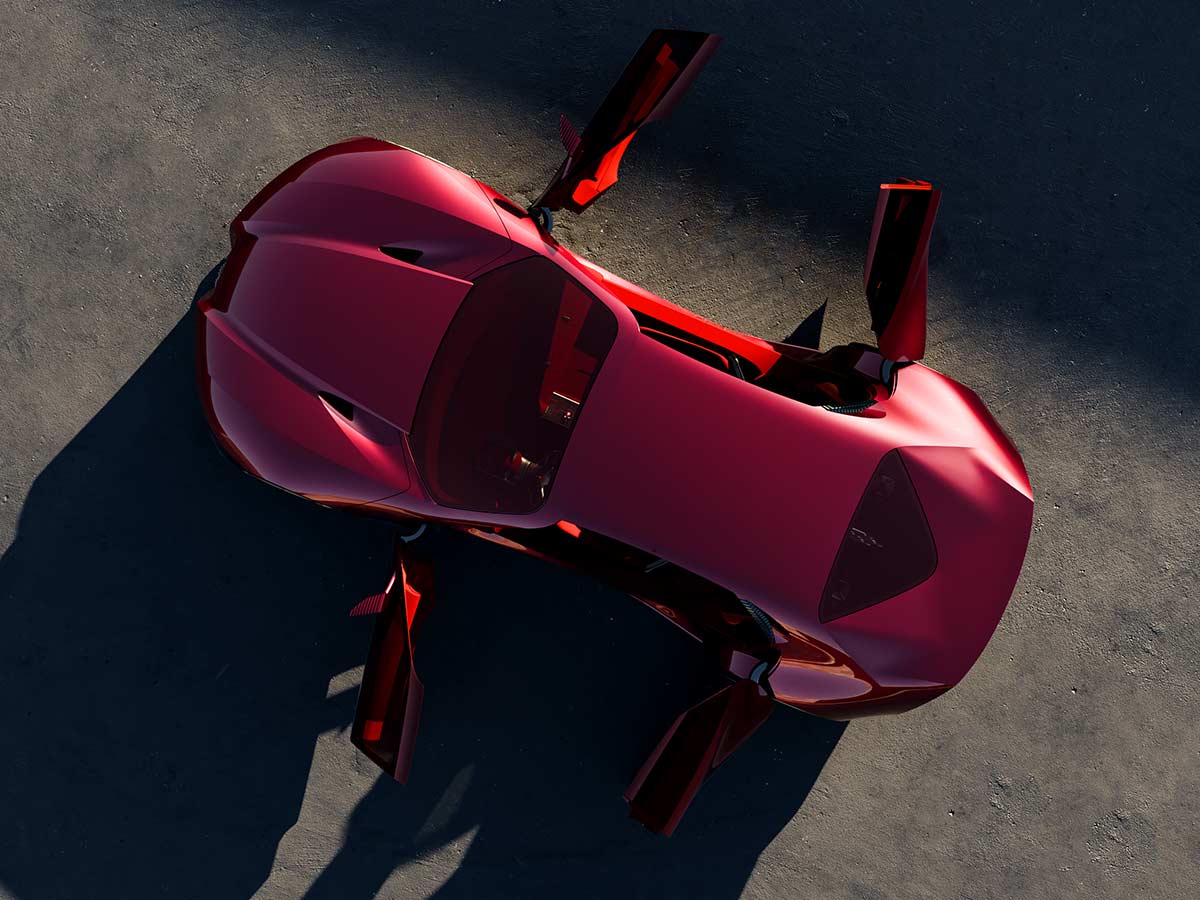
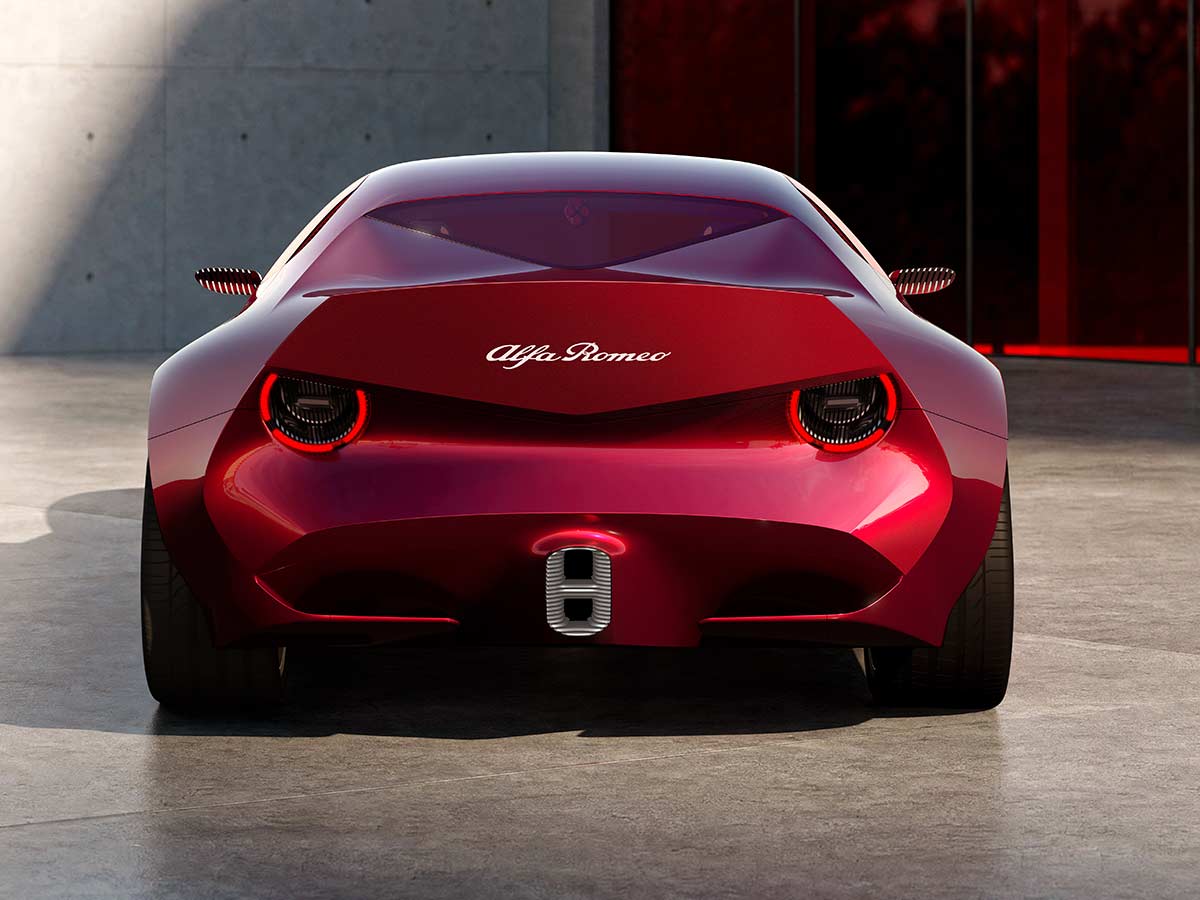
The rear of the concept continues the emphasis on integrated forms. Its most unusual feature is a Scudetto-shaped rear window, which is incorporated into the body volume rather than appearing as an independent glazed panel.
The Coda Tronca houses two circular rear lights, while the surrounding surfaces remain relatively clean and uninterrupted.
The result links the rear styling to Alfa Romeo’s established design vocabulary without simply reproducing older models. Traditional references are reinterpreted through a more sculptural and contemporary form.
The side profile follows the same logic. Conventional door handles disappear, replaced by a touch control on the roof to open the doors. The fully flush windows and body-integrated logos further reduce visual interruptions.
The concept also uses rear-facing doors, creating a more dramatic opening into the cabin. This arrangement contributes to the visual presentation of the car and supports the idea of entering an interior designed as a continuous environment rather than a collection of separate elements.
Aerodynamic details extend to the mirrors and wheels
Cuorerosso’s exterior design incorporates several smaller features intended to reduce visual mass while contributing to aerodynamic efficiency.
The rear-view mirrors feature a series of inlays embellished with the Italian flag. Their shape echoes aerodynamic slats, which divide up the visual volume and are intended to help manage airflow.
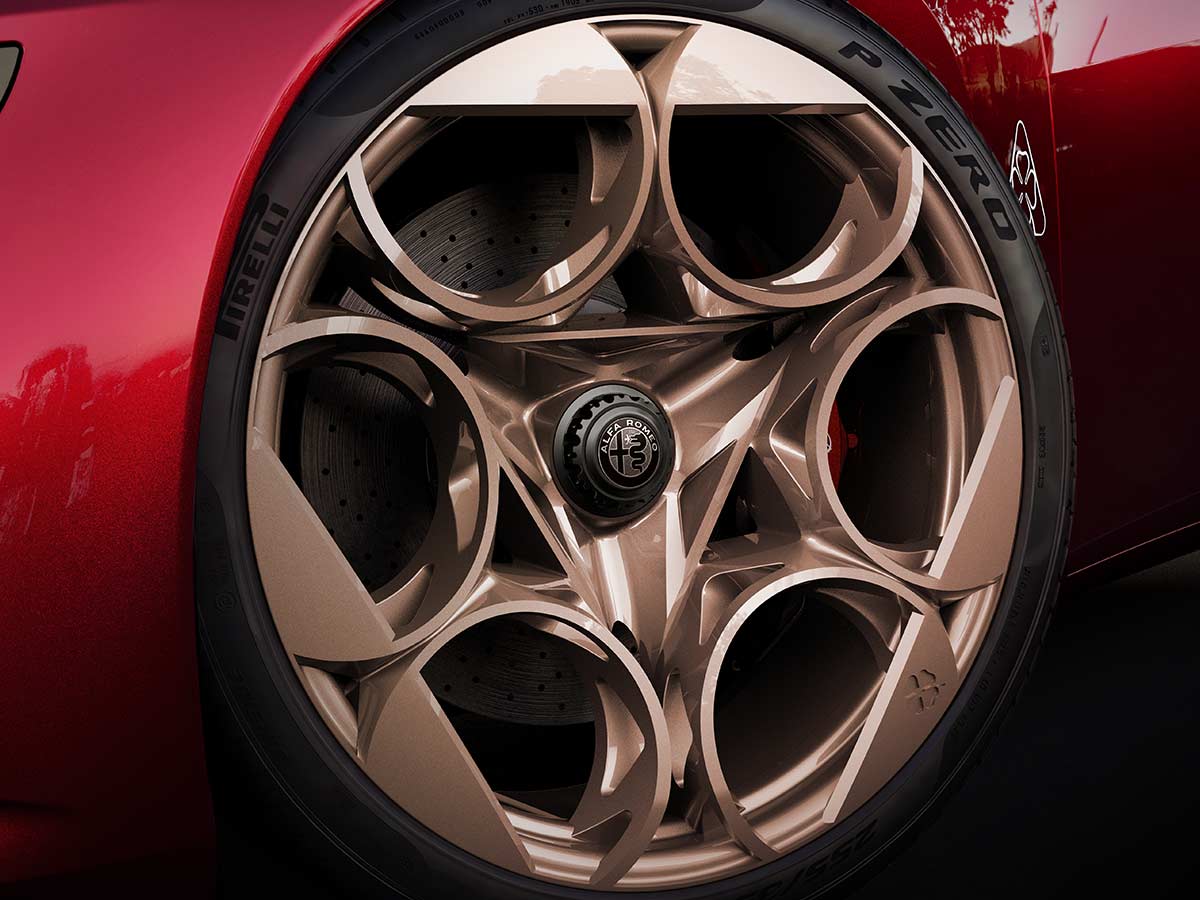
The forged wheels reinterpret Alfa Romeo’s familiar telephone-style wheel design. Six circular elements are arranged across three spokes in a 2+2+2 pattern, while triangular openings reference the Scudetto.
These openings are intended to lighten the visual appearance of the wheels and improve aerodynamic efficiency. A titanium-inspired finish combines cooler tones with warmer metallic reflections, complementing the bodywork’s sculptural character.
The Quadrifoglio symbol also appears on the concept. Its presence connects Cuorerosso with one of Alfa Romeo’s most recognisable expressions of sporting intent and signals that high-performance identity remains part of the brand’s future vision.
Chassis and Braking Technology: Hardware for a Sporting Concept
Alfa Romeo has equipped Cuorerosso with a selection of performance-oriented chassis and braking technologies. These include air suspension and a Brembo carbon-ceramic braking system with dedicated Alfa Romeo calipers.
Air suspension uses air springs instead of conventional steel coil springs. Depending on the system’s configuration and control strategy, this type of suspension can allow changes to ride height or spring characteristics and can help balance comfort with body control.
The braking system is equally significant as a statement of intent. Carbon-ceramic brakes use a carbon-fibre-based ceramic composite for the friction discs rather than conventional cast iron.
Such systems are associated with high-performance applications because they can offer strong resistance to heat-related brake fade and lower disc mass than comparable conventional arrangements. Their actual advantages depend on system design, operating conditions and the vehicle in which they are installed.
For Cuorerosso, the combination of air suspension and carbon-ceramic brakes reinforces the focus on sporting capability. It also shows how the concept’s design philosophy extends beyond appearance into the mechanical systems that support its intended character.
Interior Design: A Cockpit Built Around the Driver
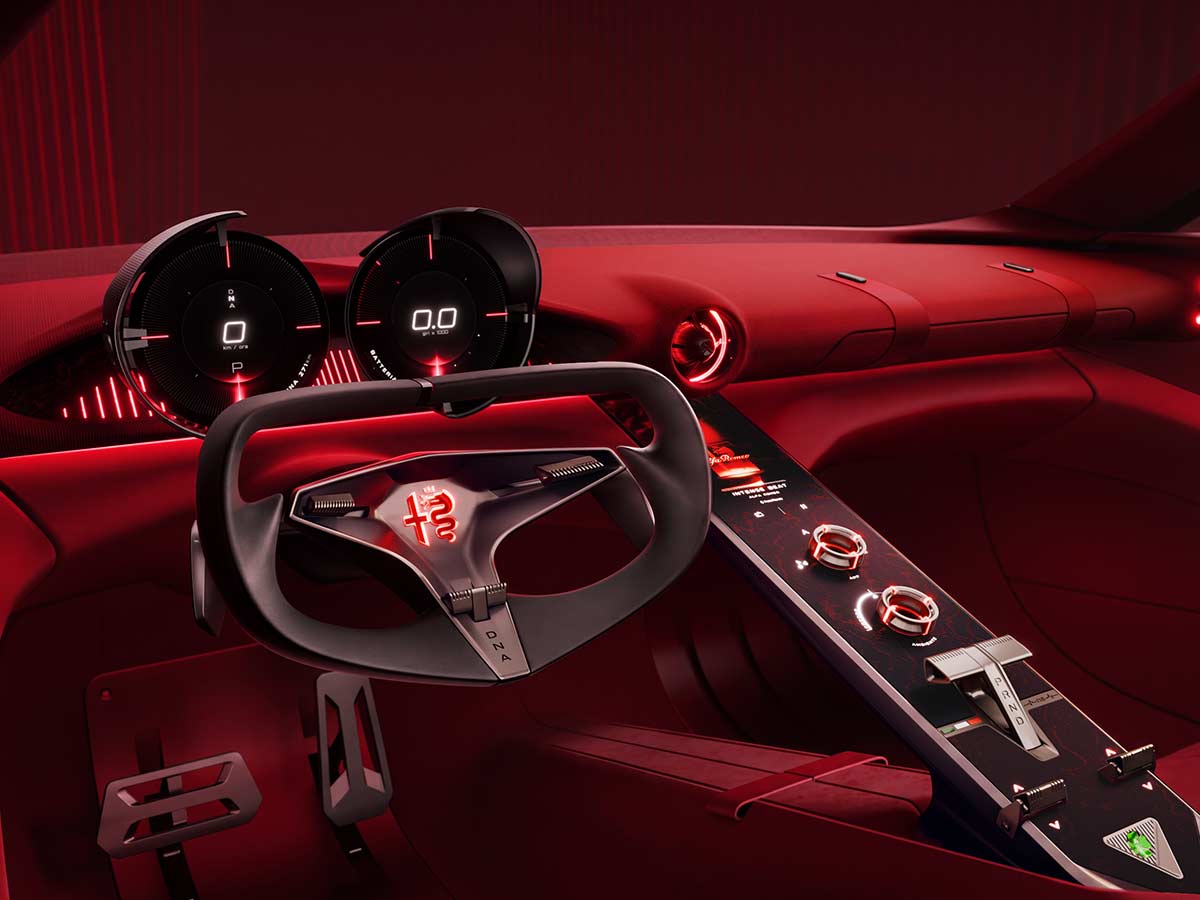
The interior of the Alfa Romeo Cuorerosso follows the same principle as the exterior: every element should have a purpose, and technology should enhance the experience without overwhelming it.
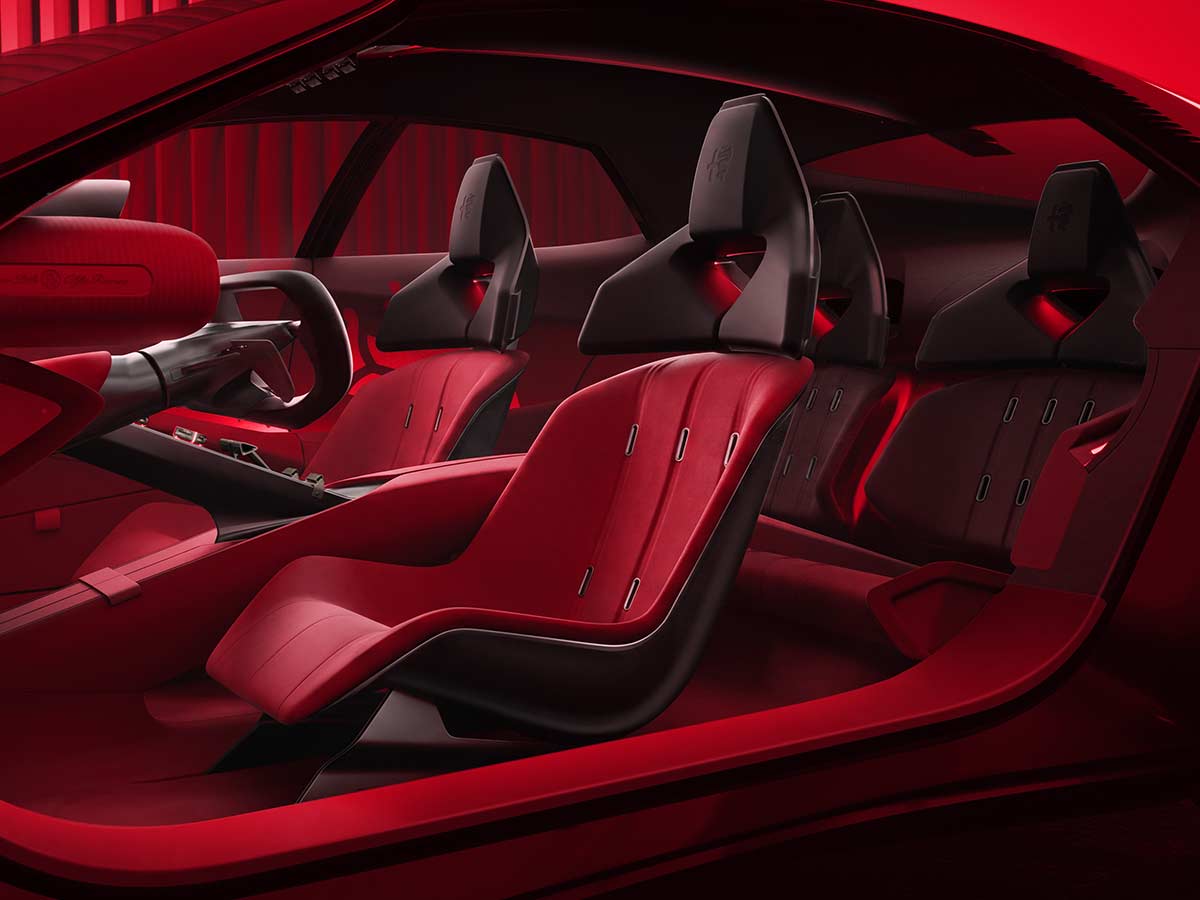
The concept features four individual seats, an elongated centre console and flowing longitudinal shapes across the door panels. These elements wrap around the occupants, creating an enclosed cockpit that emphasises the driver’s position while retaining space for three additional passengers.
The seats reinterpret the traditional bucket-seat concept through enveloping shapes and an emphasis on ergonomics. Their form is intended to provide a close connection with the cabin while maintaining comfort.
This approach reflects an important distinction in sports-car design. A cockpit can be visually dramatic without making the driver work harder to operate the vehicle. The Cuorerosso attempts to combine a focused driving environment with controls that remain accessible and intuitive.
A dashboard inspired by the 33 Stradale
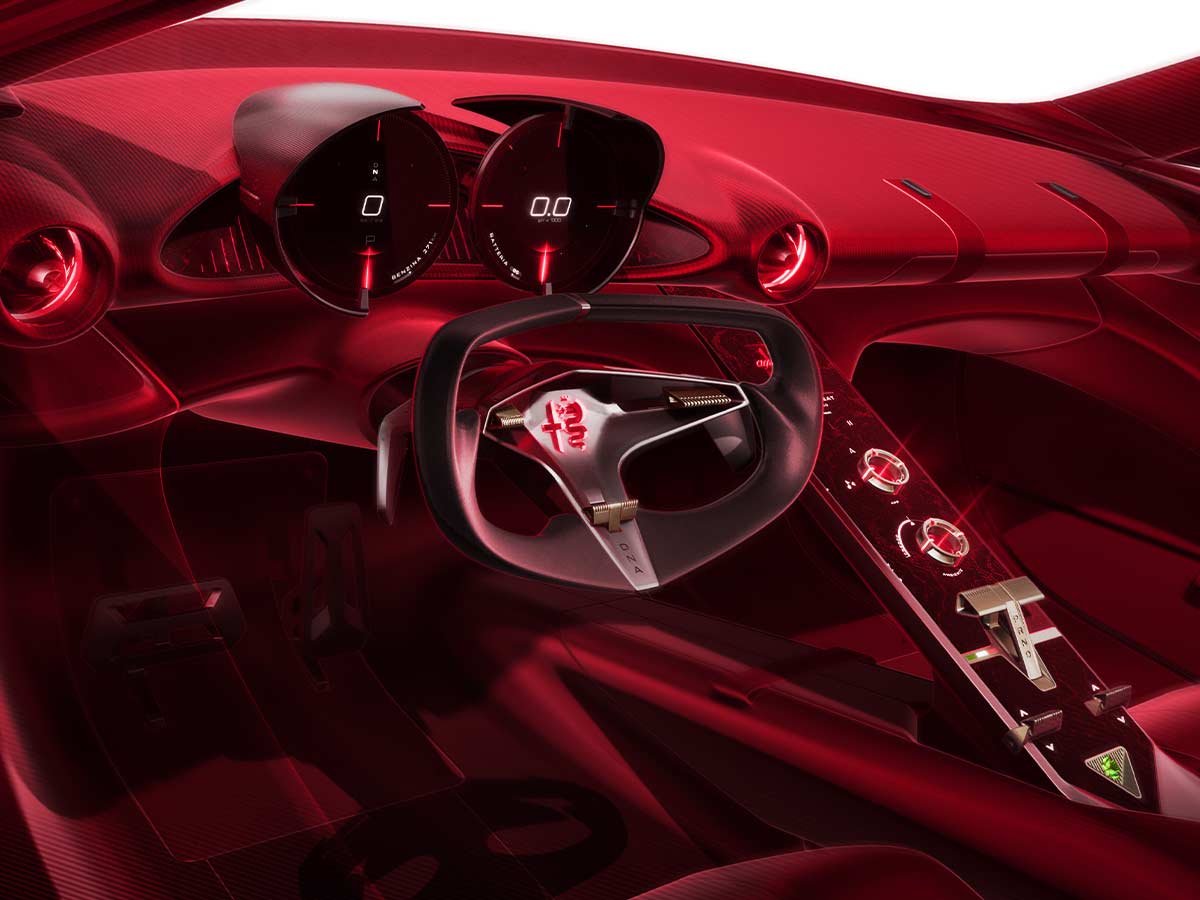
The dashboard takes inspiration from the architecture of the 1967 Alfa Romeo 33 Stradale and its modern counterpart.
Rather than using a visually heavy, upright dashboard structure, the Cuorerosso employs a thin horizontal arrangement that extends across the cabin and into the door panels. This creates an impression of continuity while emphasising lightness and technical precision.
The horizontal architecture also supports the concept’s driver-focused layout. Surfaces and controls are arranged to draw attention towards the main driving position without visually fragmenting the interior.
The reference to the 33 Stradale provides a connection to Alfa Romeo’s sports-car heritage, but the execution is not a simple retro recreation. The concept uses the historical inspiration as a starting point for a contemporary interpretation of cockpit ergonomics and digital interaction.
Cannocchiale Vivente: An instrument cluster that changes shape
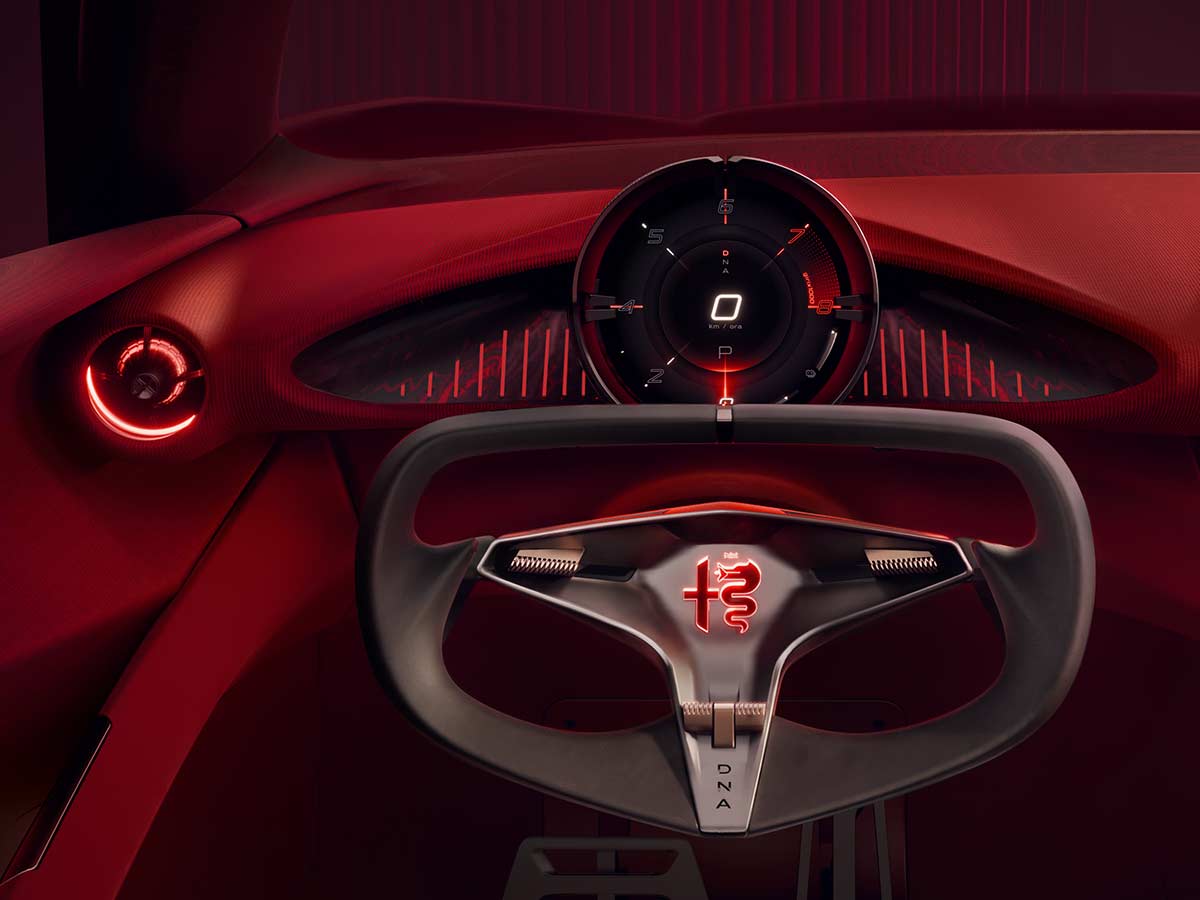
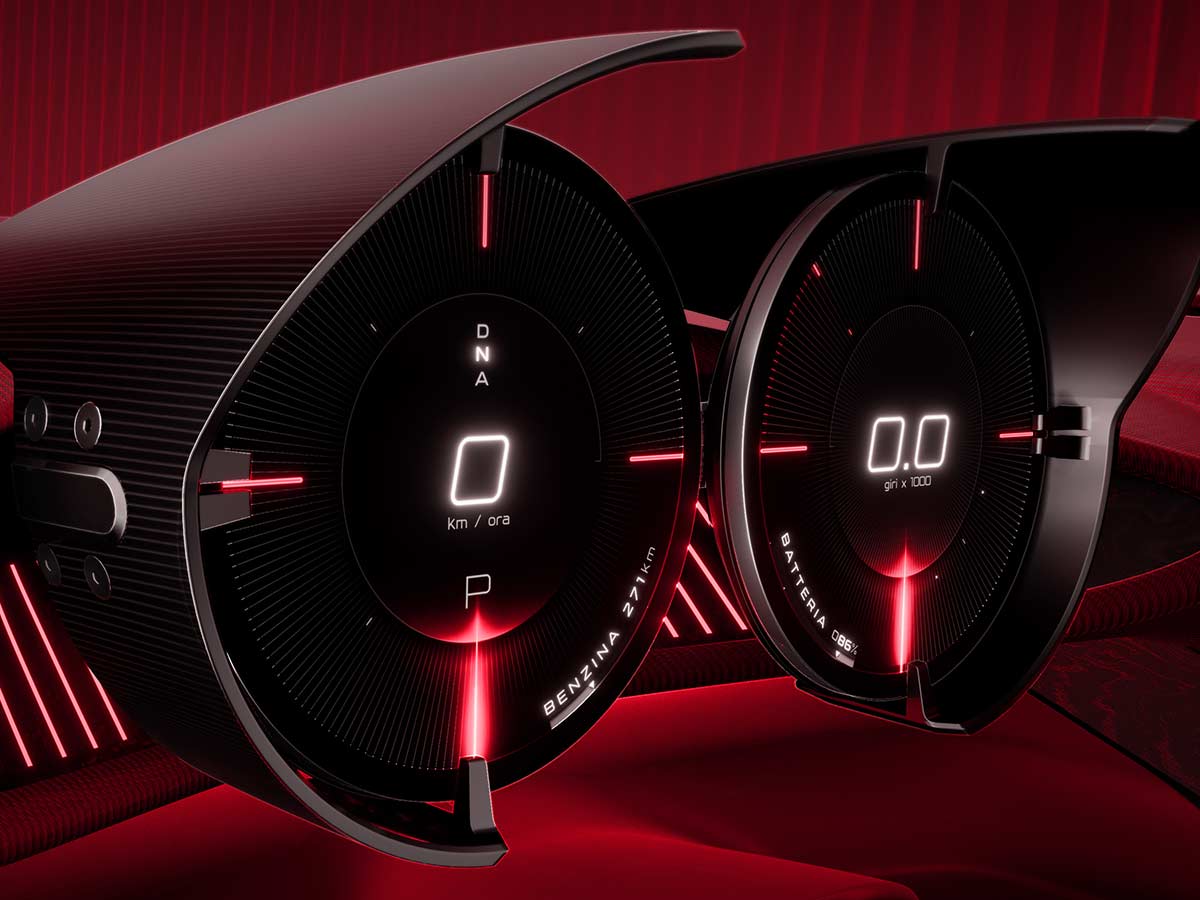
One of Cuorerosso’s most distinctive interior technologies is the Cannocchiale Vivente, or Living Telescope.
The name refers to an instrument arrangement that recalls a recognisable Alfa Romeo design feature. In the concept, the instrumentation is transformed into a dynamic interface with two physical configurations: Immersivo and Concentrato.
In Immersivo mode, the display retains its traditional two-element arrangement. In Concentrato mode, the two instrument sections physically merge into one, producing a simplified configuration inspired by the essential instrumentation found in historic racing cars.
The important distinction is that the system changes its physical presentation, rather than relying solely on a different graphic layout on a conventional screen.
This gives the concept a more tangible approach to digital interaction. The shape of the instrument display becomes part of the driving experience, reinforcing the idea that technology should respond to the driver’s level of engagement.
As driving involvement increases, the system progressively reduces the information presented, leaving only what is considered essential. The intention is to limit unnecessary distraction and keep the driver’s attention on the road.
The technology also has potential relevance beyond the concept itself. Alfa Romeo identifies the Stellantis STLA SmartCockpit digital platform as a possible direction for further development of this kind of interaction.
STLA SmartCockpit is described as a platform intended to provide an intuitive, personalised and evolving in-car experience while preserving the individual identity of each Stellantis brand.
Cruise, Sport and Quadrifoglio driving experiences
The concept provides three driving experiences: Cruise, Sport and Quadrifoglio.
These modes are designed to adjust the interaction between the car and its driver according to the level of engagement required. Their role therefore extends beyond simply assigning different names to driving settings.
The lighting system also responds to these configurations, becoming more restrained in Concentrato mode and adopting a more focused treatment in Quadrifoglio mode.
Four points of light in the air vents symbolically reference the Cross in the Alfa Romeo logo. This is another example of the concept’s attempt to make the vehicle’s identity part of the interaction between driver and machine.
The underlying principle is straightforward: a driving environment should be able to adapt to the task rather than forcing the driver to process the same volume of information in every situation.
Steer-by-Wire Steering and the Con-tatto Volante Concept
The Alfa Romeo Cuorerosso uses an electronically controlled steer-by-wire steering system, which allows the traditional mechanical steering arrangement to be reinterpreted.
In a steer-by-wire system, steering inputs are transmitted electronically rather than relying exclusively on a direct mechanical connection between the steering wheel and the road wheels. Such systems can provide greater flexibility in how steering response and feedback are calibrated, although their actual behaviour depends on the hardware, software and safety architecture.
The associated design principle is called Con-tatto Volante. It retains a strong physical and analogue component despite the electronic steering technology.
The steering wheel uses Alfa Romeo’s familiar three-spoke configuration, reinterpreted with a contemporary form. Haptic and acoustic feedback from the mechanical controls is intended to strengthen the driver’s sense of connection with the car.
This is an important part of the concept’s broader approach to electrification and digital technology. The aim is not to eliminate physical interaction, but to decide where it contributes most to the driving experience.
In this interpretation, steering remains a central point of contact between the driver and the vehicle. Electronic control offers new possibilities, while the design preserves tactile and audible cues intended to make the interface feel direct and involving.
Magma Display: Blending Digital Controls With Physical Switches
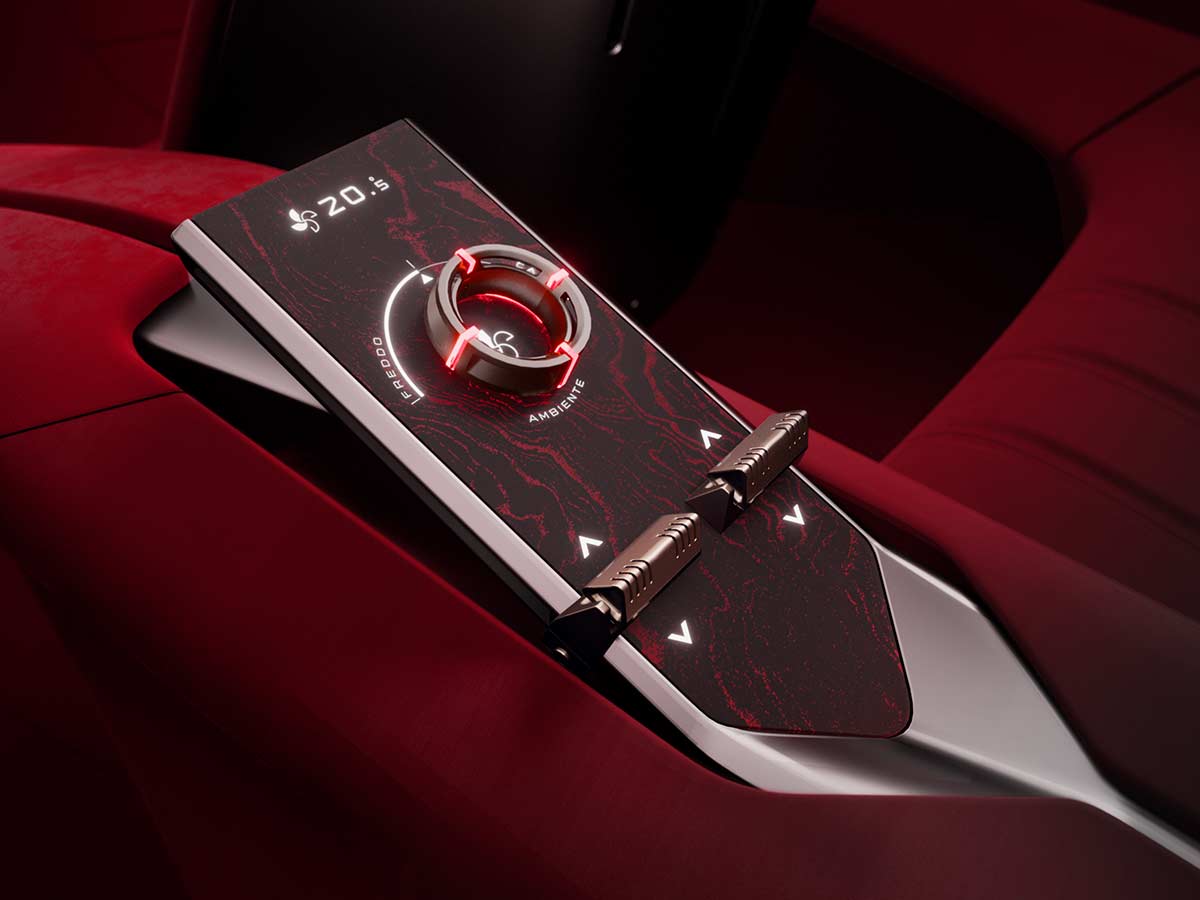
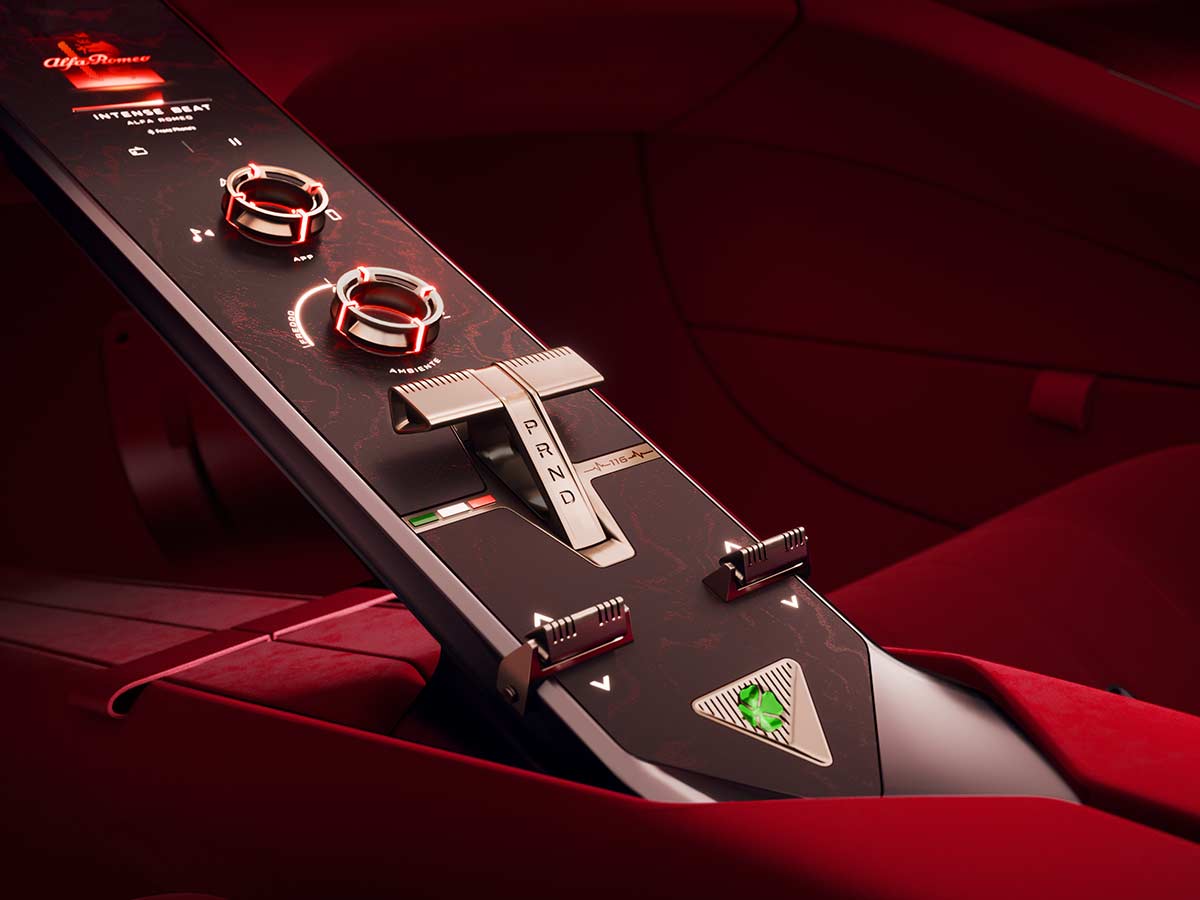
The Magma Display is the concept’s central control interface, positioned on the centre tunnel.
It combines a digital touch surface with a rotary dial, a drive-mode selector and toggle controls. Rather than moving every function onto a touchscreen, the arrangement mixes digital interaction with physical controls.
This distinction has practical significance. Touchscreens can accommodate changing interfaces, but physical controls provide tactile references that can be easier to locate without looking away from the road. A rotary dial or toggle can also provide a more defined physical action than touching a flat display.
The Cuorerosso’s approach is to retain both forms of interaction and use them where appropriate. The controls are intended to remain discreet until required, then become immediately accessible.
The centre console also contributes to the cabin’s overall shape, working with the ergonomic seats and longitudinal door-panel volumes to create a continuous, enveloping environment.
Its lighting follows the concept’s red visual theme. When activated, red light emerges through a surface texture inspired by magma and lava, making the console appear to glow from within.
Here, the illuminated surface is both a material treatment and part of the interface’s visual identity. It reinforces the relationship between the name Cuorerosso, the red colour palette and the idea of energy flowing through the vehicle.
Liquid Ink Red: Why Colour Is Central to the Concept
Red is one of the three central pillars of the Alfa Romeo Cuorerosso, alongside Italy and sportiness. In this concept, the colour is treated as a defining part of the vehicle’s identity rather than a conventional paint choice.
The exterior uses a new finish called Liquid Ink Red, created by combining a fine aluminium base with a transparent coloured layer.
According to Alfa Romeo, the combination gives the bodywork considerable visual depth. Light enters the surface and reflects from within, creating an appearance that shifts between liquid metal and incandescent lava.
The finish changes with the viewing angle. Under direct light, it appears intense and vibrant, while different angles can make the bodywork appear almost black.
This changing appearance complements the car’s sculptural form. The uninterrupted surfaces provide room for the paint to interact with light, allowing the same body panel to appear different as the observer moves around the vehicle.
The approach also connects the exterior to the interior, where red is used in materials, lighting and surface treatments to establish a consistent visual theme.
Inside the Cabin: Recycled Materials, Italian Craftsmanship and Sailing Technology
The interior’s material selection demonstrates how Bellezza Necessaria is intended to influence more than the arrangement of controls and surfaces.
The cabin combines nubuck, metals inspired by titanium, anthracite and gunmetal, and newer materials developed with an emphasis on function and tactile quality.
A particularly notable example is a regenerated leather material containing 60% post-industrial waste from the processing of premium upholstery. The material is intended to give existing resources another use without sacrificing the quality and sensory characteristics expected in the cabin.
The figure refers to the post-industrial waste content described by Alfa Romeo. It should not be interpreted as a claim that 60% of the entire interior, or even all of its leather components, consists of recycled material.
Poltrona Frau nubuck used where it matters most
The concept uses hand-finished Poltrona Frau nubuck in areas that come into direct contact with occupants.
This targeted application reflects the Necessary Beauty principle. Rather than covering every surface in the same premium material, the design concentrates tactile richness and craftsmanship where occupants are most likely to appreciate them.
The nubuck also receives a manually applied colour treatment that creates a shaded effect. Red becomes progressively more intense towards the driver and transitions into darker shades towards the rear.
This gradient is intended to express the concept’s emotional theme through the arrangement of materials, not just through decorative lighting or paint.
The leatherworking process also extends to the headrests, which use a complex construction technique previously tried on the Alfa Romeo 33 Stradale. Their detailing provides another link between traditional craftsmanship and the concept’s contemporary design language.
Materials inspired by high-performance ocean sailing
Alfa Romeo has also drawn on its technological collaboration with Luna Rossa, using experience from high-performance ocean sailing as inspiration for an interior material.
The dashboard features a lightweight, transparent and tensioned monofilament fabric derived from technical clothing used in sailing. The material is intended to combine lightness, resistance and functionality.
The choice brings together two different approaches to material development. Traditional automotive craftsmanship contributes tactile quality and visual warmth, while technical textiles introduce a more performance-oriented approach to weight and function.
This combination is consistent with the concept’s broader philosophy. Advanced materials are not intended to replace craftsmanship, but to work alongside it.
Recycled carbon fibre and red resins
Alfa Romeo is also experimenting with recycled carbon fibres combined with red resins to create new-generation composite materials.
The concept uses this research to explore a different visual and tactile expression of composite construction. Rather than leaving the material defined only by its technical appearance, the red resin contributes to a more organic aesthetic.
A removable bag integrated into the dashboard
One of the more unusual details is a removable bag integrated into the passenger-side dashboard area.
The bag can be taken out when leaving the car, while its securing straps double as a carrying handle. This turns the attachment system into a functional part of the accessory rather than an additional piece of hardware.
It is a small detail, but one that captures the logic behind Bellezza Necessaria particularly well. A component is expected to perform a defined function while fitting naturally into the overall design.
The bag also reflects Alfa Romeo’s attempt to connect automotive design with fashion and lifestyle. The relationship between the car’s interior and the objects used within it is treated as part of the overall experience rather than a separate consideration.
Lighting as a Functional Part of the Driving Experience
The Cuorerosso uses light to connect the exterior identity with the cabin’s interaction systems.
Outside, the triangular grille elements create a backlit pattern inspired by Alfa Romeo’s historic symbols. The welcome-light sequence extends that visual language to the driver’s approach to the car.
Inside, the red lighting emerges through textured surfaces, including the centre console. The effect is intended to suggest energy radiating from within the materials rather than being applied as a conventional decorative accent.
The lighting also communicates changes in driving configuration. In Concentrato mode, illumination is reduced to help limit potential distractions. In Quadrifoglio mode, selected elements are dimmed further, while four illuminated points in the vents reference the Cross symbol.
These details indicate an approach in which cabin lighting has more than one purpose. It reinforces the brand identity, creates a particular atmosphere and communicates aspects of the car’s operating state.
The same idea links the lighting to the Cannocchiale Vivente instrument display. Both systems are designed to reduce unnecessary visual activity when the driver needs to concentrate, while remaining part of a coherent interior design.
Alfa Romeo’s Multi-Energy Strategy: Electric, Hybrid and Performance Powertrains
The Cuorerosso also provides a broad outline of Alfa Romeo’s future powertrain philosophy. The brand intends to accommodate different energy solutions rather than define its future around a single propulsion system.
The proposed range could include:
- Full-electric powertrains, using electric motors as the primary means of propulsion.
- Plug-in hybrid powertrains, combining electric propulsion and an internal-combustion engine with the ability to recharge the battery externally.
- Mild-hybrid powertrains, using electrical assistance to support an internal-combustion engine.
- Full-hybrid powertrains, combining an engine and electric motor with a more substantial role for electric propulsion than a conventional mild-hybrid arrangement.
The intended flexibility is central to the strategy. Alfa Romeo wants future vehicles to meet different customer requirements without abandoning the brand’s emphasis on sportiness and driver engagement.
The brand also describes future architectures capable of supporting models up to 4.7 metres long, with the potential to accommodate Quadrifoglio versions.
This points to a range strategy in which the design and performance identity can be carried across multiple vehicle segments and powertrain types. Cuorerosso provides the visual and philosophical framework for that approach, rather than announcing a complete production roadmap.
The proposed 2.9-litre V6 full-hybrid configuration
For its most performance-focused interpretation, Alfa Romeo outlines a potential 2.9-litre V6 full-hybrid powertrain.
The proposed configuration combines the engine with Q4 all-wheel drive, a torque converter and a carbon-fibre driveshaft.
Each element has a distinct role in the broader mechanical concept. A V6 provides the internal-combustion component, while hybridisation introduces an electrical element to the propulsion system. Q4 denotes Alfa Romeo’s all-wheel-drive designation, and the torque converter forms part of the proposed transmission arrangement.
The carbon-fibre driveshaft is another performance-oriented detail. Such a component can be used in driveline applications where reducing component mass is a design objective.
Crucially, this is a potential powertrain configuration, not a confirmed production specification. Alfa Romeo has not supplied an output figure, torque rating, battery capacity, electric-only range, acceleration time or top speed for the proposed arrangement.
The combination nevertheless shows how the company is thinking about electrification in relation to its sporting identity. Rather than treating hybrid technology solely as a route to efficiency, the concept presents it as a possible means of supporting performance and driving engagement.
What Cuorerosso Says About the Future of Alfa Romeo
The Cuorerosso is significant because it brings several strands of Alfa Romeo’s future design thinking together in a single concept.
Its exterior establishes a direction based on sculptural surfaces, integrated details and recognisable brand cues. Its interior explores a combination of digital systems and physical controls, with the aim of keeping technology accessible without allowing it to dominate the driving experience.
The concept also shows how Alfa Romeo intends to preserve a distinct identity while accommodating a wider range of propulsion technologies.
That ambition is not limited to the powertrain. The use of recycled materials, sailing-inspired textiles, specialised leather finishes and carefully integrated controls suggests that the brand is also exploring how material choices and craftsmanship can contribute to a more coherent product experience.
At the same time, the concept should be understood within its stated role. It is neither a production-ready car announcement nor a guarantee that every displayed feature will appear in a future showroom model.
Its dimensions, weight, aerodynamic coefficient and named technologies establish a clear picture of the concept itself. Its proposed powertrain combinations and references to future platforms indicate areas of potential development, rather than confirmed specifications for a forthcoming vehicle.
That distinction is particularly important for prospective buyers and Alfa Romeo enthusiasts. Cuorerosso offers a useful indication of the design language and driving philosophy the company wants to pursue, but it does not yet provide the information required to evaluate a production car’s performance, price, practicality or ownership costs.
Conclusion: A Sporting Identity Beyond a Single Powertrain
The Alfa Romeo Cuorerosso concept presents a future in which Italian design, performance-oriented engineering and electrification are intended to reinforce one another. Its 2+2 coupé proportions, 0.28 drag coefficient, air suspension, carbon-ceramic brakes and adaptable cockpit make it a detailed exploration of that direction.
Its defining idea, however, is Bellezza Necessaria: the belief that design should remove the superfluous while giving every remaining component a clear purpose. From the sculptural exterior and Living Telescope instrument cluster to the recycled upholstery material and sailing-inspired dashboard fabric, the concept applies that principle across the vehicle.
The proposed multi-energy strategy is equally important. Alfa Romeo intends to preserve its sporting character across fully electric and hybrid powertrains, with the potential for future Quadrifoglio models and a high-performance 2.9-litre V6 full-hybrid configuration.
Cuorerosso does not answer every question about the cars that may follow, but it clearly establishes the values Alfa Romeo wants those cars to express: distinctive design, purposeful technology and an enduring connection between the driver and the machine.

Frequently Asked Questions About the Alfa Romeo Cuorerosso
Q: What is the Alfa Romeo Cuorerosso?
A: The Alfa Romeo Cuorerosso is a concept car unveiled at the 2026 Paris Motor Show. It is a design and technology manifesto exploring the brand’s future approach to styling, driver engagement, materials and electrification, rather than a preview of a specific production model.
Q: What are the dimensions of the Alfa Romeo Cuorerosso?
A: The Cuorerosso measures 4,700 mm long, 1,980 mm wide and 1,331 mm high, with a wheelbase of 2,930 mm. Alfa Romeo lists its weight at 1,750 kg.
Q: What is the drag coefficient of the Alfa Romeo Cuorerosso?
A: The concept has a stated aerodynamic drag coefficient of 0.28. Alfa Romeo attributes its aerodynamic approach to the uninterrupted body shape, truncated Coda Tronca tail and low diffuser integrated into the bodywork.
Q: What engine does the Alfa Romeo Cuorerosso have?
A: The supplied information does not establish a definitive engine specification for the physical concept car. Alfa Romeo describes a potential high-performance configuration using a 2.9-litre V6 full-hybrid powertrain, Q4 all-wheel drive, a torque converter and a carbon-fibre driveshaft.
Q: Is the Alfa Romeo Cuorerosso fully electric?
A: The Cuorerosso represents a multi-energy approach rather than a confirmed single-powertrain vehicle. Alfa Romeo’s future strategy is intended to accommodate full-electric, plug-in hybrid, mild-hybrid and full-hybrid solutions.
Q: What is Bellezza Necessaria?
Bellezza Necessaria, meaning Necessary Beauty, is Alfa Romeo’s design philosophy of removing unnecessary elements and giving each component a clear purpose. It brings aesthetics, functionality, technology, materials and craftsmanship together in one design language.
Q: What is the Cannocchiale Vivente in the Alfa Romeo Cuorerosso?
A: The Cannocchiale Vivente, or Living Telescope, is a dynamic instrument interface with two configurations. Immersivo retains a two-element arrangement, while Concentrato physically merges the two instrument sections into one simplified display.
Q: What is the Magma Display?
A: The Magma Display is the Cuorerosso’s central control interface, positioned on the centre tunnel. It combines a digital touch surface with a rotary dial, a driving-mode selector and toggle controls to balance digital functionality with tactile operation.
Q: Does the Alfa Romeo Cuorerosso have steer-by-wire steering?
A: Yes. The concept uses electronically controlled steer-by-wire steering and retains a physical, three-spoke steering wheel. Its Con-tatto Volante approach emphasises haptic and acoustic feedback to preserve a direct, tactile relationship between the driver and the car.
Q: What suspension and brakes does the Cuorerosso use?
A: The concept features air suspension and a Brembo carbon-ceramic braking system with dedicated Alfa Romeo calipers. Alfa Romeo has not provided detailed suspension calibration or braking-performance figures in the supplied material.
Q: What materials are used in the Alfa Romeo Cuorerosso interior?
A: The interior combines Poltrona Frau nubuck, metals in titanium-inspired, anthracite and gunmetal shades, a regenerated leather material containing 60% post-industrial upholstery-processing waste, and a lightweight monofilament dashboard fabric inspired by high-performance ocean sailing. Alfa Romeo is also experimenting with recycled carbon fibre combined with red resins.
Q: What is Liquid Ink Red?
A: Liquid Ink Red is the Cuorerosso’s exterior colour finish. It combines a fine aluminium base with a transparent coloured layer to create visual depth and an appearance that changes with the viewing angle, ranging from vibrant red to nearly black.
Q: Will the Alfa Romeo Cuorerosso enter production?
A: The Cuorerosso is explicitly described as a manifesto rather than an advance preview of a specific production model. It is intended to inspire future Alfa Romeo vehicles, but the supplied material does not confirm production plans for the concept itself.
Q: Will future Alfa Romeo models have Quadrifoglio versions?
A: Alfa Romeo’s stated future vision includes the potential for Quadrifoglio versions within a multi-energy line-up. This indicates an intention to preserve the brand’s high-performance identity, but it does not confirm specific models, launch dates or powertrain specifications.
Q: What is the significance of the Cuorerosso name?
A: Cuorerosso combines the Italian words cuore, meaning heart, and rosso, meaning red. The name represents the concept’s two central themes: emotional connection with the driver and the sporting passion associated with Alfa Romeo.
Source: Alfa Romeo