






There is a moment on a fast coastal road when an SUV reveals whether it is merely practical or genuinely desirable. The steering loads up, the horizon begins to move quickly, and the car has to shrink around its driver rather than feel like a tall, heavy object being persuaded into a corner.
That is the test Polestar has set for the 2026 Polestar 4 SUV.
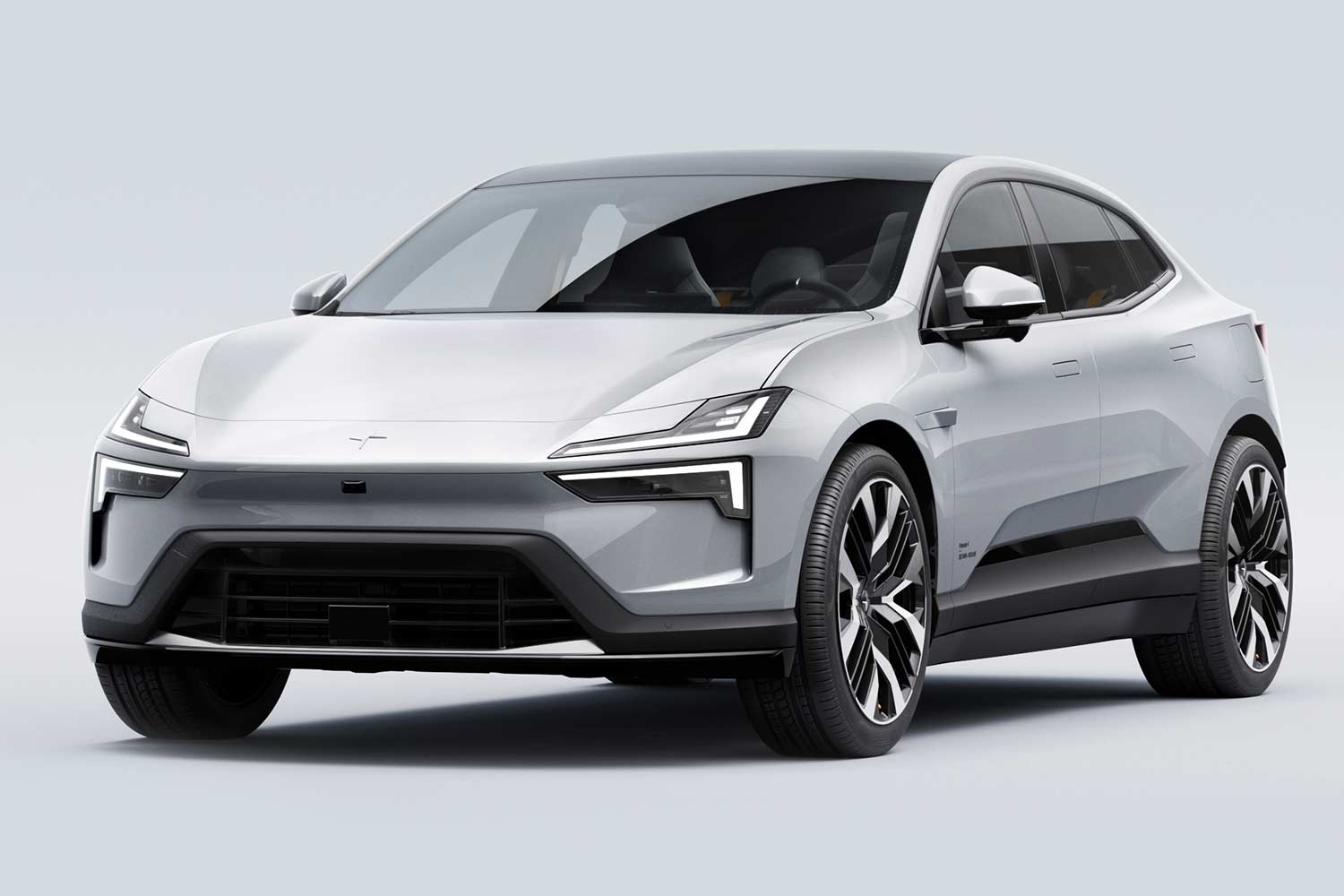
This is not simply a Polestar 4 coupé with a larger boot. The new SUV variant takes the same SEA architecture, electric performance philosophy and minimalist Scandinavian design language, then stretches them toward a more useful proposition. It gains a more upright rear end, additional headroom, roof rails and substantially greater cargo flexibility without abandoning the chassis tuning that has made the Polestar 4 one of the more dynamically interesting cars in its class.
The result is a compact executive electric SUV that occupies an increasingly important middle ground: more practical than a performance coupé, considerably sharper than the average family EV, and priced from EUR 57,900 in Germany. In its most potent form, it produces 544 hp, 686 Nm and 0-100 km/h in 3.9 seconds. Yet the quieter achievement may be the Rear motor version, which can travel up to 630 km on the WLTP cycle.
>>> Great Discounts on Car & Bike Accessories <<<
Polestar 4 SUV: What You Need to Know
- Model: 2026 Polestar 4 SUV
- Powertrains: Rear motor or Dual motor all-wheel drive
- Maximum output: 400 kW / 544 hp
- Maximum torque: 686 Nm
- 0-100 km/h: 3.9 seconds in Dual motor specification
- Maximum WLTP range: 630 km in Rear motor specification
- Battery: 100 kWh
- DC charging: Up to 200 kW
- Cargo capacity: Up to 1,665 litres
- Roof load: Up to 100 kg dynamically
- V2L: Up to 3.3 kW
- Starting price: EUR 57,900 in Germany
- Production: Busan, South Korea
- First deliveries: Fourth quarter of 2026
The Polestar 4 SUV Is More Than a Practical Polestar 4
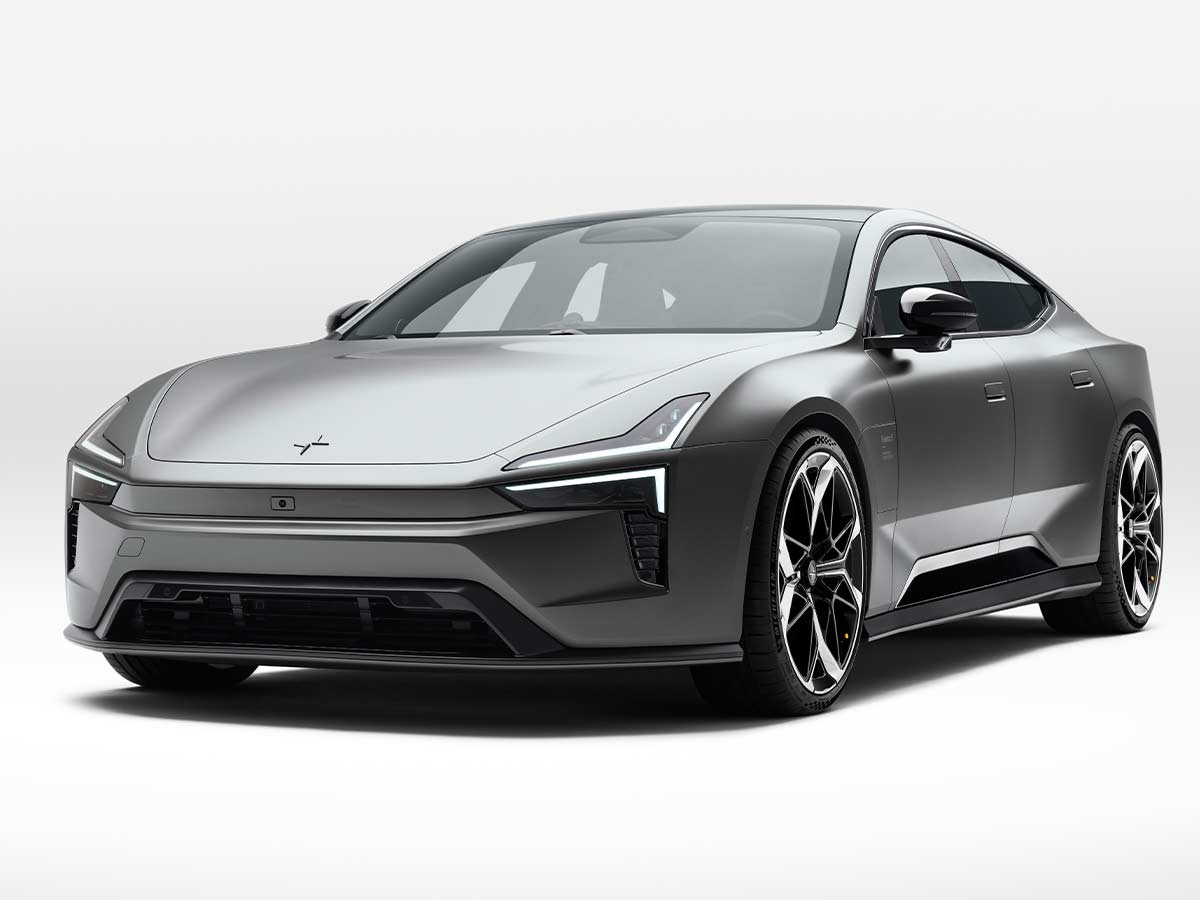
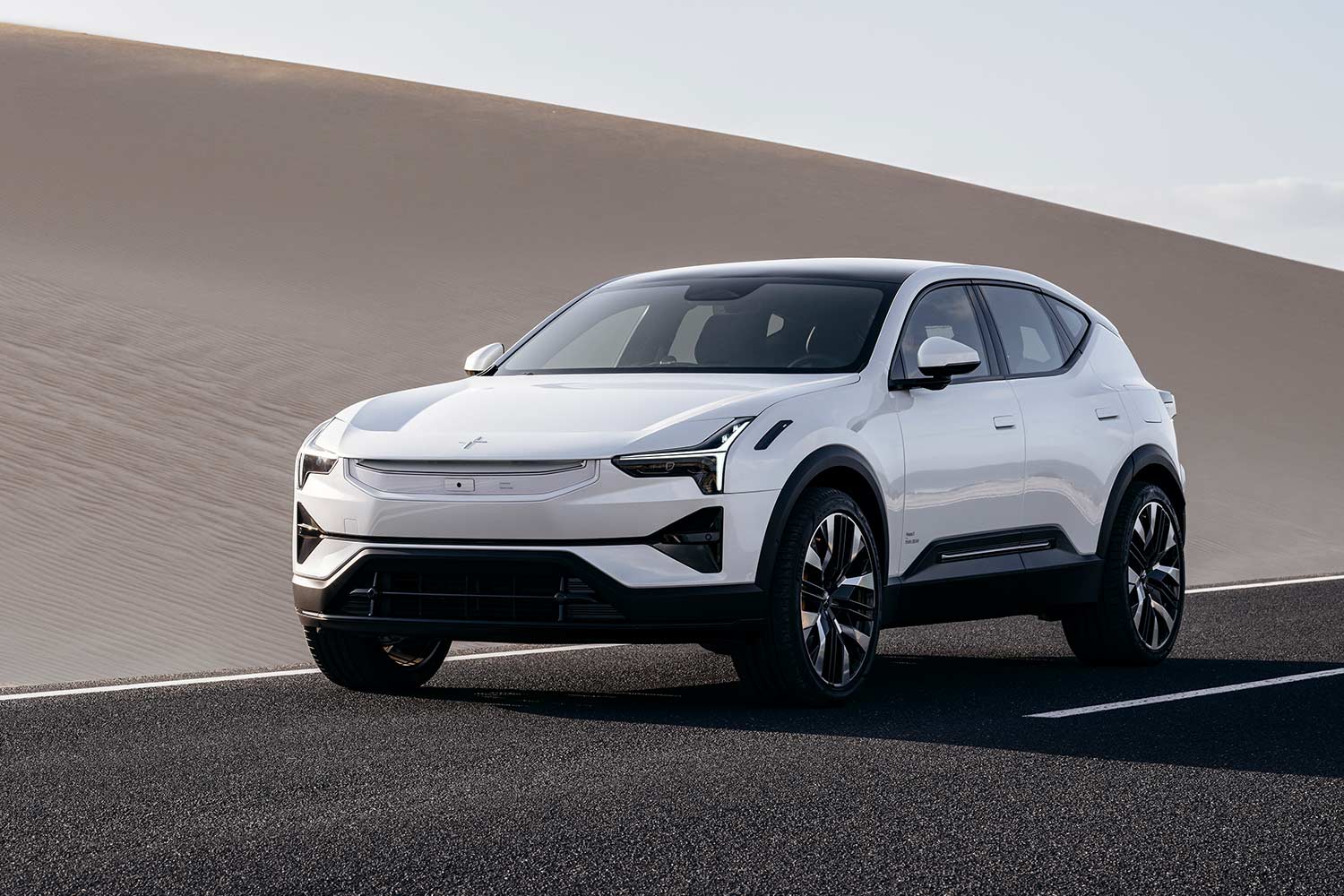
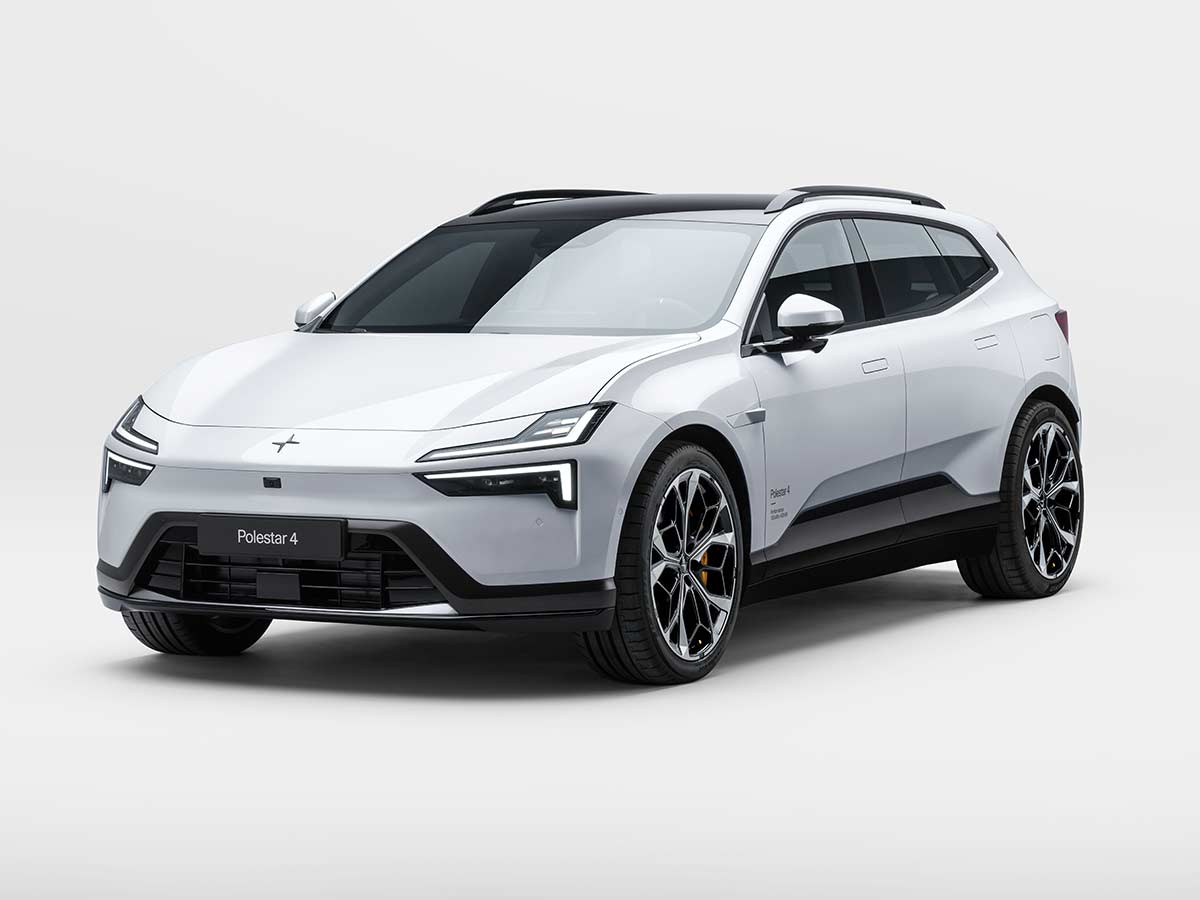
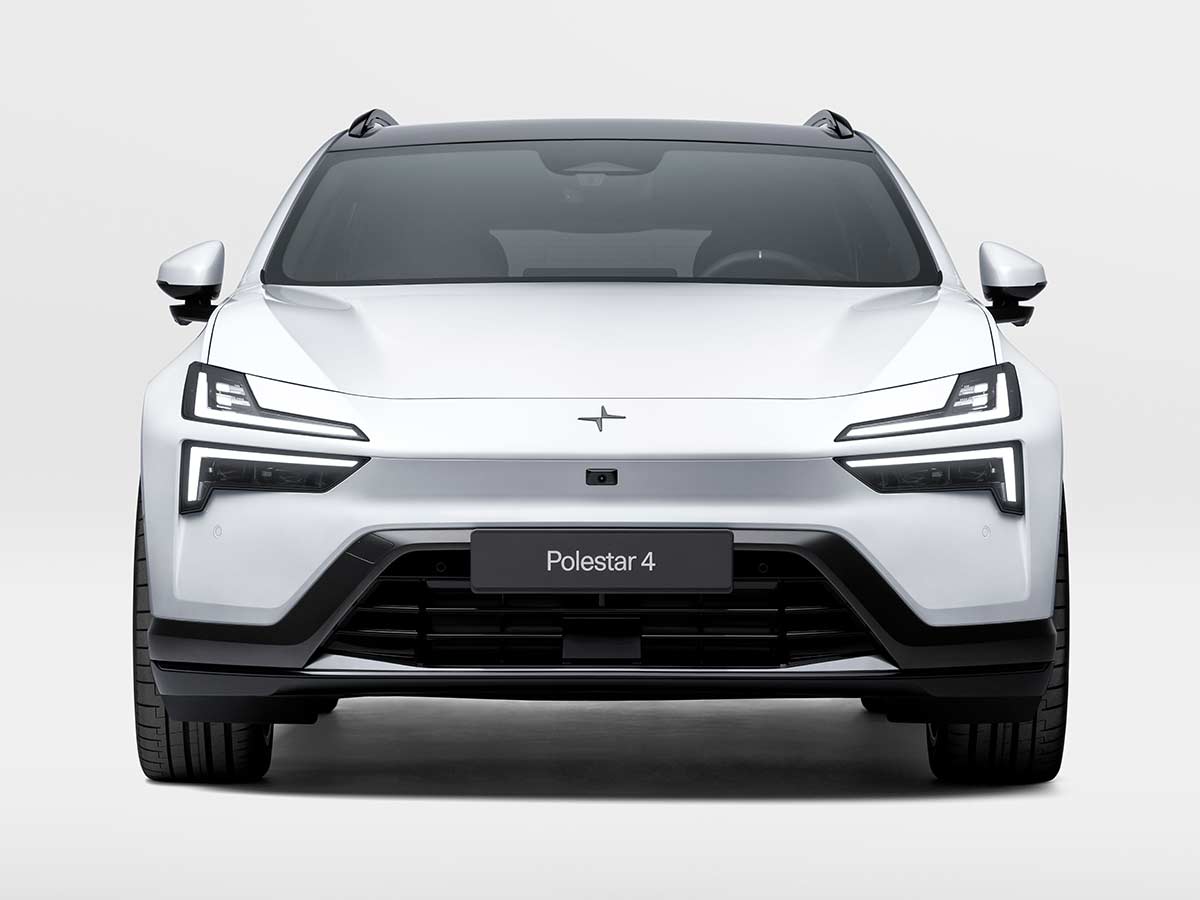
The fundamental character remains recognisably Polestar. The nose retains the marque’s distinctive dual-blade headlights and illuminated logo, while the body continues to carry the taut, almost architectural surfaces that distinguish the Polestar 4 coupé.
But walk around to the rear and the engineering brief becomes obvious.
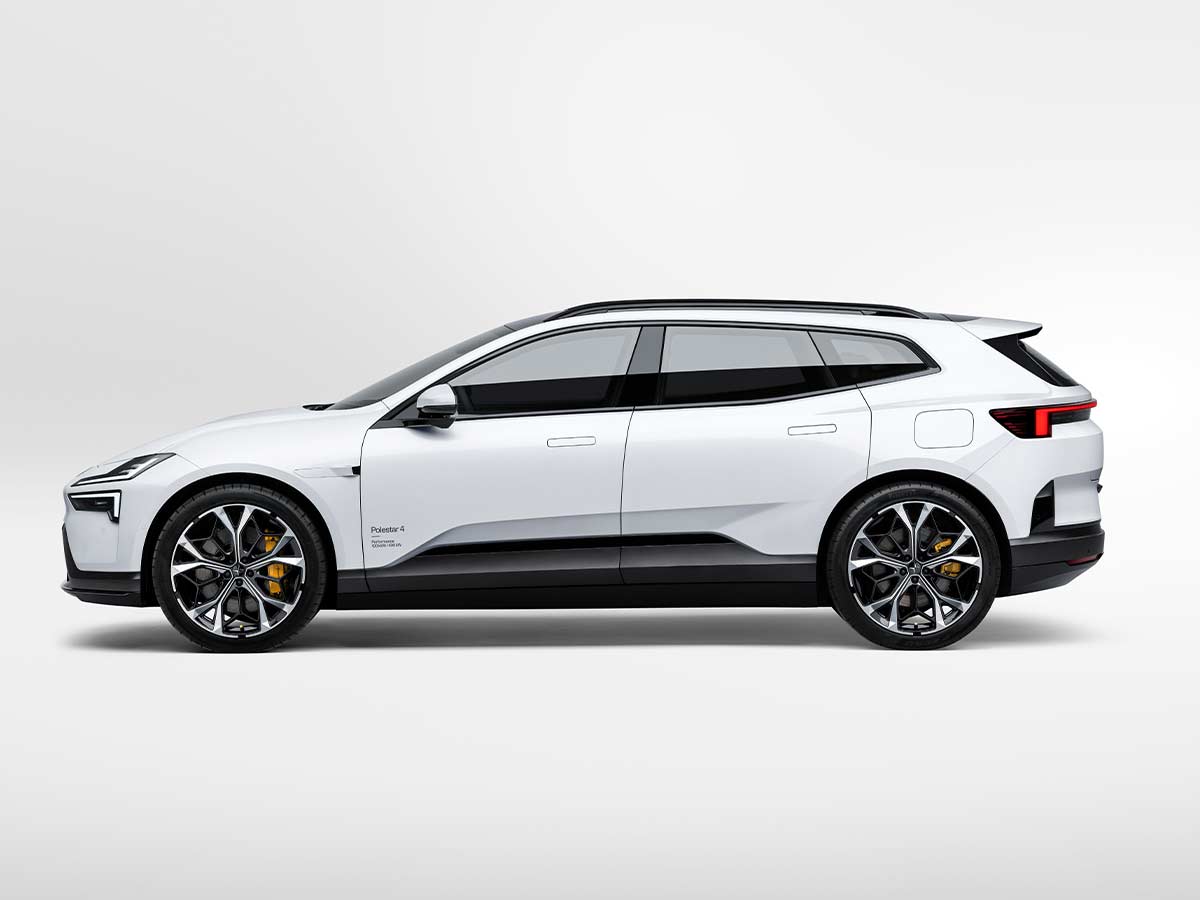
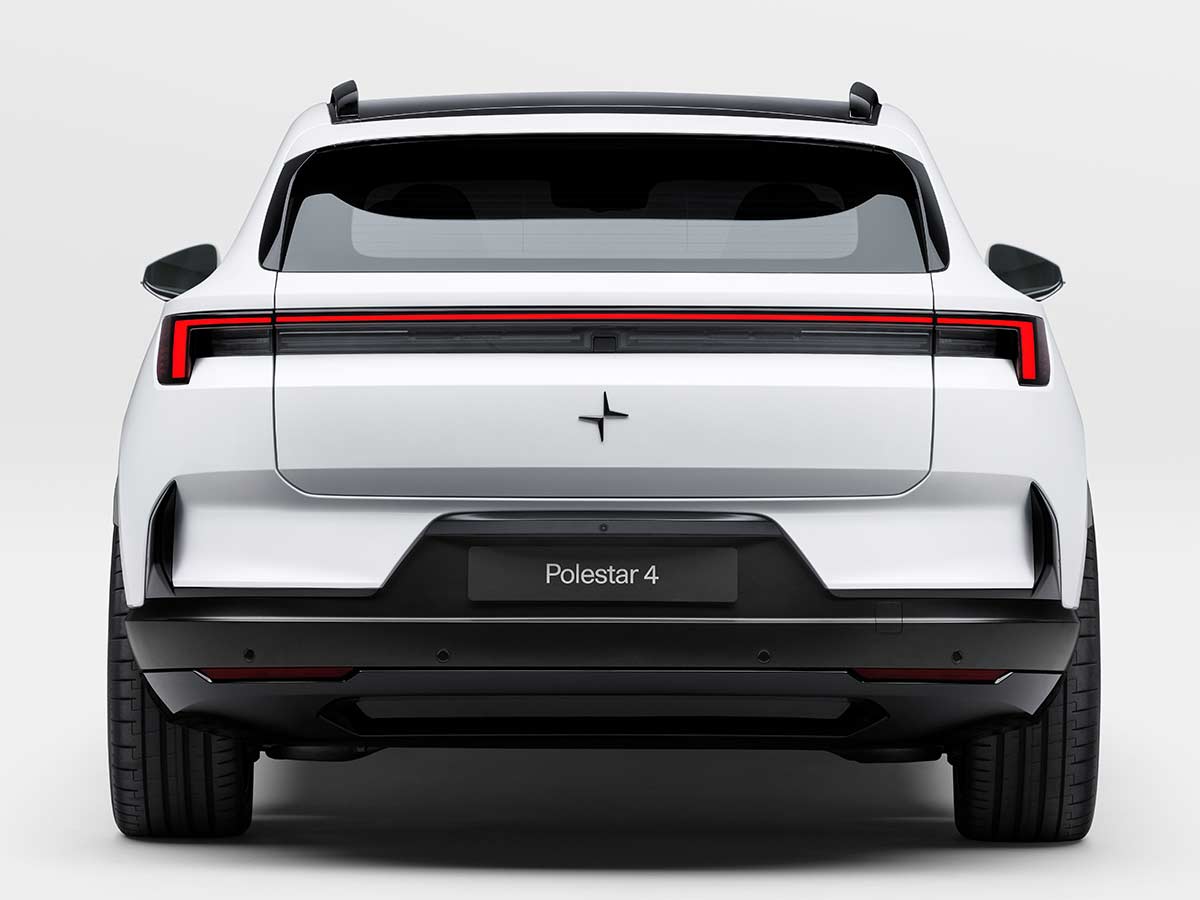
The roofline is straighter. The tailgate is more upright. Full-length roof rails turn the roof from a styling surface into useful equipment, with a dynamic load capacity of 100 kg. The transformation is subtle enough that the SUV retains the visual tension of its coupé sibling, but significant enough to make it a different kind of machine.
That distinction matters.
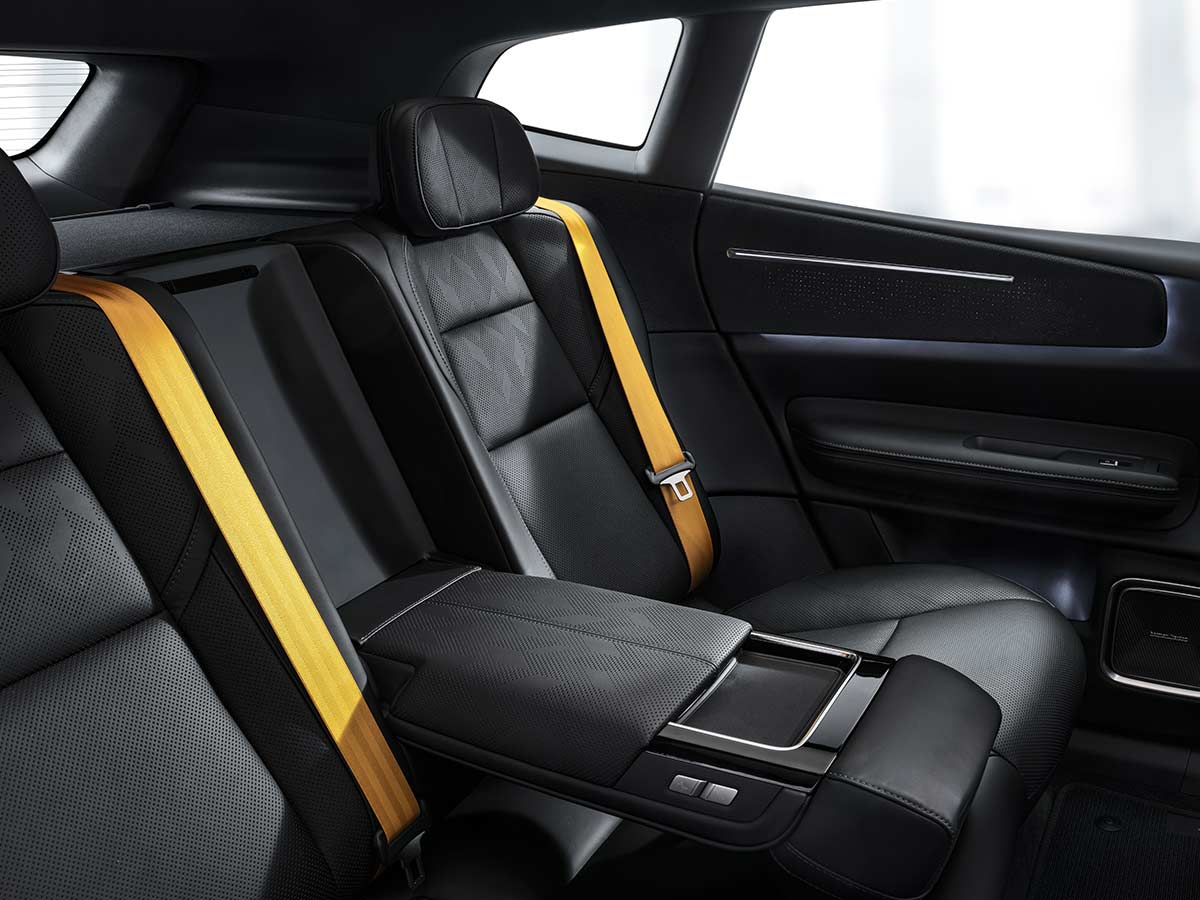
The Polestar 4 SUV is aimed at buyers who want electric performance without treating everyday practicality as a compromise. Its rear seats gain another 2.5 cm of headroom, while the new panoramic glass roof stretches farther toward the tailgate. The result should feel particularly convincing from the second row, where the coupé’s visual drama can otherwise come at the expense of airiness.
The standard glass roof provides 99.5 percent UV protection. An optional electrochromic roof goes further, allowing occupants to vary the amount of light entering the cabin electronically. Fully transparent, fully tinted or selectively shaded sections can be chosen through the centre display.
It is an unusually sophisticated solution to a very simple problem: sometimes you want the sky, and sometimes you do not.
1,665 Litres of Cargo Space Changes the Equation
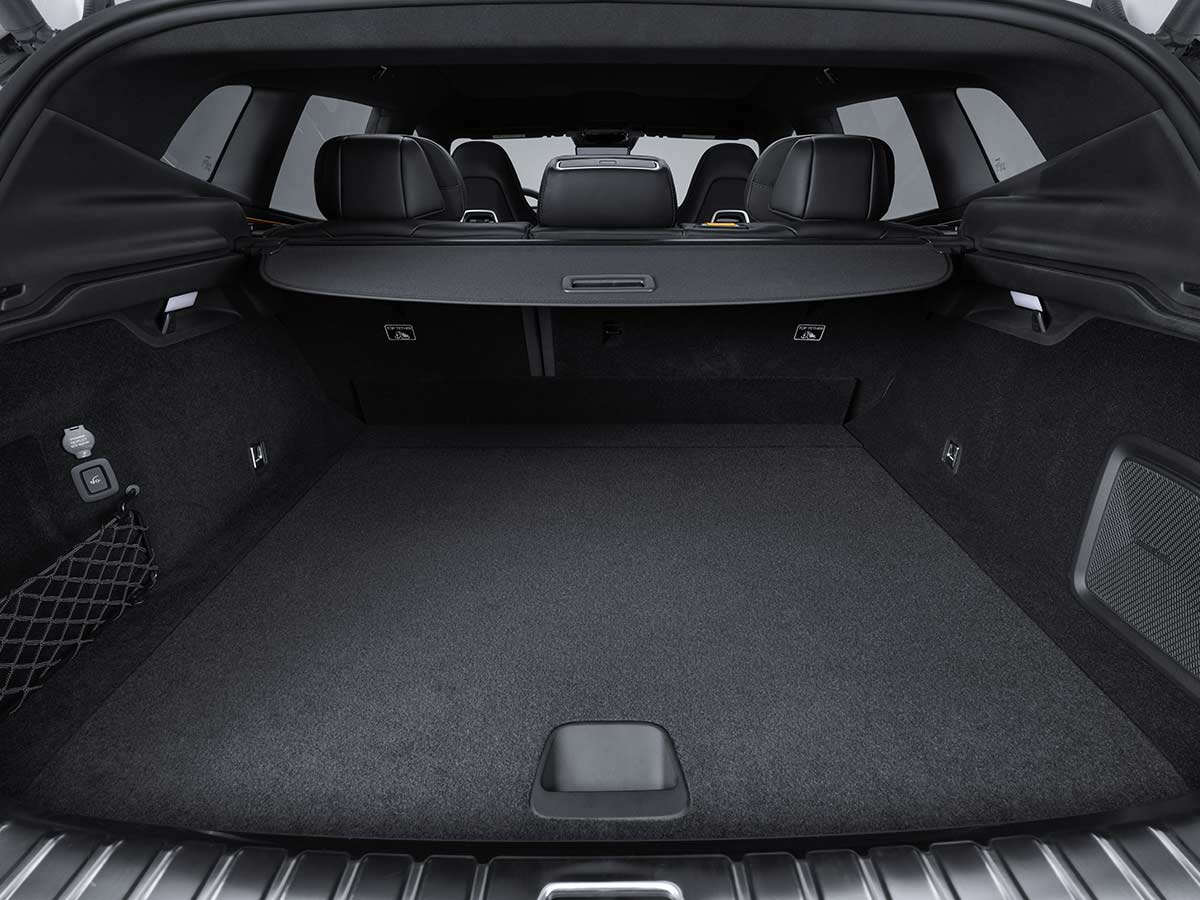
The most consequential change is behind the rear seats.
The Polestar 4 SUV offers 530 litres of rear luggage space measured to the seatbacks, increasing to 655 litres when measured to the inner roof. Fold the 60/40-split rear seats and total luggage capacity rises to 1,665 litres.
There is additional storage at the front, taking total versatile storage to 1,680 litres.
This is where the SUV earns its badge rather than merely wearing it.
The figures place genuine utility alongside the performance credentials. Roof rails add another layer of flexibility, while the more upright tailgate makes loading bulky objects considerably more natural than in a low-slung performance crossover.
For buyers comparing electric premium SUVs, this is arguably more significant than another tenth shaved from a 0-100 km/h sprint.
Dual Motor or Rear Motor: Which Polestar 4 SUV Makes More Sense?
There are two distinct personalities within the range.
The Polestar 4 SUV Dual motor is the obvious choice for those who regard performance as non-negotiable. Its two-motor all-wheel-drive system produces 400 kW, equivalent to 544 hp, and 686 Nm of torque. It reaches 100 km/h from rest in just 3.9 seconds, while its WLTP range extends to 600 km.
That is serious pace for an SUV designed to carry luggage, passengers and a roof box.
Yet the Rear motor Polestar 4 SUV is arguably the more intriguing specification. With 200 kW, or 272 hp, and 343 Nm, it is slower at 7.3 seconds to 100 km/h, but its maximum WLTP range rises to 630 km.
For long-distance drivers, that trade is compelling. The rear-drive car retains enough performance to feel properly brisk while extracting more distance from the same 100 kWh battery.
Both versions use the same fundamental battery architecture, with DC charging capability of up to 200 kW. AC charging can reach 22 kW in selected markets, although market-specific charging capability varies.
The important point is that Polestar has not treated the less powerful model as an afterthought. It is a different interpretation of the same car.
The Chassis Is Where the Polestar 4 SUV Earns Its Badge
Electric SUVs have become remarkably quick. Far fewer have become genuinely satisfying to drive.
Polestar’s answer is chassis calibration.
The Polestar 4 SUV shares its chassis specification with the recently updated Polestar 4 coupé. Its suspension tuning is designed to combine long-distance refinement with steering precision and responsive handling. That is a difficult balance because an electric SUV has to contend with considerable mass, substantial battery packaging and a high level of body rigidity.
The goal here is not simply to make the car feel fast in a straight line. It is to give the driver a sense of connection when the road begins to twist.
For buyers who want the sharpest version, the Performance pack brings recalibrated active dampers supplied by ZF, high-performance Brembo brakes and a new 22-inch wheel wrapped in Pirelli P Zero performance tyres.
And then there are those unmistakable Swedish-gold details.
The Performance pack’s seatbelts and rotary control knob carry Polestar’s signature gold treatment, while the Brembo callipers provide a visual reminder that this is not merely an appearance package. The hardware is there to deal with the demands created by the SUV’s substantial electric performance.
The specification is reminiscent of the philosophy that has made performance versions of cars such as the BMW iX, Porsche Macan Electric and Tesla Model Y Performance so interesting: the real differentiator is no longer simply how much power an EV can produce, but how intelligently that power is integrated into the chassis.
Polestar’s ambition is clear. The 4 SUV should feel like a driver’s car that happens to have an unusually large rear compartment.
A Cabin That Treats Technology as Architecture
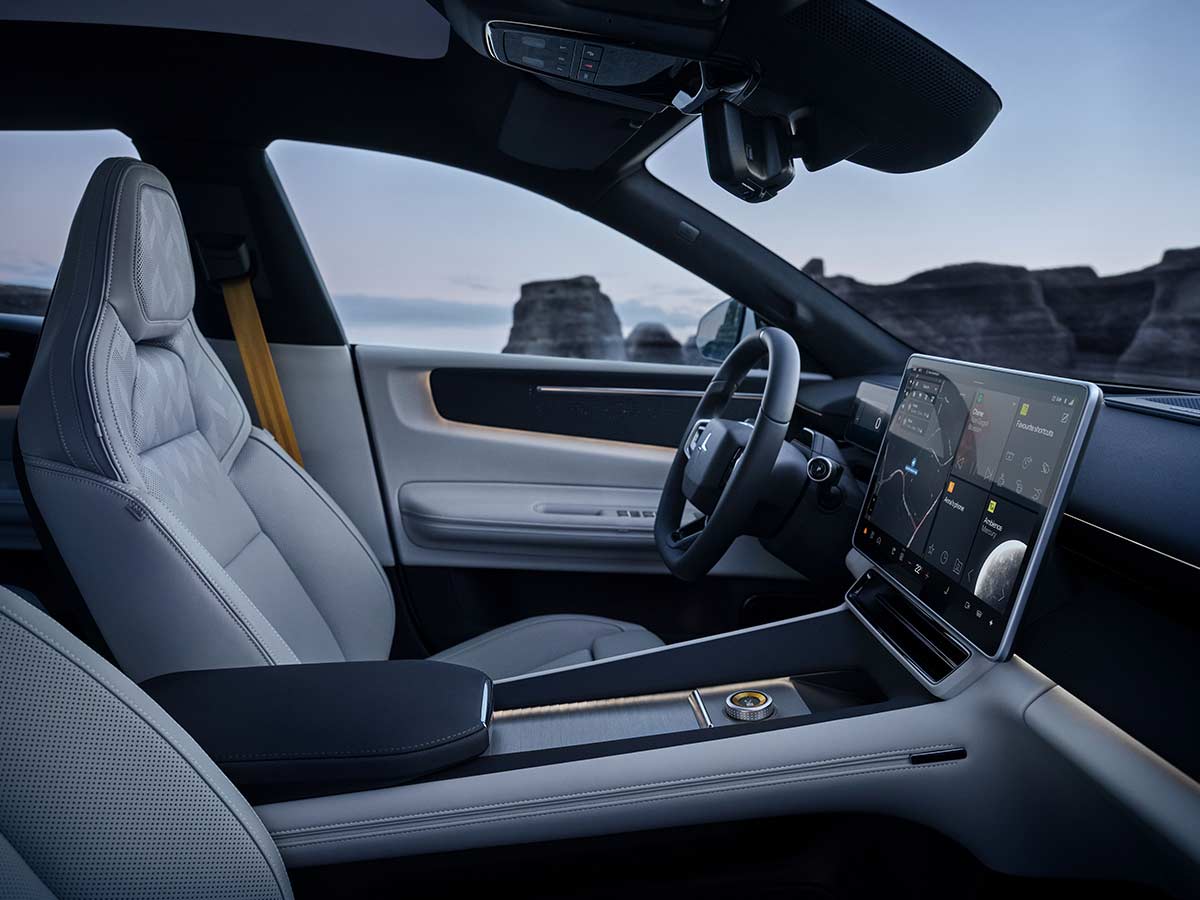
Inside, the Polestar 4 SUV remains resolutely Scandinavian.
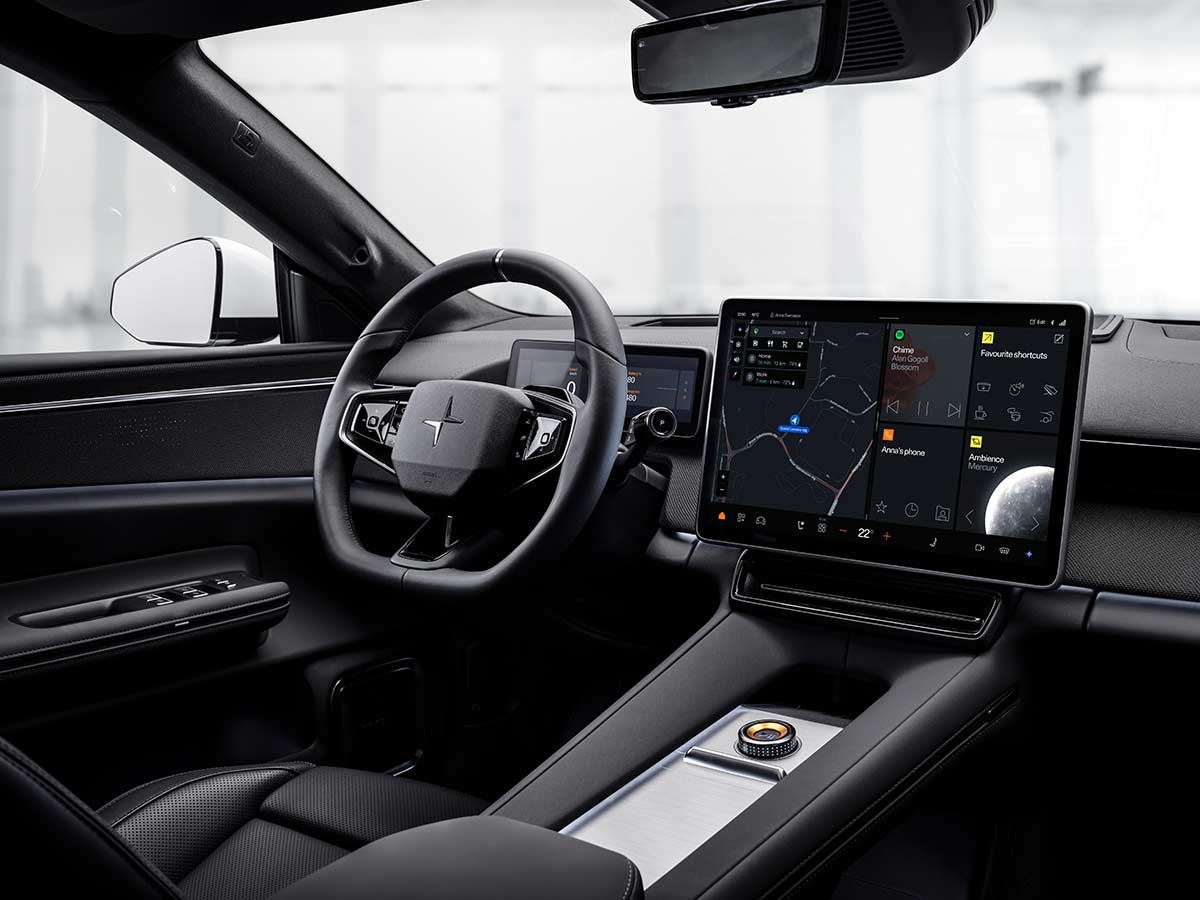
There is little interest in button-heavy ornamentation. Instead, the cabin is organised around a landscape-oriented central display and a separate driver display, with an expanded shortcut system increasing the number of widgets from six to nine.
It sounds like a small software revision. In practice, details such as these determine whether a modern car feels intuitive or merely technologically impressive.
The atmosphere is more theatrical than the minimalist surfaces initially suggest. Polestar’s ambient lighting draws inspiration from the solar system, allowing occupants to select different cosmic themes. Combined with the Star Knit decorative treatment, the effect should be particularly striking after dark.
An optional Harman Kardon Premium Sound system adds 12 speakers and a 1,400-watt channel-hybrid amplifier, specifically tuned for the SUV.
Even the upholstery is part of the larger engineering story. Standard bio-attributed MicroTech uses a backing made from 100 percent recycled PET, while its PVC surface contains 53 percent bio-attributed content. The optional Tailored Knit upholstery is 3D-knitted from 89 percent recycled PET, a manufacturing process intended to reduce waste.
For those who still want traditional luxury, Bridge of Weir Nappa leather is available. It is chrome-free, derived as a by-product of the food industry and fully traceable to its origin.
This is luxury presented less as ornament and more as material provenance.
The Rear View Is Finally, Deliberately Conventional
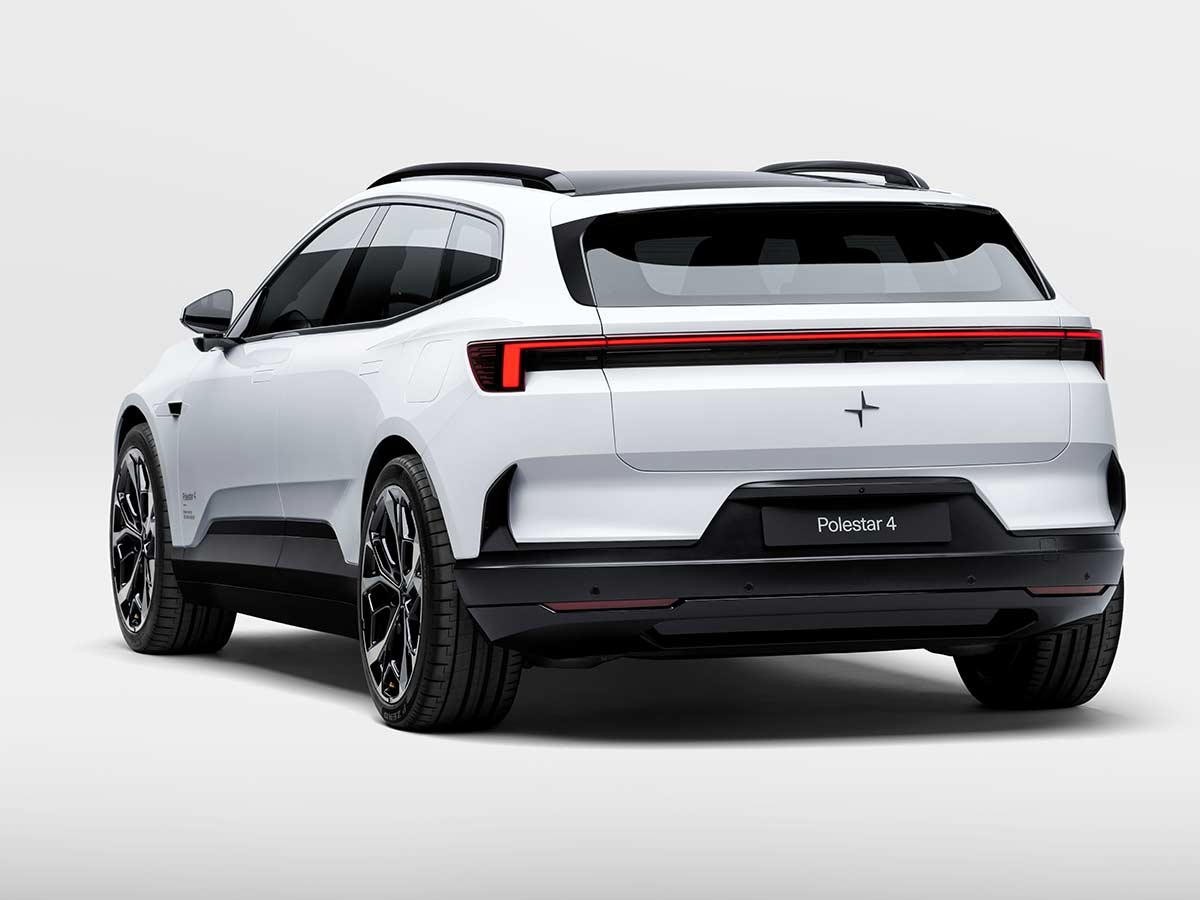
One of the more curious aspects of the original Polestar 4 coupé was its approach to rear visibility. The SUV changes that equation.
The Polestar 4 SUV has a conventional rear window and conventional rear-view mirror as standard, giving passengers and drivers a direct visual connection to the road behind. Those who prefer the broader, unobstructed field of view offered by a digital system can still specify the digital rear-view mirror.
It is a sensible evolution. With the luggage compartment fully loaded, the digital mirror can preserve visibility that a conventional mirror might lose, while the standard arrangement gives the SUV the familiar visual behaviour expected by drivers coming from conventional vehicles.
V2L Turns the Polestar 4 SUV Into a Power Source
The most interesting utility feature may not be the boot at all.
Vehicle-to-Load, or V2L, allows the Polestar 4 SUV’s high-voltage battery to supply AC electricity to external equipment. The system can provide up to 3.3 kW at 16A and 230V through a certified adapter.
That means camping equipment, power tools, lighting and consumer electronics can draw energy directly from the vehicle.
It changes the relationship between car and destination. The Polestar no longer stops being useful when the wheels stop turning.
The accompanying Camping mode pushes that idea further. With the SUV parked, the cabin can become a climate-controlled environment with access to entertainment, ambient lighting and vehicle controls through the front and rear displays. USB-C connections, a 12V outlet and V2L functionality complete the setup.
For an electric SUV, this is more than a lifestyle gimmick. It demonstrates a broader shift in how manufacturers can think about a vehicle’s battery: not merely as a reservoir that gets the car from A to B, but as an energy asset that can remain useful once the journey is over.
Google Gemini Brings AI Into the Driver’s Seat
The other major change is digital rather than mechanical.
Google Gemini is integrated into the Polestar 4 SUV through Google built-in, replacing conventional command-style voice interaction with a more conversational AI experience.
The distinction is important. Traditional voice assistants expect a command. Gemini is designed to understand context and multi-turn dialogue, allowing more natural interactions.
Through Gemini Live, the system can also assist with brainstorming, trip planning and real-time translation.
The ambition is therefore not simply to make voice control more sophisticated. It is to make the vehicle’s interface less dependent on rigid phrasing.
Whether that becomes genuinely transformative will ultimately depend on how naturally drivers can use it in real-world conditions. But the direction is unmistakable: the next generation of automotive interfaces is moving away from menus and commands toward conversation.
One of Polestar’s Lowest-Carbon Cars
Performance and sustainability are often presented as opposing ideas. Polestar’s approach is to interrogate the manufacturing footprint instead.
The Polestar 4 SUV has a cradle-to-gate carbon footprint of 21.1 tCO2e in Dual motor form and 20.2 tCO2e in Rear motor specification, making it one of the lowest-carbon vehicles in the Polestar line-up.
Several measures contribute to those figures. Battery cell production uses 100 percent renewable electricity. Aluminium sourced from smelters powered by renewable electricity accounts for 34 percent of total aluminium content, while 23 percent of the aluminium is recycled.
The significance lies in where the reductions occur. An electric vehicle’s environmental footprint is not simply determined by what comes out of its exhaust pipe, because there is no exhaust pipe. Battery production, aluminium and upstream energy remain substantial parts of the equation.
Polestar’s effort to reduce those inputs gives the 4 SUV’s sustainability story considerably more substance than a collection of recycled-material talking points.
Polestar 4 SUV Price and Availability
The 2026 Polestar 4 SUV starts at EUR 57,900 in Germany for the Rear motor version. The Dual motor model starts at EUR 65,900, while the Performance pack version starts at EUR 76,300. These are German base prices including VAT and excluding handover fees.
Production has already begun in Busan, South Korea, with manufacturing starting during the second quarter of 2026. First customer deliveries are planned for the fourth quarter of 2026.
At these prices, the Polestar 4 SUV enters a competitive field that includes premium electric SUVs from BMW, Porsche, Mercedes-Benz and Tesla. Its proposition is distinctive because it does not try to win solely on outright acceleration or battery size.
Instead, it combines performance-car dynamics, Scandinavian design, substantial luggage capacity, long-range capability and an increasingly sophisticated software ecosystem.
Verdict: The Polestar 4 SUV Makes the Sensible Choice Feel Irresponsibly Interesting
The great achievement of the Polestar 4 SUV is that practicality has not diluted its personality.
The Dual motor version is genuinely rapid, with 544 hp and a 3.9-second 0-100 km/h time. The Rear motor version is the range specialist, capable of up to 630 km on the WLTP cycle. Both versions carry a 100 kWh battery, and both benefit from a chassis developed with the driver’s involvement in mind.
Then there is the other side of the equation: 1,665 litres of luggage capacity, extra rear headroom, roof rails, V2L, Camping mode and an increasingly capable Google-based digital experience.
That combination makes the Polestar 4 SUV difficult to pigeonhole. It is not as overtly extravagant as some luxury electric SUVs, nor is it trying to mimic a conventional family crossover. It occupies a more interesting territory between the executive express and the adventure-ready utility vehicle.
And perhaps that is exactly the point.
On paper, the Polestar 4 SUV is a collection of sensible decisions: more space, more range, more utility, more usable technology. On the road, its success will be measured differently. The question is whether all that added capability still leaves room for the small, irrational thrill that makes a performance car worth owning.
Polestar’s answer is yes.
The 4 SUV is an electric performance car that has learned how to carry the weekend with it.
Source: Polestar