




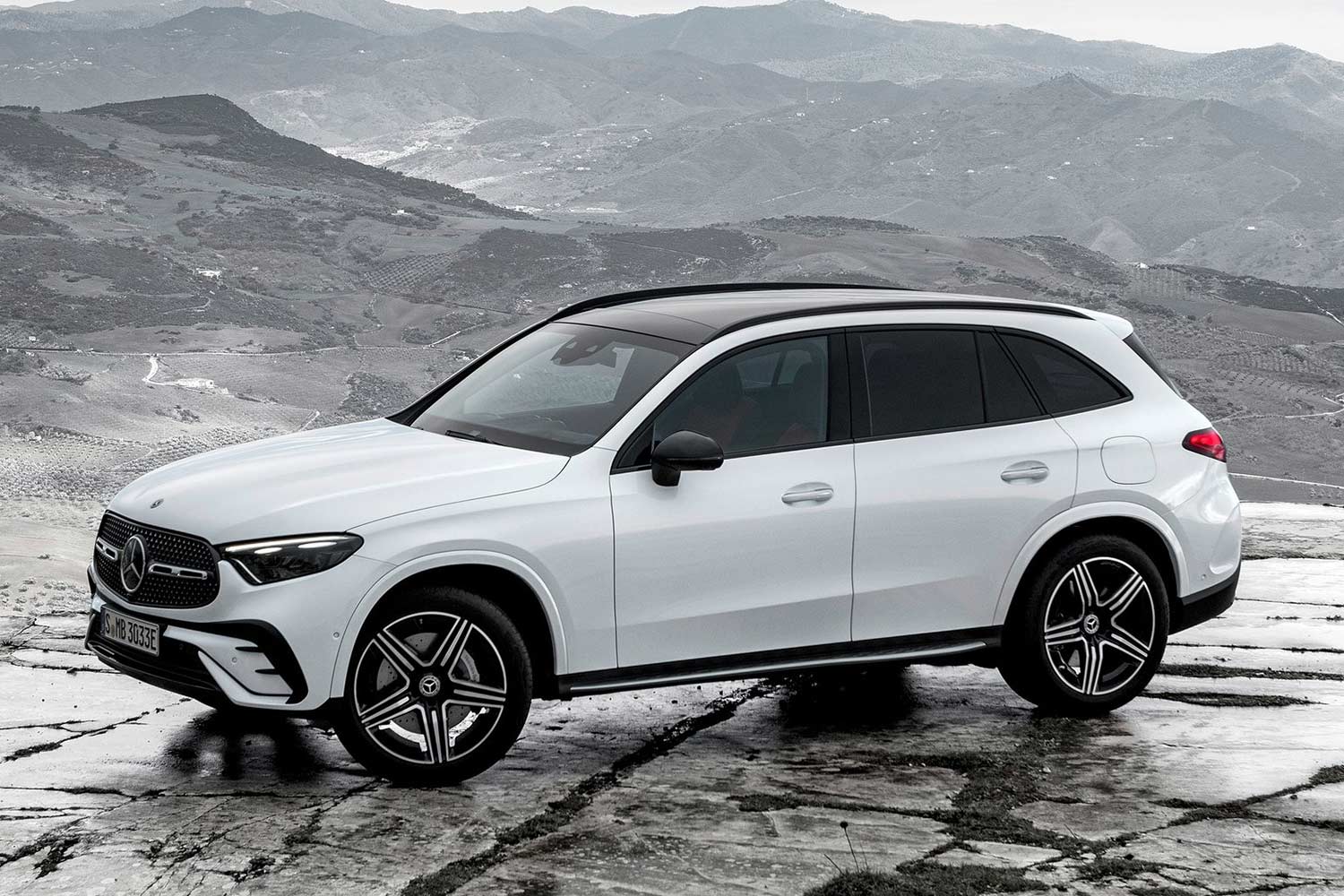








New engines, an AI-powered operating system, cloud-connected dampers, and a redesigned face give the flagship Mercedes-Benz SUV its most substantial refresh in years. Here is every single detail that matters.
>>> Great Discounts on Car & Bike Accessories <<<
Overview: What Has Actually Changed on the 2026 GLS
Mercedes-Benz officially revealed the refreshed GLS on 31 March 2026 — the same week the brand marked 140 years of continuous automotive production. The timing was clearly intentional. There are few models better suited to that occasion than the GLS, a vehicle that has occupied the very top of the Mercedes-Benz SUV range for two decades and carries the weight of the S-Class nameplate by design rather than coincidence.
This is a facelift, not a generation change, but it is a thorough one. Mercedes-Benz has touched the powertrain, the suspension technology, the driver assistance hardware and software, the exterior design, the display architecture, the interior trim, the air filtration system, and the lighting. Virtually every system in the vehicle has received some degree of attention, which makes the GLS feel considerably more contemporary than the model it replaces.
The headline additions are the MB.OS operating system — the same AI-powered platform developed for the new S-Class and CLA — the standard-fit MBUX Superscreen with passenger display, cloud-based AIRMATIC damper control, and a revised exterior that borrows the upright bonnet star from the S-Class. Underneath, a comprehensively updated engine range now includes an electrically heated catalyst on both diesel variants and a restructured V8 prepared for forthcoming emissions legislation.
For buyers of previous-generation GLS models, the technological leap in the cabin will be immediately apparent. For those cross-shopping against the BMW X7 or Range Rover, the new GLS arrives with a convincingly modernised argument. And for anyone who simply wants the most comfortable large SUV money can buy without crossing into Rolls-Royce Cullinan territory, the updated GLS continues to be the benchmark.
Here is a quick summary of the key changes at a glance:
- Revised engine range across all four variants, with V8 output rising to 395 kW
- MB.OS AI operating system with over-the-air updates
- MBUX Superscreen with passenger display now standard
- Cloud-based AIRMATIC damper control using Car-to-X data
- Upright bonnet star (illuminated in China and the USA)
- New micro-LED DIGITAL LIGHT headlamps standard, with 40% larger light field
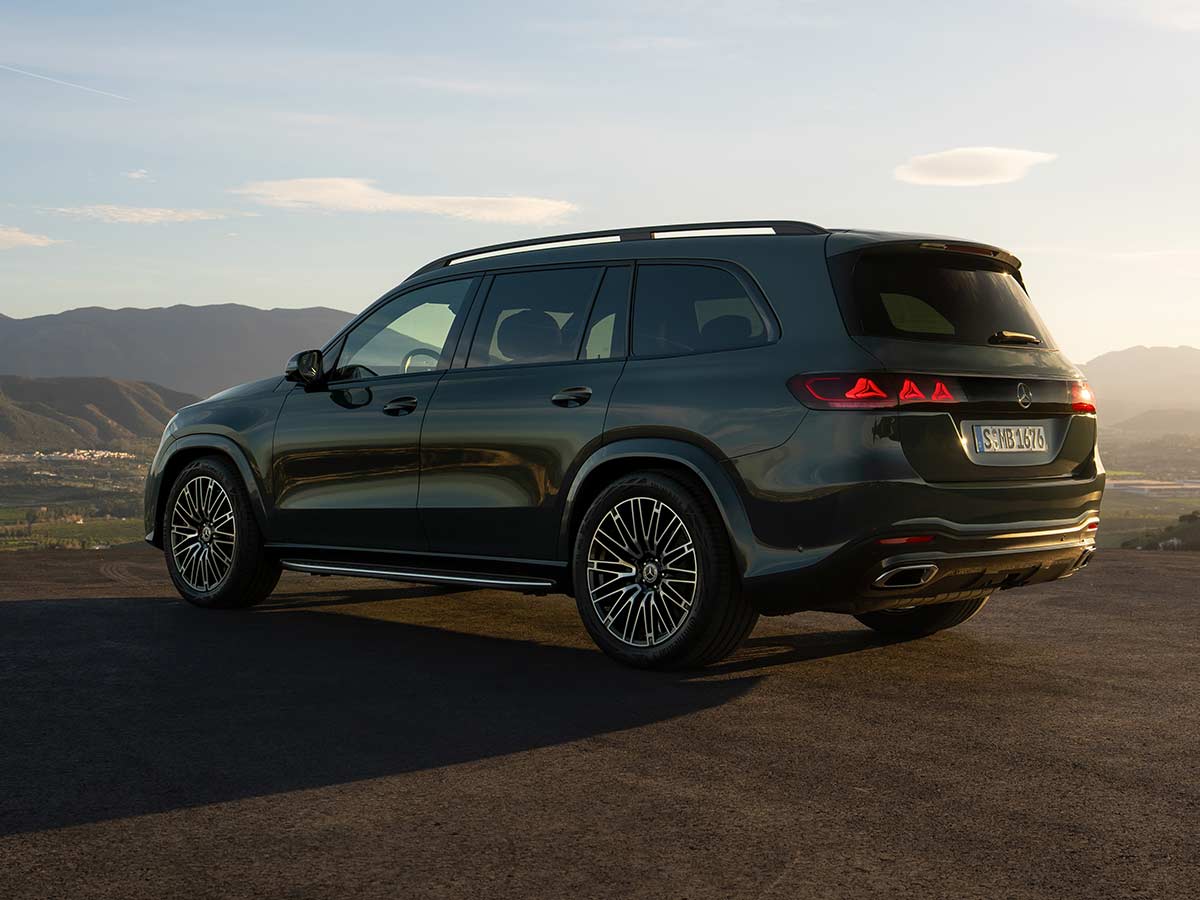
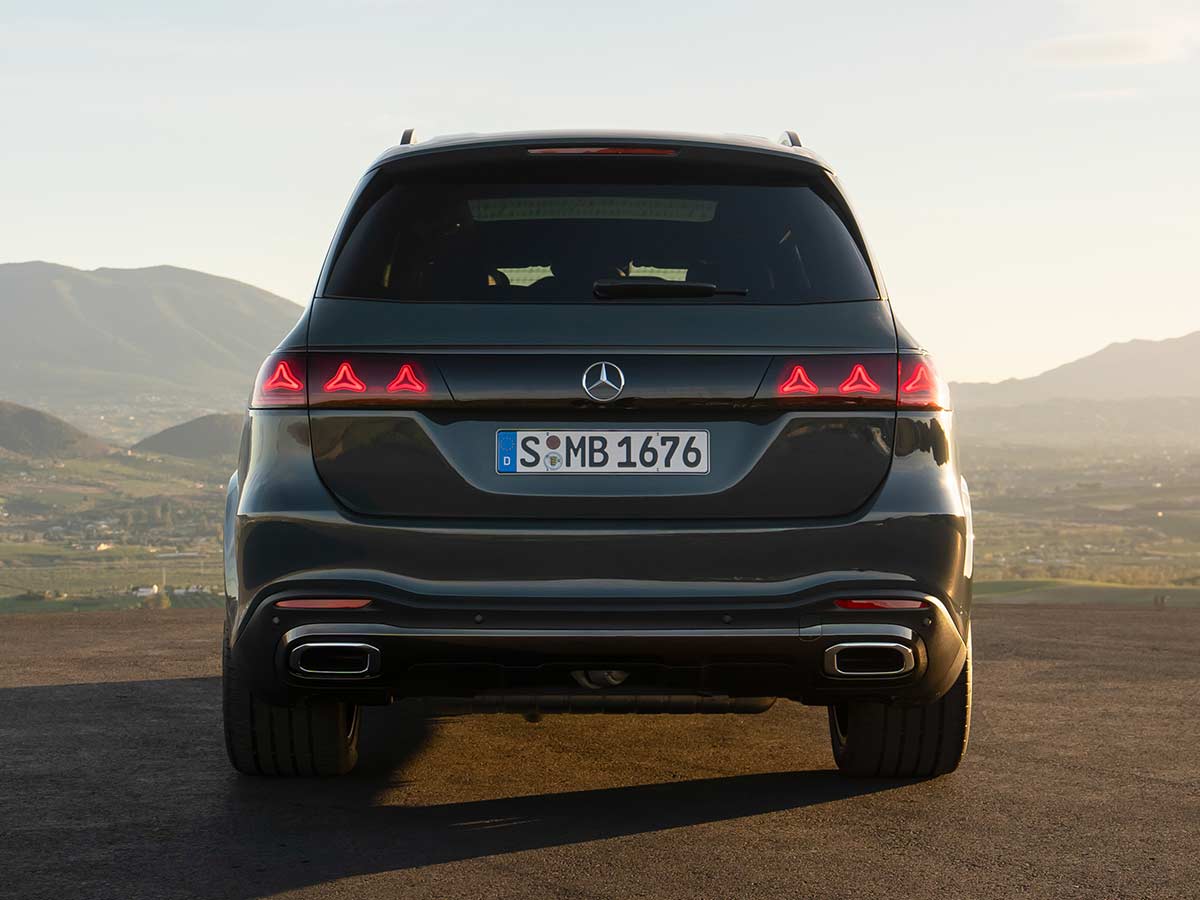
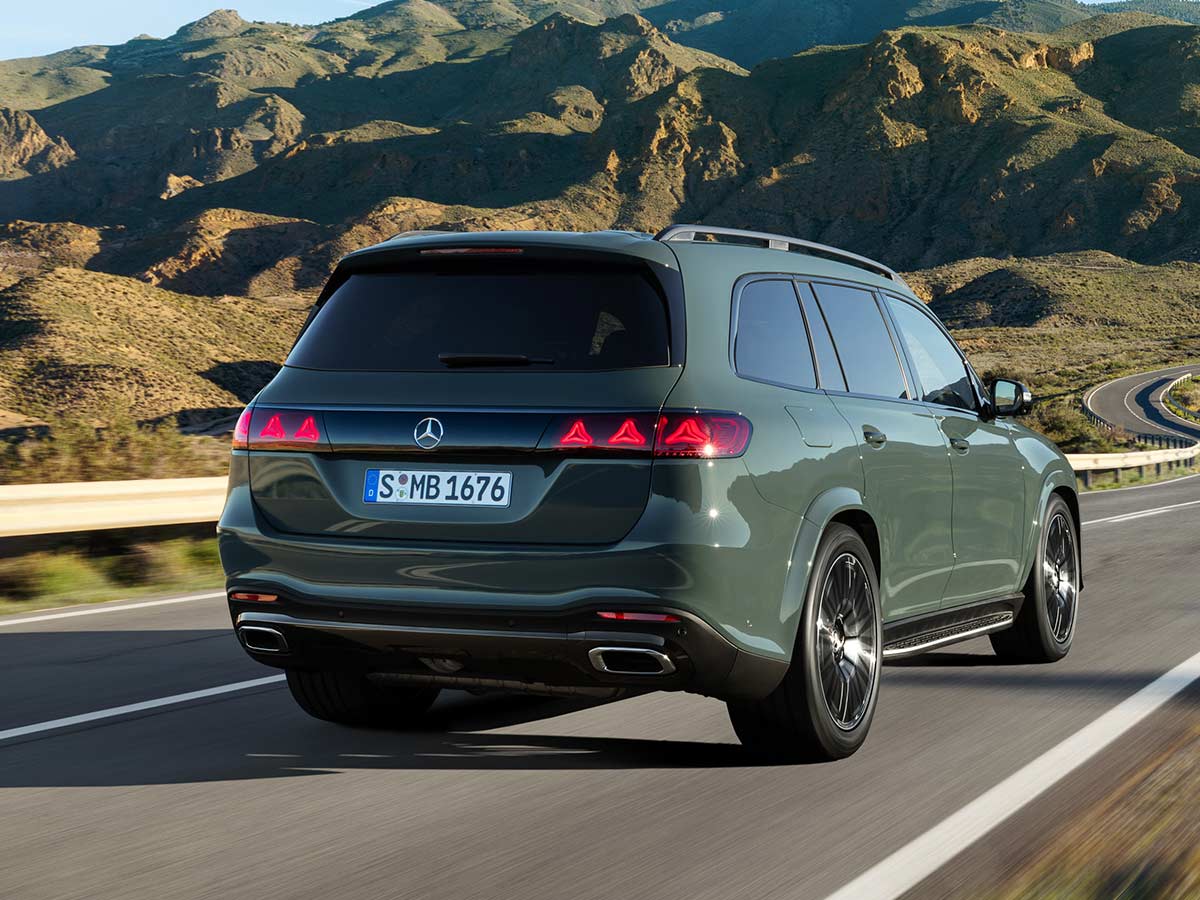
- Revised front bumper, larger chrome grille, new tail lamp treatment
- New interior colours, round air vents, rocker-and-roller steering wheel controls
A New Face for an Icon: Exterior Design Changes
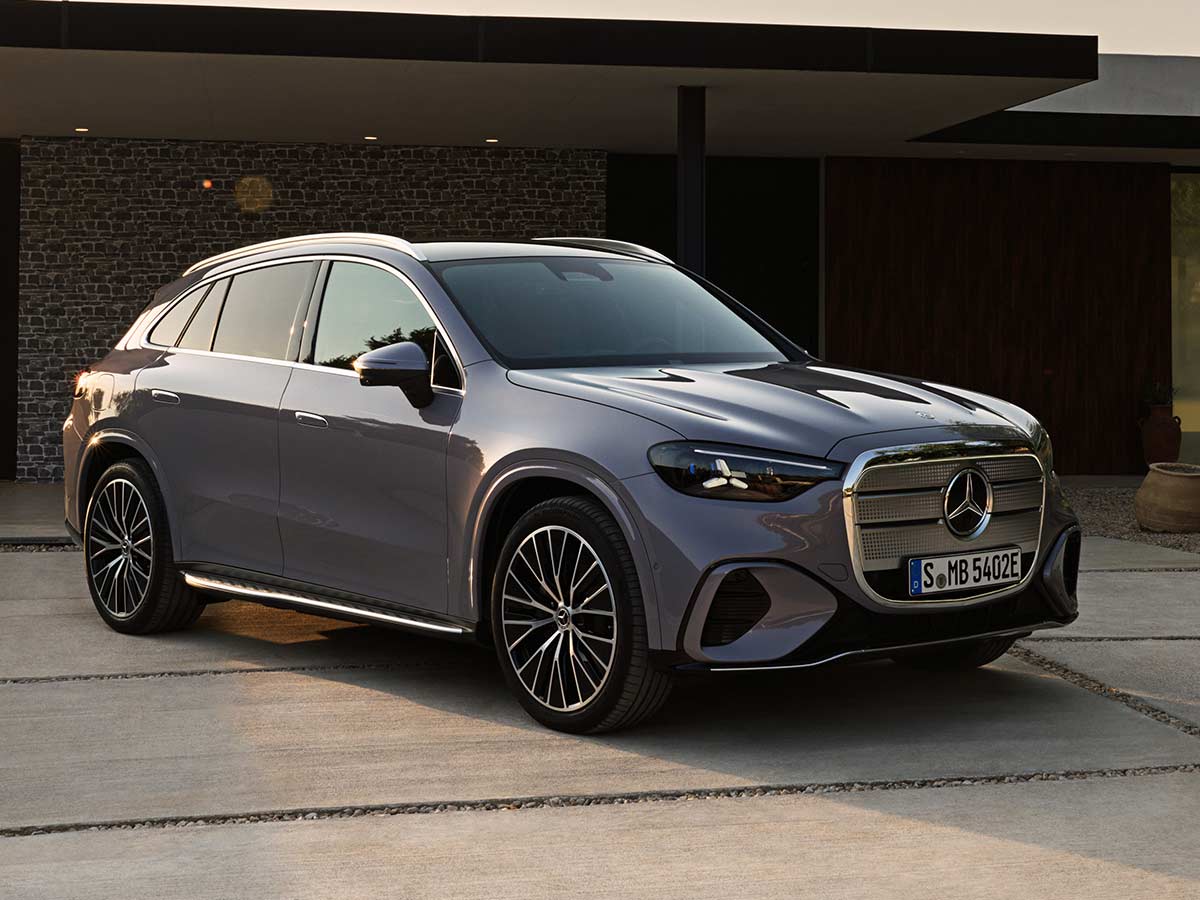
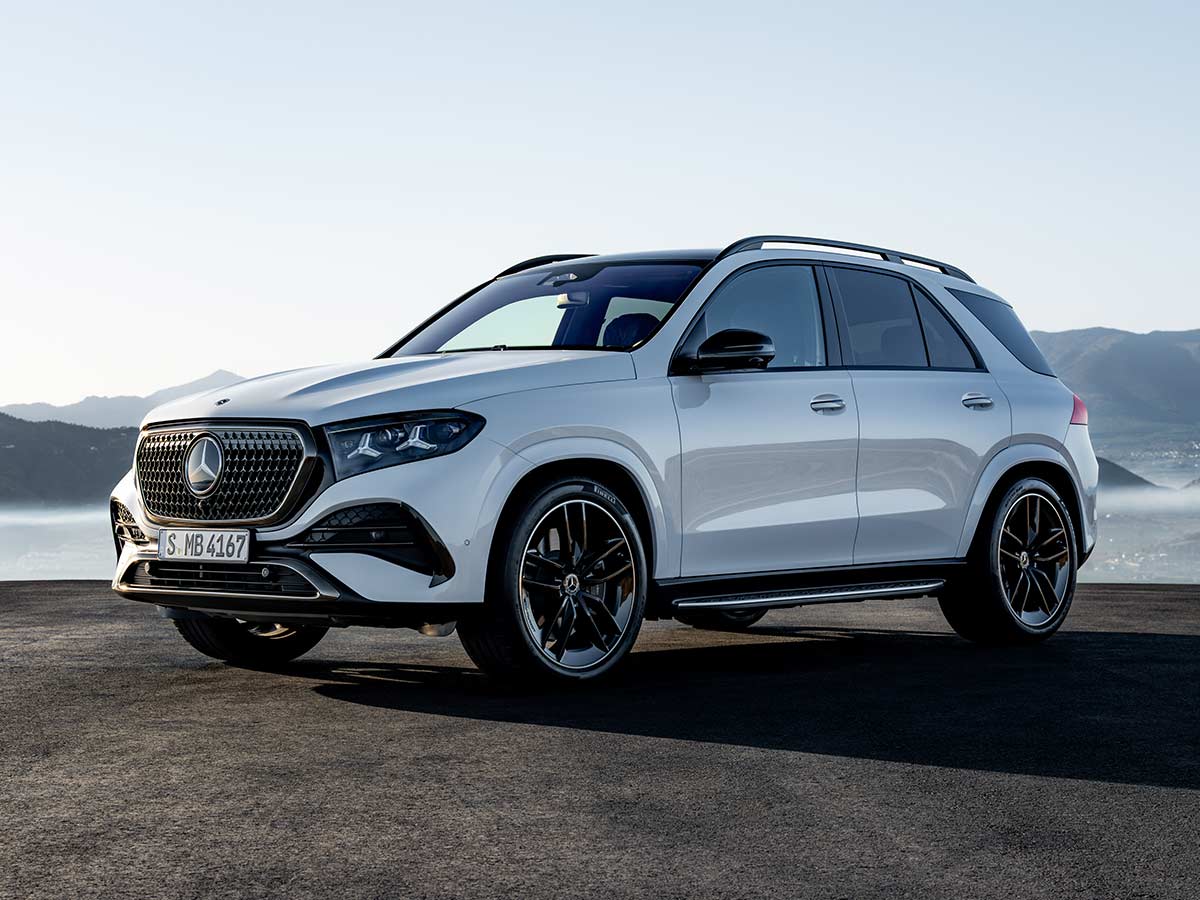
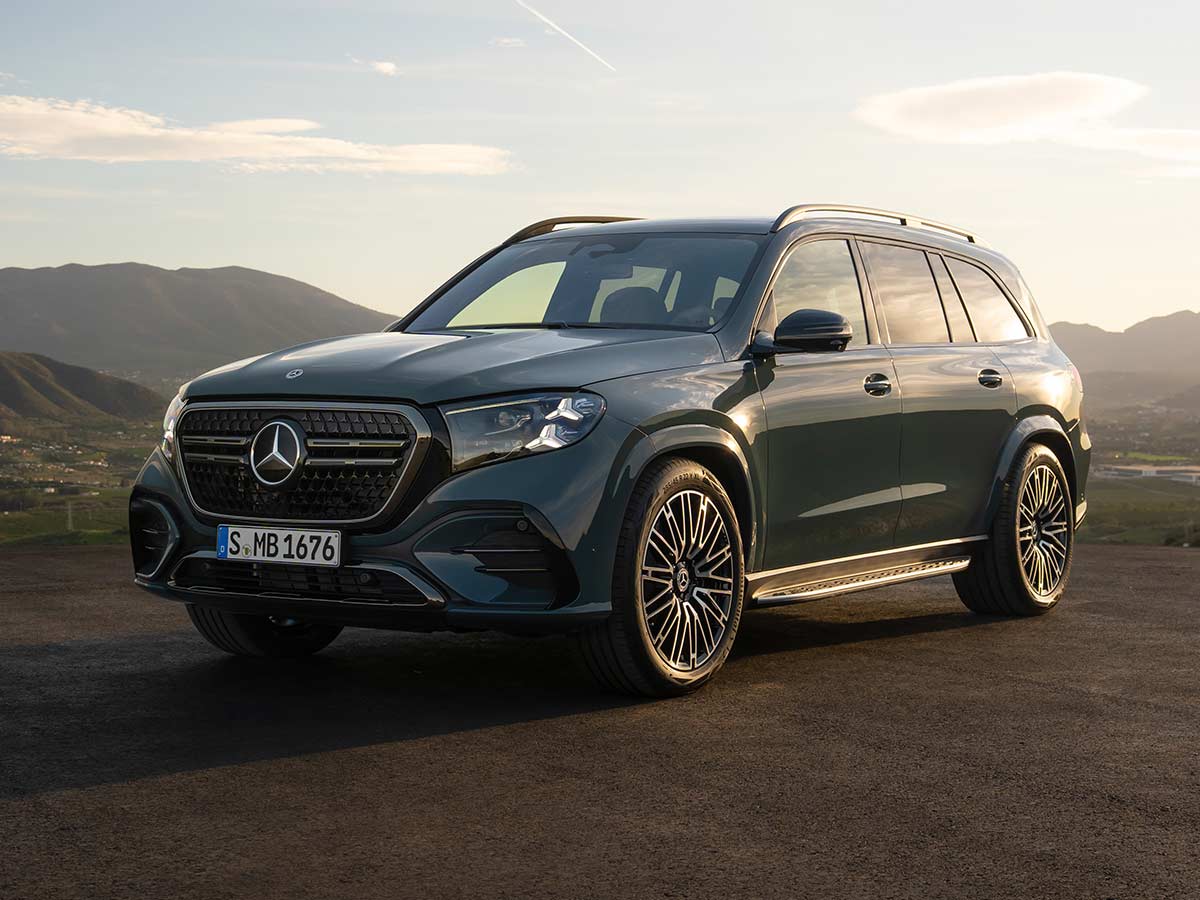
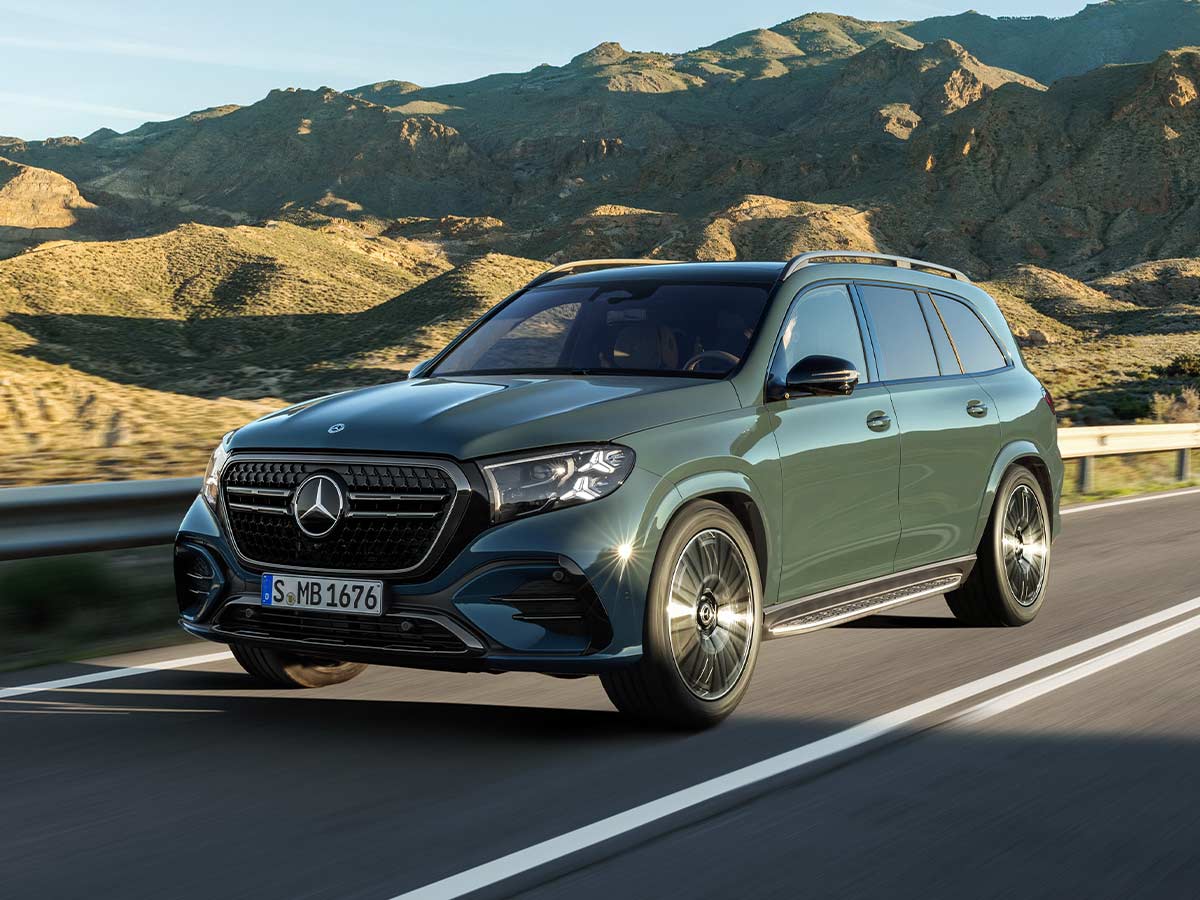
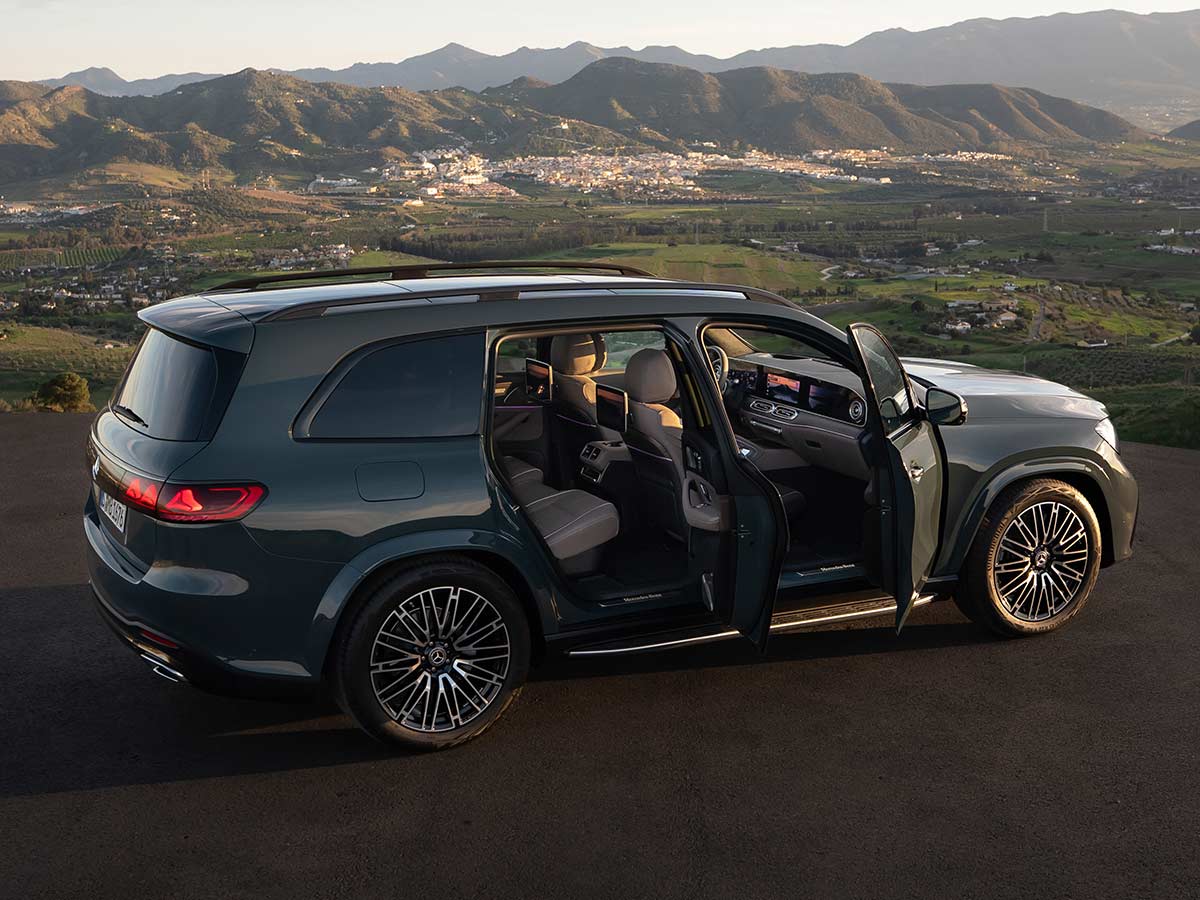
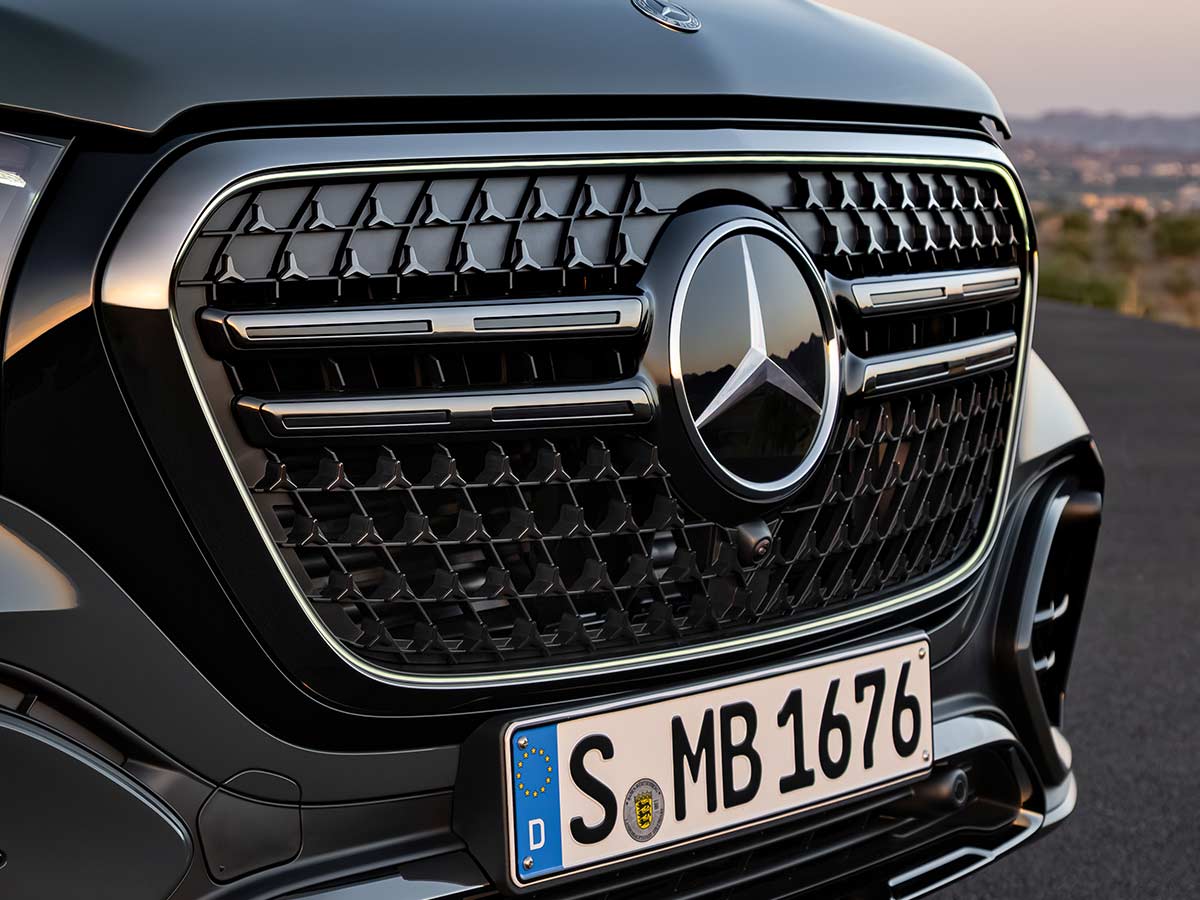
You will recognize the facelift GLS from the front almost immediately, even without any prior knowledge of the update. The most striking single change is the adoption of the upright, three-dimensional Mercedes-Benz star on the bonnet — a feature long associated with the S-Class. It is not a cosmetic flourish for its own sake: in the context of Mercedes-Benz design language, the standing bonnet star is a deliberate signal of hierarchy and pedigree, a visual declaration that this vehicle belongs at the very top of the family.
In certain markets, that star illuminates. In China, it lights up when the vehicle is stationary. In the United States, it remains lit even while driving. Whether you find that theatrical or elegant will likely depend on your personal relationship with automotive theater, but it is hard to deny the visual impact at night.
The Grille: Bigger, Brighter, More Assertive
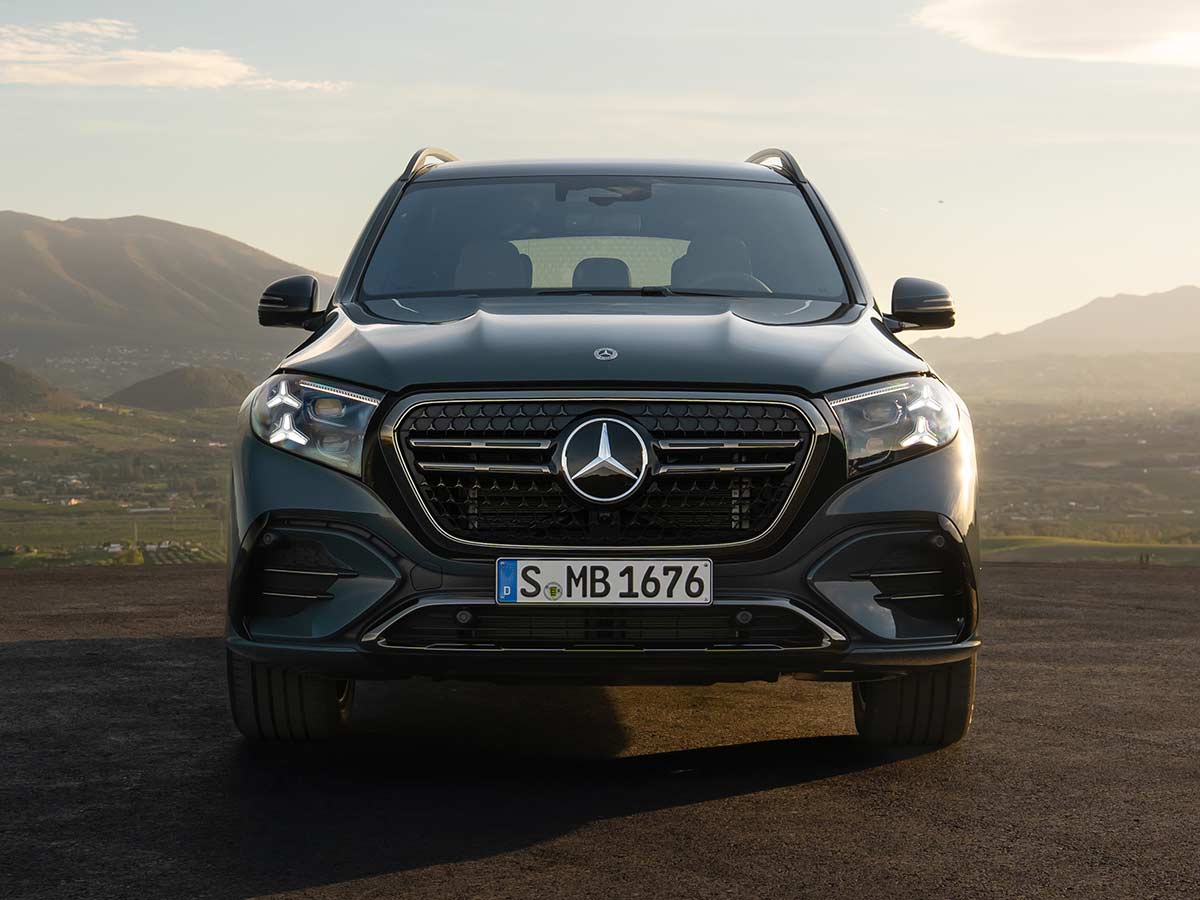
The radiator grille has grown in size and gained a striking treatment that distinguishes it from its predecessor. A chrome frame with built-in contour lighting frames the opening. Three horizontal chrome fins and one vertical fin sit within the aperture alongside a shimmering Mercedes-Benz pattern in chrome. The effect is unmistakably premium — this is a face that communicates status before the engine is even running.
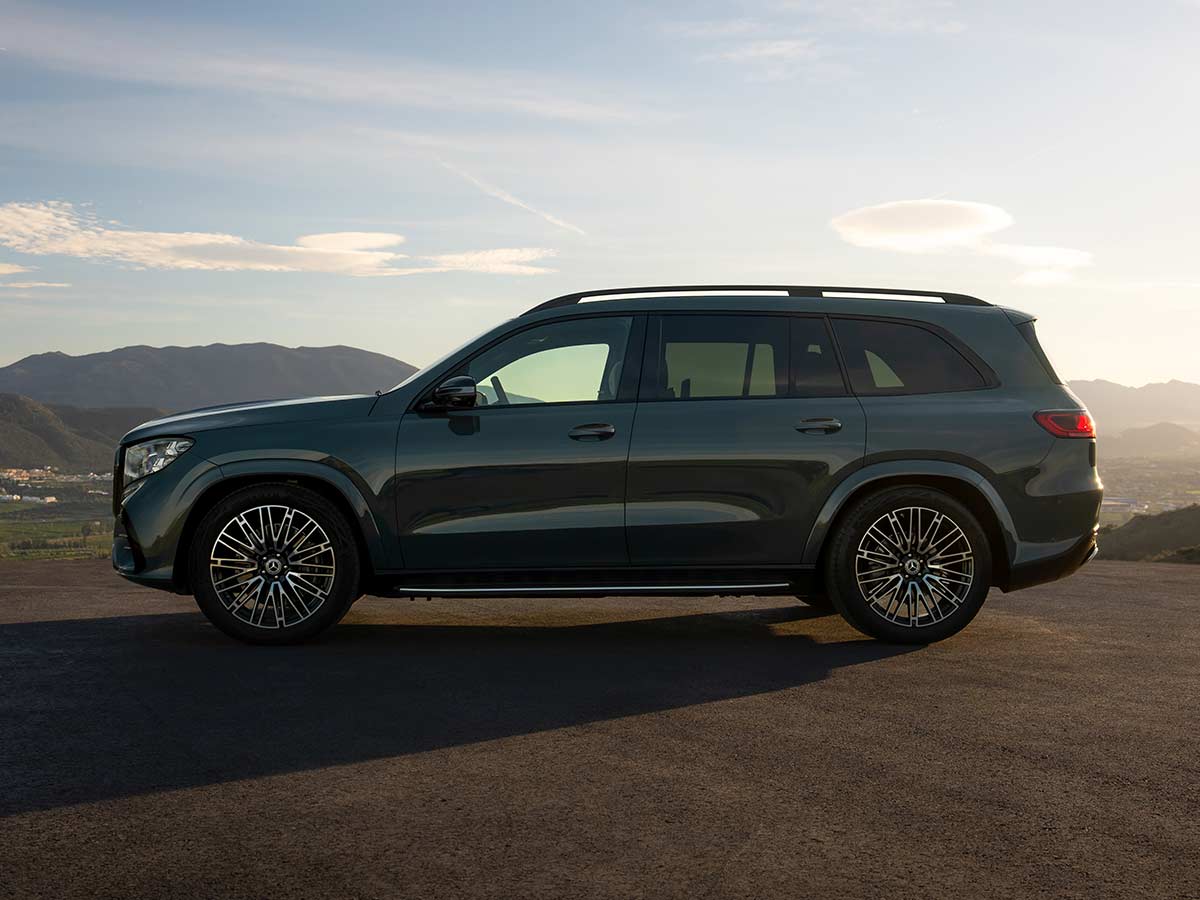
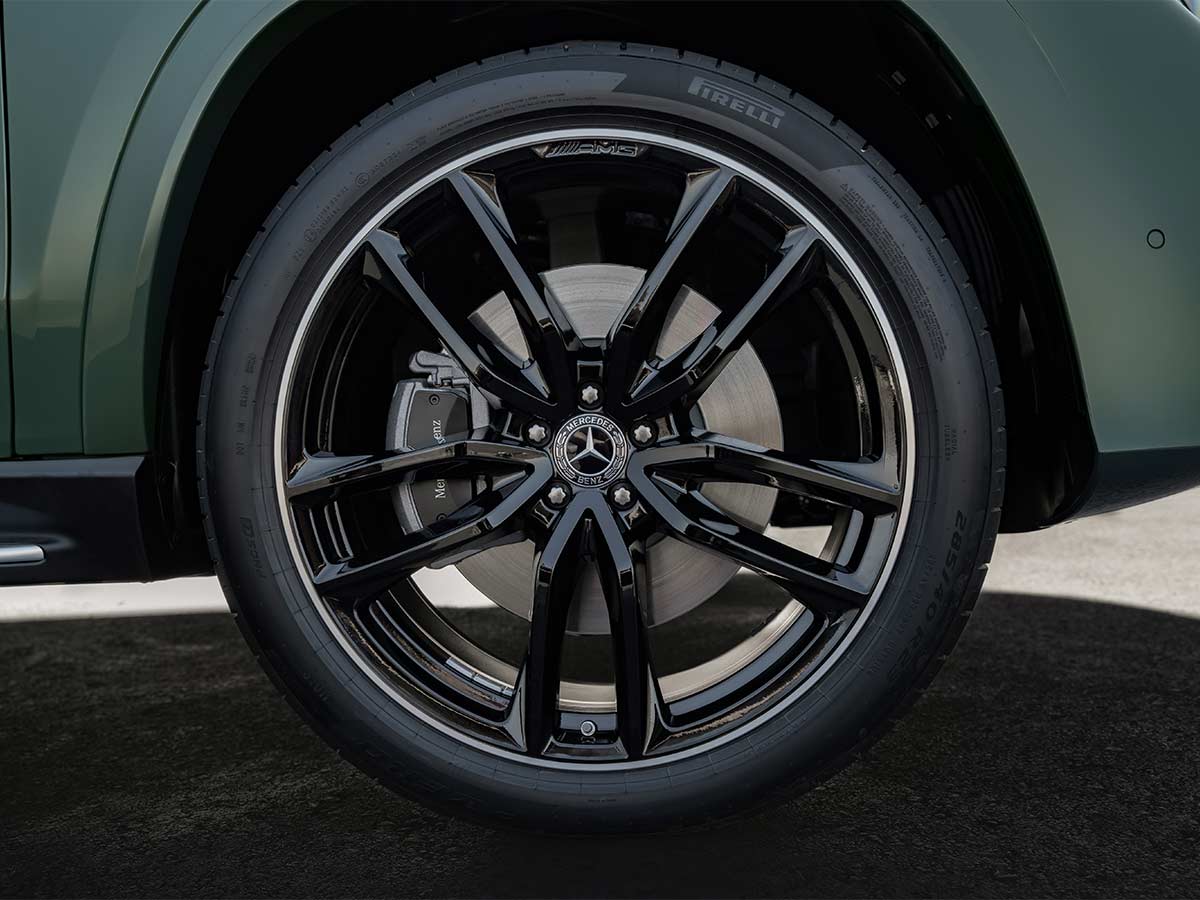
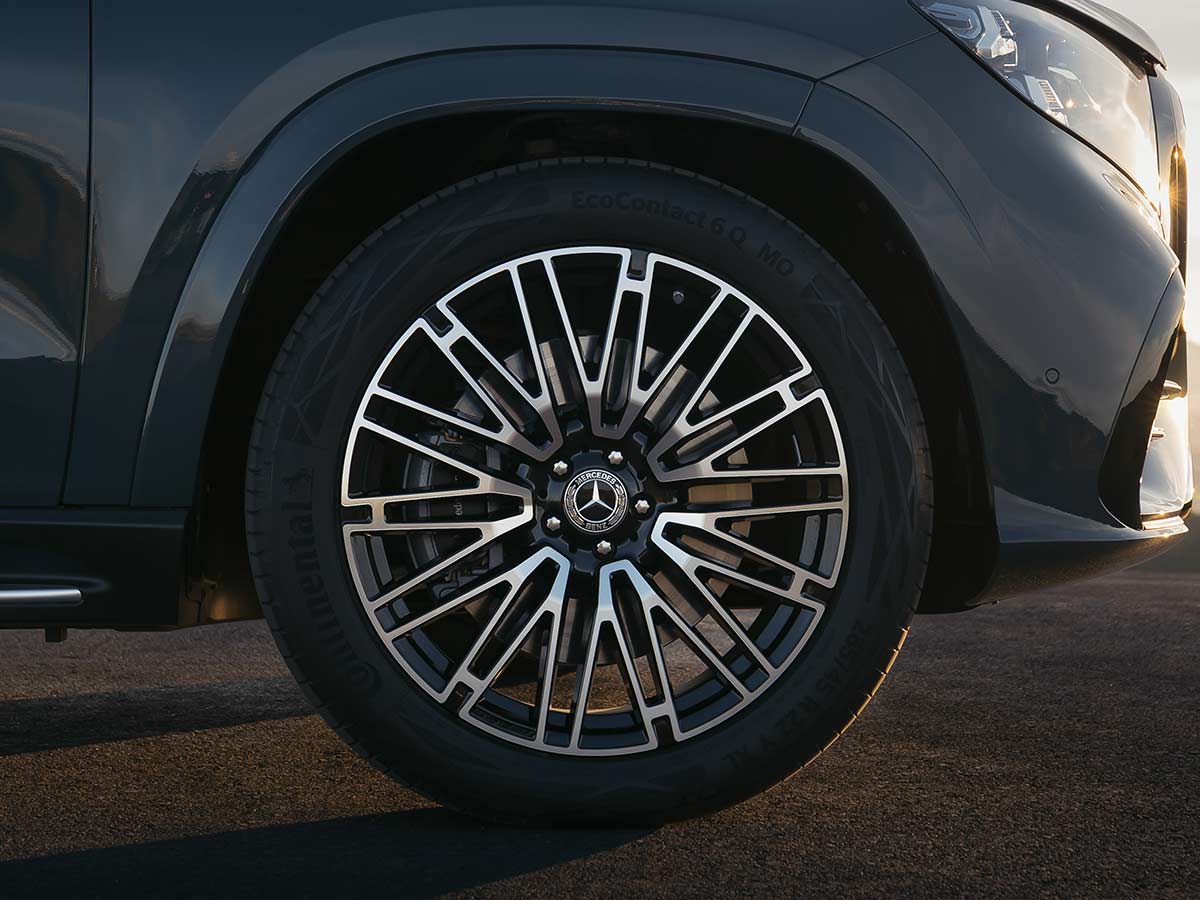
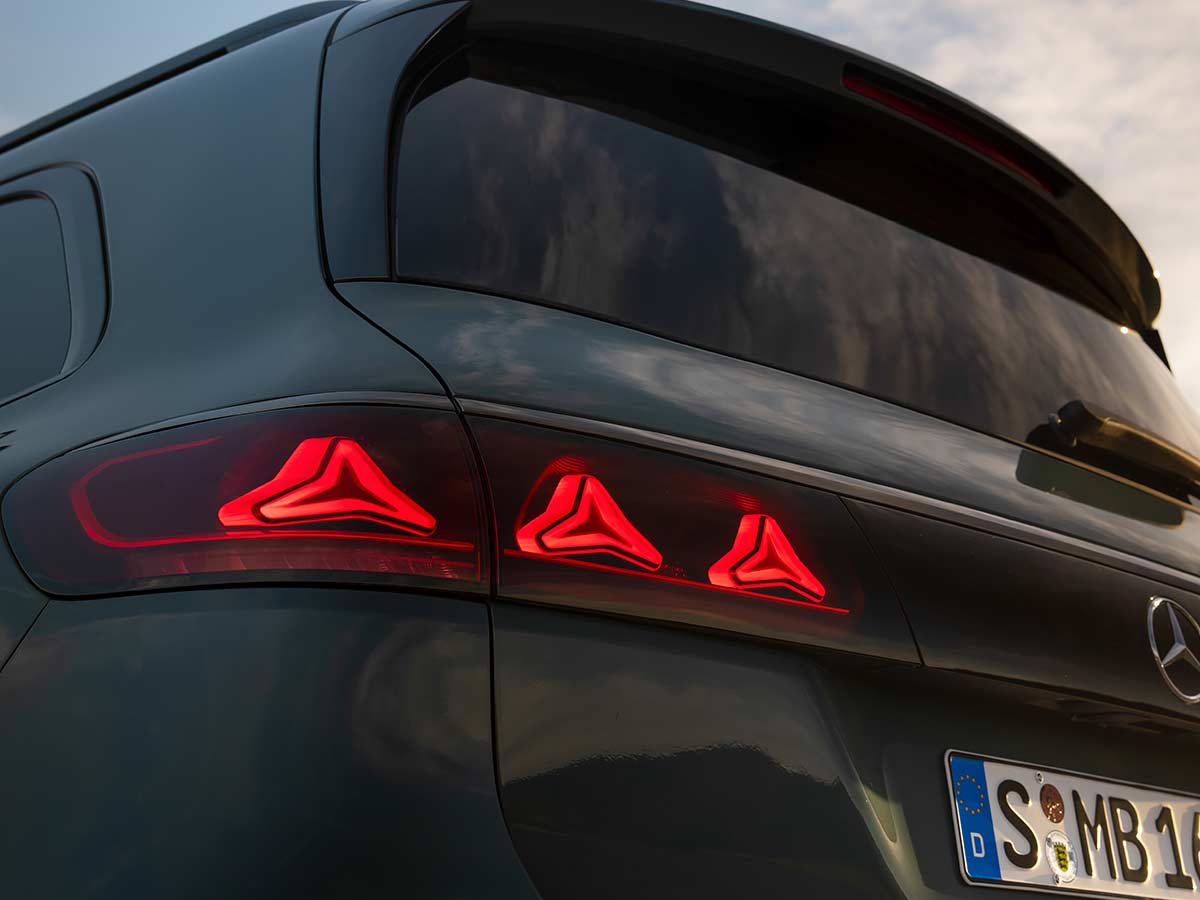
A redesigned front bumper completes the revisions at the front, with a sleek black panel that visually bridges the headlamps and grille into a single cohesive element. At the rear, a new design trim integrates the Mercedes star into a flowing piece that links both tail lamps and emphasises the car’s considerable width. Two new paint finishes join the palette: Dark Petrol flat and MANUFAKTUR Patagonia Red Metallic. Two new 21-inch alloy wheel designs are available, alongside a new 22-inch AMG wheel offered in two colour variants.
DIGITAL LIGHT: Micro-LED and a 40% Larger Light Field
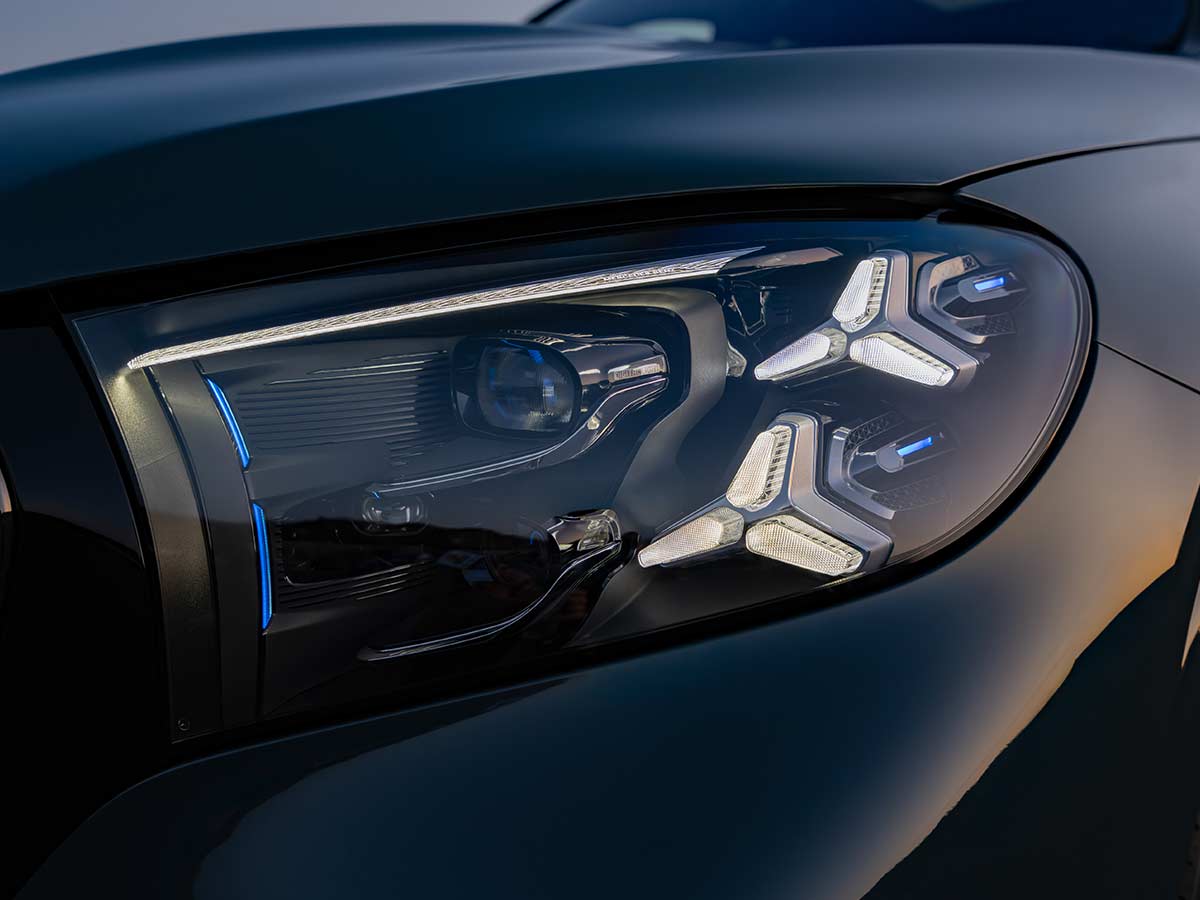
The new GLS comes standard with the latest generation of Mercedes-Benz’s DIGITAL LIGHT technology, now using micro-LED rather than conventional LED units. The high-resolution light field is approximately 40% larger than before, while energy consumption falls by up to 50%. The headlamps themselves are over 25% lighter, thanks to the more compact module and a consolidated single control unit.
The ULTRA RANGE high beam extends to 600 metres — roughly six football pitches — and now physically swivels for better cornering illumination. A partial high-beam function improves the detection of poorly lit road users without blinding oncoming traffic, and the cornering light uses both camera data and map information to respond to road curvature more precisely.
Every GLS also comes standard with a panoramic roof spanning more than one square metre of glazing — one of the largest in any production SUV. The front section opens electrically and slides over the fixed rear glass panel.
The 2026 GLS Engine Range: Four Powertrains, All with 48V
The European lineup consists of four variants — two petrols and two diesels — each with meaningful engineering updates. Every engine includes an integrated starter generator (ISG) operating on a 48-volt electrical system, enabling coasting, boost, and recuperation functions. The ISG also makes the start-stop function essentially imperceptible — a genuine comfort benefit in city traffic.
GLS 580 4MATIC: The V8, Reborn
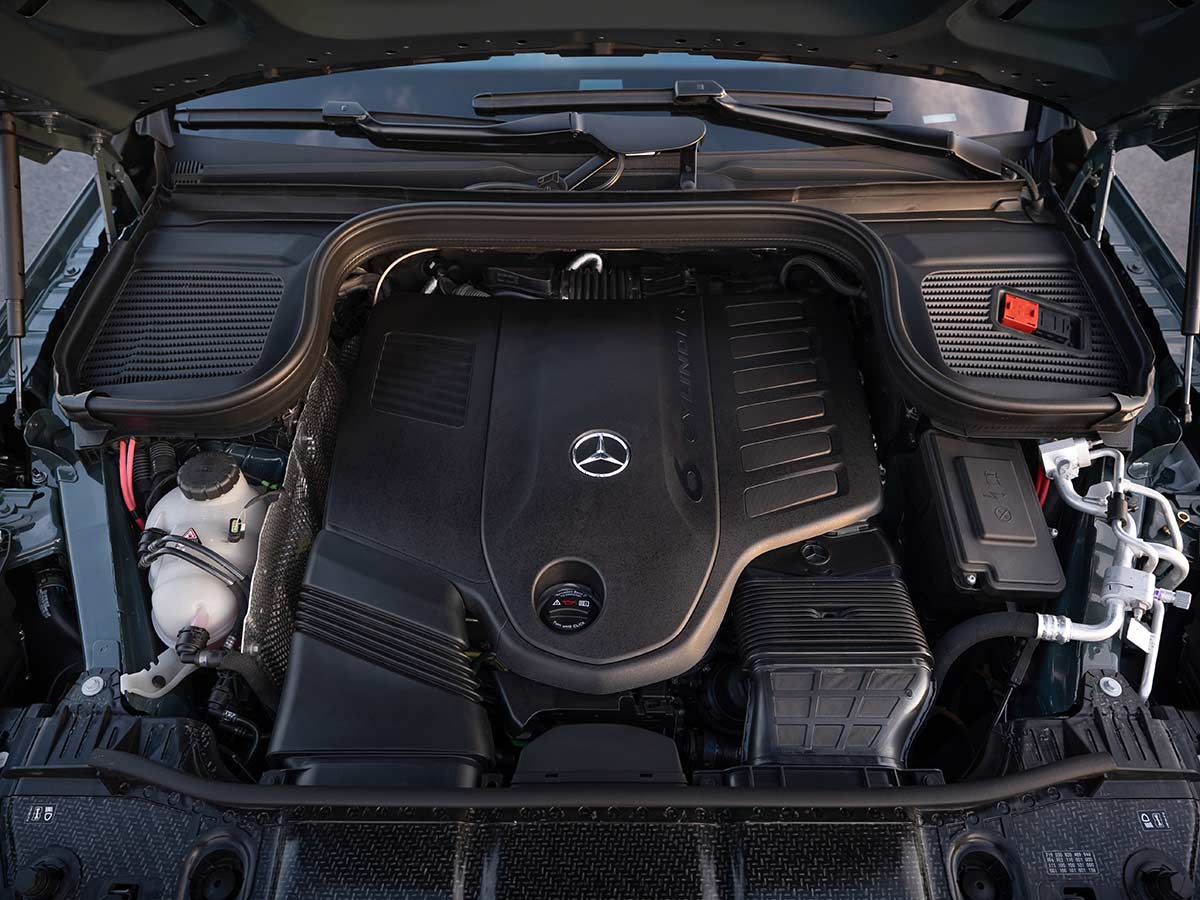
The flagship GLS 580 4MATIC retains its 4.0-litre twin-turbocharged V8, but this is a substantially revised unit. Output rises from 380 kW to 395 kW (537 hp), and peak torque increases from 730 Nm to 750 Nm, now available across the wide band of 2,500 to 4,500 rpm. The 0–100 km/h sprint takes 4.7 seconds.
More consequential than the power increase is the architectural change underneath: the V8 has switched from a cross-plane crankshaft to a flat-plane configuration, with the ignition sequence now alternating between both cylinder banks. This is a significant modification made in preparation for future emissions regulations, and it required accompanying changes to the injection system, exhaust aftertreatment (with particulate filter), cylinder head ports, intake camshaft, and the exhaust gas turbocharger. Two Lanchester balance shafts maintain the engine’s characteristic smoothness despite the different crank geometry.
GLS 450 4MATIC: A More Responsive Six-Cylinder Petrol
The 3.0-litre inline-six petrol in the GLS 450 4MATIC has been tuned for improved responsiveness, particularly under partial load. Rated torque rises to 560 Nm — a 12% improvement — thanks to a more powerful electric auxiliary compressor, optimised cylinder head ports, and a revised intake camshaft. Rated output stands at 280 kW (381 hp), with a 0–100 km/h time of 5.7 seconds.
GLS 350d and 450d 4MATIC: The Diesels Go Electric-Catalyst
For the first time on the GLS diesel range, both six-cylinder diesel variants receive an electrically heated catalyst. This brings the exhaust system to its optimal temperature from cold, maintaining it throughout the drive cycle regardless of load conditions — improving real-world efficiency beyond what test cycle figures suggest.
Both diesel engines also benefit from an all-aluminium engine block and cylinder head, reducing front-axle weight and improving handling balance. NANOSLIDE® cylinder liners — the same technology used in Mercedes-Benz Formula 1 engines — and high-tech steel pistons with shaker cooling reduce friction and improve thermal management. Combined fuel consumption for both diesel variants is 7.8–8.5 l/100 km under preliminary WLTP figures.
NVH: The One You Can’t See But Will Certainly Feel
Mercedes-Benz has also addressed noise, vibration, and harshness (NVH) throughout. The transmission tunnel and engine bulkhead are now lined with a higher-quality nonwoven material. The engine cover receives a heavy mat designed to absorb high-frequency combustion noise. Acoustic foam applied to selected bodyshell cavities reduces road, wind, and engine noise transmission into the cabin. These changes are not dramatic on paper but they matter significantly in daily driving.
2026 Mercedes-Benz GLS Full Specification Table (Preliminary WLTP Data)
| Specification | GLS 350d 4MATIC | GLS 450d 4MATIC | GLS 450 4MATIC | GLS 580 4MATIC |
|---|---|---|---|---|
| Engine Layout | I6 Diesel | I6 Diesel | I6 Petrol | V8 Petrol |
| Displacement | 2,989 cc | 2,989 cc | 2,999 cc | 3,982 cc |
| Power Output | 230 kW / 313 hp | 270 kW / 367 hp | 280 kW / 381 hp | 395 kW / 537 hp |
| Peak Torque | 650 Nm | 750 Nm | 560 Nm | 750 Nm |
| Electric Motor Peak | 17 kW / 205 Nm | 17 kW / 205 Nm | 17 kW / 205 Nm | 17 kW / 205 Nm |
| 0–100 km/h | 6.3 s | 5.9 s | 5.7 s | 4.7 s |
| Top Speed | 238 km/h | 250 km/h | 250 km/h | 250 km/h |
| Fuel Consumption WLTP | 7.8–8.5 l/100 km | 7.8–8.5 l/100 km | 9.9–11.9 l/100km | 13.1–13.7 l/100km |
| CO₂ Combined | 205–223 g/km | 205–223 g/km | 225–248 g/km | 297–310 g/km |
| CO₂ Class | G | G | G | G |
Suspension Technology: Where Physics Meets the Cloud
The GLS has long used some of the most sophisticated suspension hardware available in any production SUV. The facelift adds an important new layer: cloud connectivity. The cloud-based AIRMATIC damper control system — developed entirely in-house by Mercedes-Benz and covered by a patent application — uses Car-to-X communication to adjust damping force before the vehicle reaches a speed bump, rather than reacting to it.
The mechanism works through the Car-to-X network, where a Mercedes-Benz vehicle that has already passed a speed bump transmits that hazard data anonymously to the Mercedes-Benz Cloud via the mobile network. When a subsequent GLS approaches the same location, the system pre-conditions the AIRMATIC dampers in advance. The result is a noticeably smoother crossing — particularly in the rear seats.
Because the system uses real-time data from other drivers in the fleet, its coverage is significantly broader than what any single vehicle’s own radar or camera sensors could provide. The system effectively allows the car to anticipate what it cannot yet see.
E-ACTIVE BODY CONTROL: Still the Most Sophisticated Option
For buyers of six-cylinder and V8 variants, E-ACTIVE BODY CONTROL remains an optional upgrade that represents the pinnacle of SUV suspension technology. The system uses five multi-core processors and more than 20 sensors, analysing the driving situation 1,000 times per second. Each wheel has its own 48-volt motor-pump unit, coordinated centrally — meaning spring and damper forces can be independently controlled at each corner.
This individual wheel control allows the system to counteract not only body roll but also pitch during braking and acceleration. The body neither dips at the front under braking nor squats at the rear under hard acceleration. On poor roads, the hydropneumatic system can even recuperate electrical energy — one of the few comfort systems in any vehicle that contributes to efficiency rather than simply consuming power.
E-ACTIVE BODY CONTROL off-road specific functions:
- Free-wheel mode: Automatically raises and lowers suspension repeatedly to free the vehicle if stuck in sand or soft terrain.
- Individual wheel control: Allows the driver to adjust spring level at each wheel independently via MBUX, useful on rough terrain.
- Rear load lowering: Lowers the loading sill by over 50 mm at the touch of a button for easier luggage access.
The standard AIRMATIC air suspension also receives a recalibration for this facelift — firmer in sport modes, yet no less comfortable in comfort settings. The system maintains constant ride height regardless of passenger load.
Driver Assistance: MB.DRIVE and a New Water-Cooled Processor
The sensor suite on the 2026 GLS is extensive: ten exterior cameras, up to five radar sensors, and twelve ultrasonic sensors. These feed into a newly fitted water-cooled processor with significant reserves for future driving assistance functions to be unlocked via over-the-air updates. The hardware to support more advanced autonomy levels is already installed.
Assistance is organised into the MB.DRIVE family. MB.DRIVE Standard is fitted to every European GLS and includes DISTRONIC distance control. MB.DRIVE ASSIST and ASSIST PLUS add extended functions. The highest tier, MB.DRIVE ASSIST PRO, enables a seamless point-to-point driving experience in dense city traffic — launching first in China, followed by the USA, with European markets subject to regulatory approval.
Parking Assistance: Faster and Now Includes Manual Departures
MB.DRIVE PARKING ASSIST comes standard and has been notably improved. It detects parking spaces on both sides of the vehicle — including unmarked ones — and can now assist when leaving a space even if the vehicle was originally parked manually. When activated, the system executes the parking manoeuvre automatically at up to 5 km/h, approximately 60% faster than the previous system.
MB.DRIVE PARKING ASSIST 360 adds surround-view with a redesigned interface. A new digital extra — the wheel rim protection warning — displays a top-down distance alert when manoeuvring, helping avoid kerb damage. A reversing function enabling the vehicle to retrace a recently driven route will be available as a digital extra after market launch.
Technology: MB.OS, MBUX Superscreen, and AI Integration
This is perhaps where the new GLS makes its biggest leap. MB.OS — the Mercedes-Benz Operating System — is the backbone of the entire vehicle, governing assistance systems, suspension, lighting, climate control, and connectivity simultaneously. It connects to the Mercedes-Benz Intelligent Cloud and evolves through over-the-air updates throughout the vehicle’s life.
Microsoft AI integration enhances the MBUX Virtual Assistant’s natural language capability, enabling it to draw on internet knowledge and conduct complex, multi-part dialogues rather than relying on a fixed command library.
MBUX Superscreen: Now Standard on Every GLS
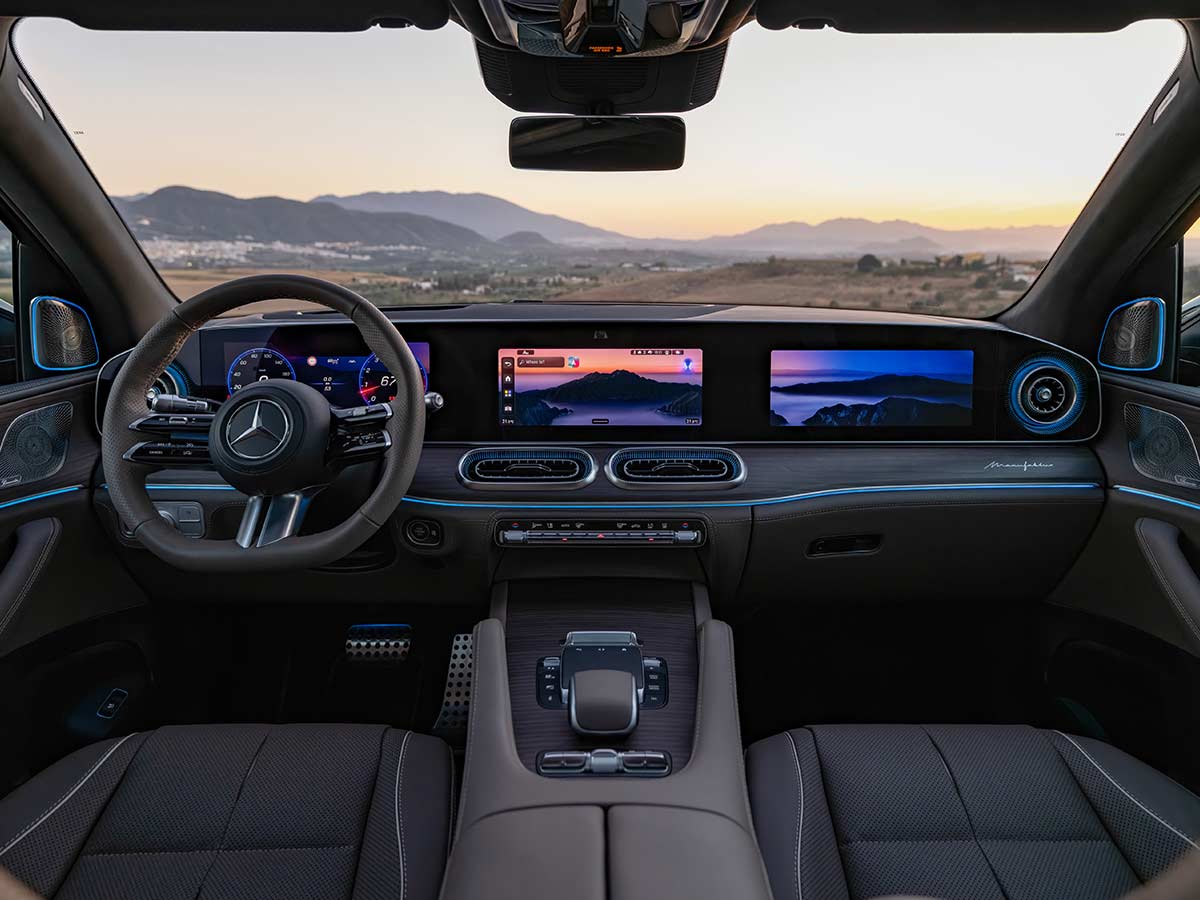
The MBUX Superscreen is fitted as standard across the entire GLS range. Three 12.3-inch displays sit beneath a single uninterrupted glass surface, spanning the cockpit. The MBUX Zero Layer interface surfaces the most relevant information in a configurable footer bar, and users can organise over 40 apps into personalised folders.
In European markets, the front passenger’s screen enables video content during motion. A camera-based system monitors driver gaze and automatically dims the passenger display if distraction risk is detected. An optional 3D driver display is available, switching into depth-perception mode at the touch of a button.
MBUX Augmented Navigation Head-Up Display: A GLS First
The 2026 GLS offers the MBUX Augmented Navigation Head-Up Display for the first time, projecting navigation arrows, lane guidance, and points of interest directly onto the windscreen. This is complemented by MBUX Augmented Reality navigation on the central display, which overlays directional graphics onto a live camera feed of the road ahead — particularly useful at complex junctions and motorway exits.
Rear Entertainment: Eleven-Inch Full HD Screens
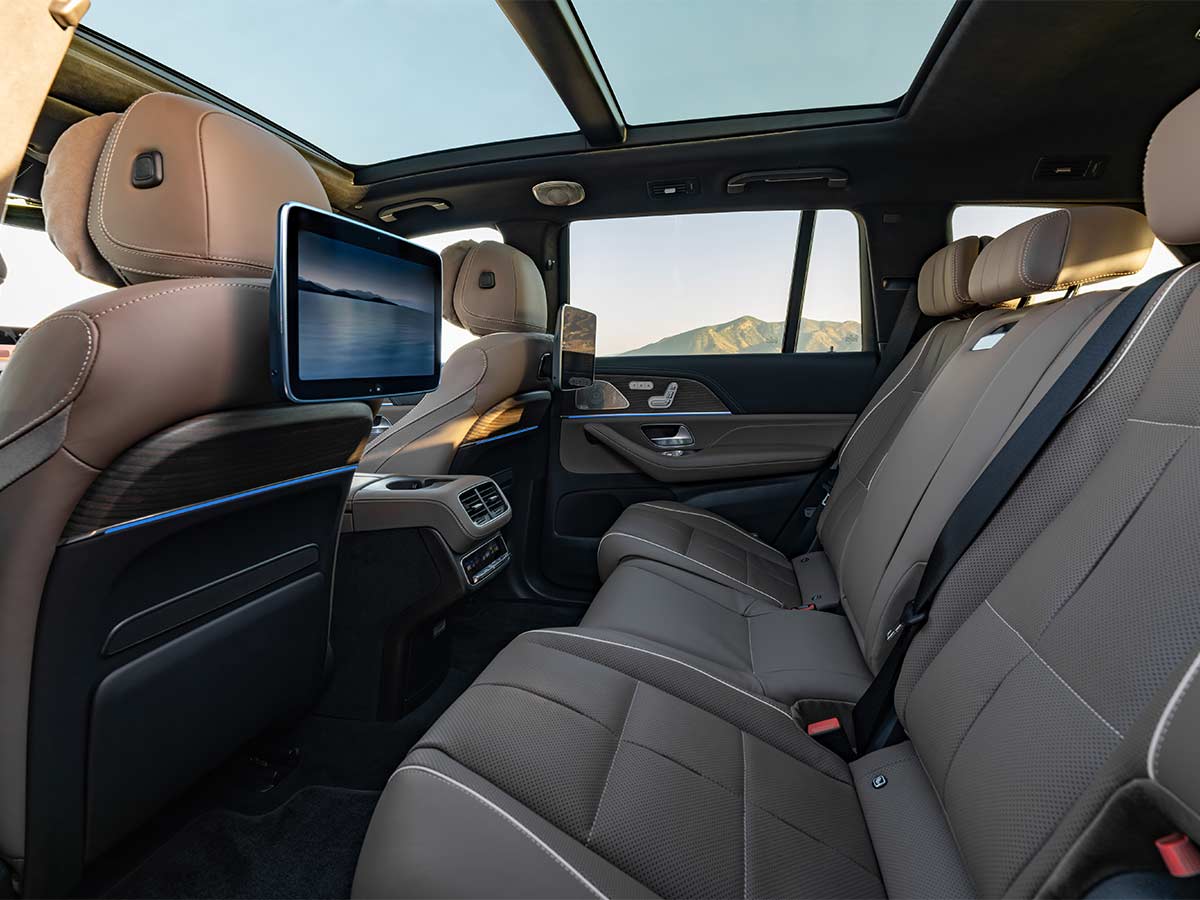
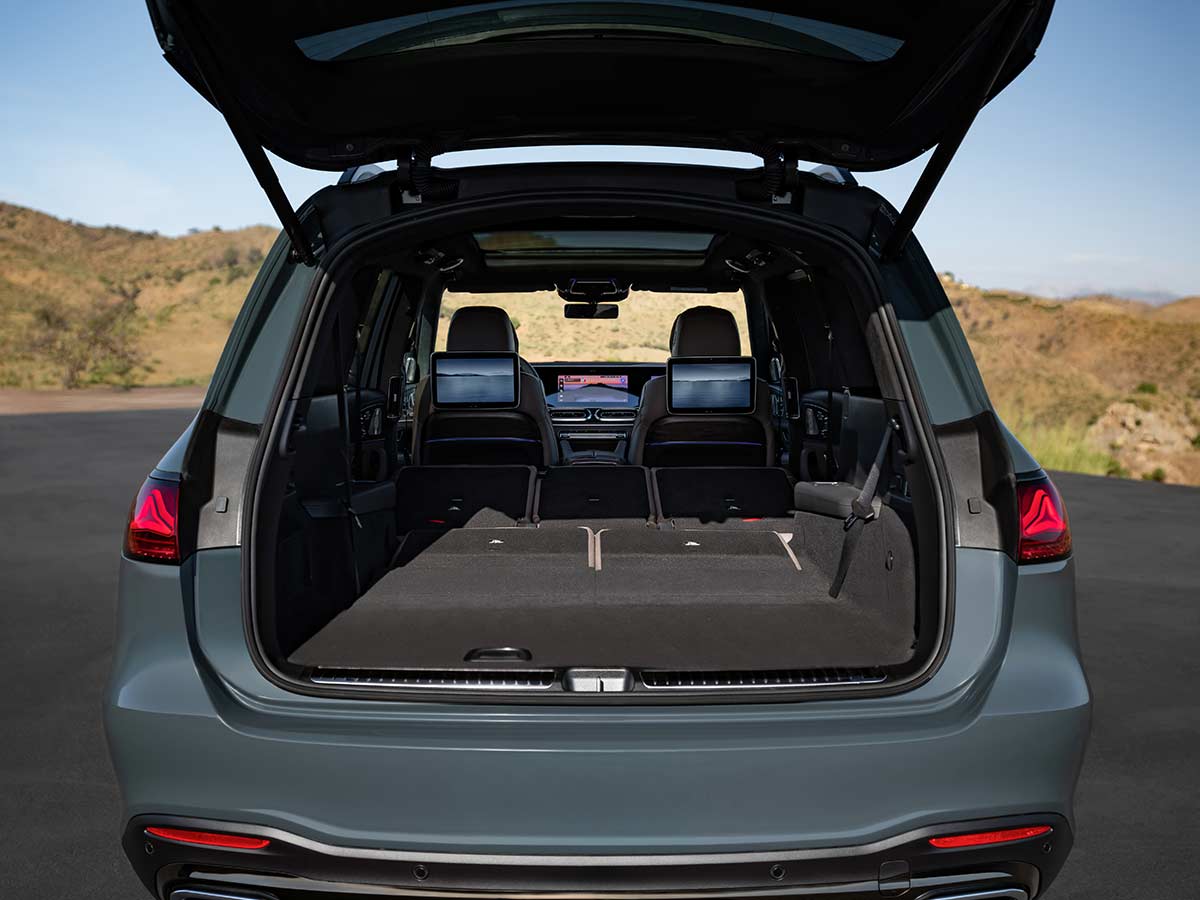
Rear passengers receive two 11.6-inch full HD screens with integrated cameras for video conferencing. New MBUX remote controls put entertainment and comfort functions — including climate, window blinds, and massage settings — directly in passengers’ hands. Streaming is available from Disney+, YouTube, and RIDEVU among others.
Digital Convenience: In-Car Payment and Digital Key
The GLS supports in-car payment through Mercedes pay+, using biometric two-factor authentication via an interior camera. Digital extras, e-vignettes, and Store purchases can be completed and activated directly in the vehicle. The digital vehicle key now includes automatic locking and unlocking based on the user’s proximity — simply carrying a paired iPhone or Android phone is sufficient.
Interior: Space, Comfort, and the Science of the Long Journey
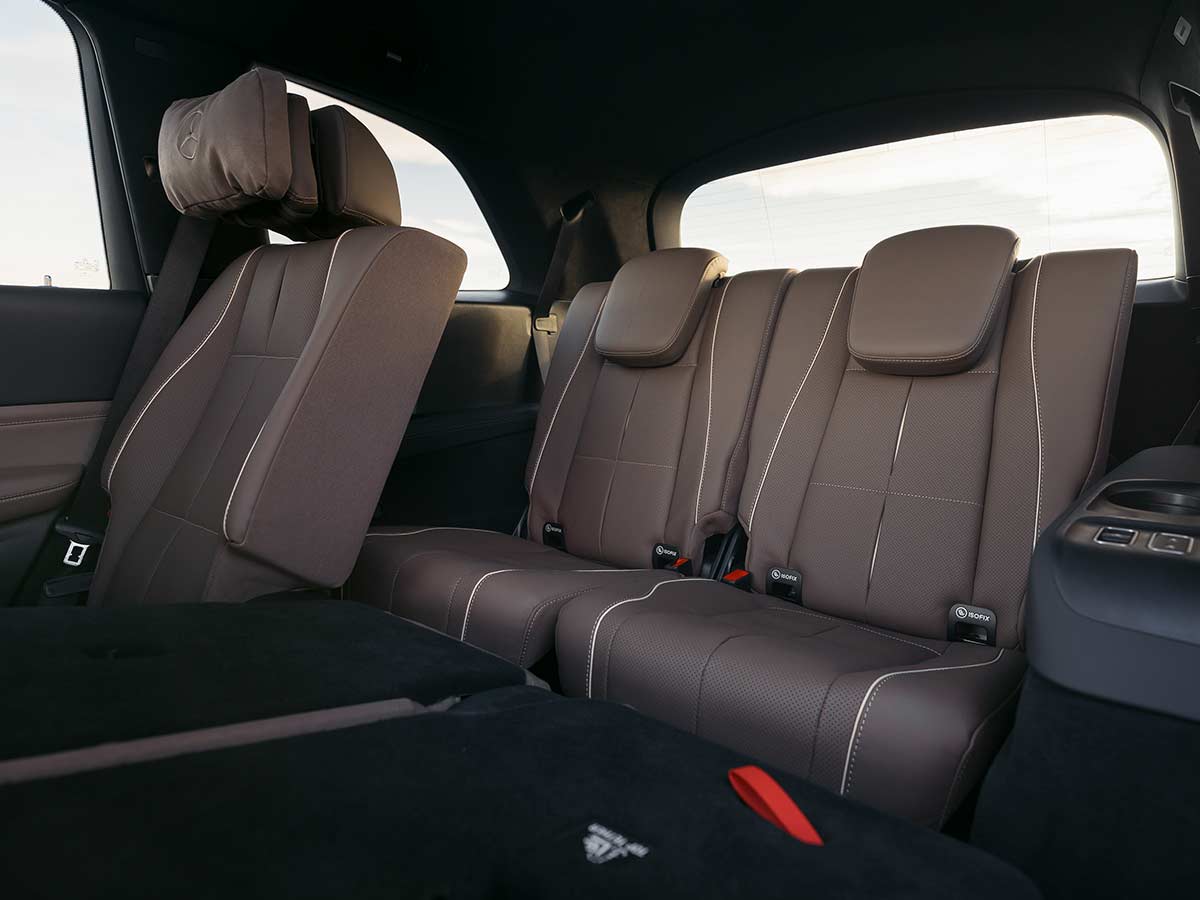
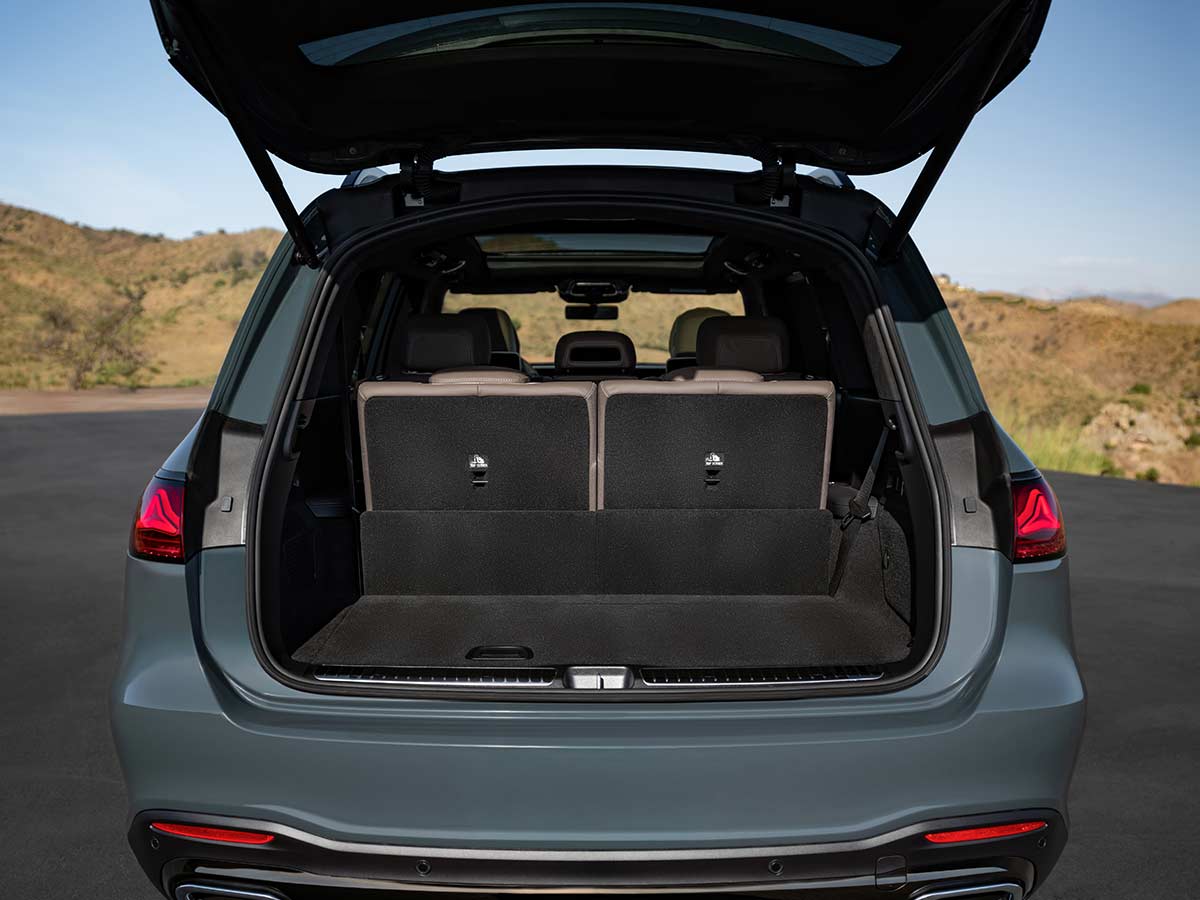
At 5,207 mm long, 1,956 mm wide, and with a 3,135 mm wheelbase — 60 mm more than the GLE — this is a genuinely large vehicle. That long wheelbase delivers rear seat legroom of a calibre normally associated with limousines. All three seat rows are fully electrically adjustable, and the third row is a genuine two-seat solution for adults up to 1.94 m tall. With the second row folded, load space reaches up to 2,400 litres.
The Rear Comfort Package Plus: Turning the Back Seat into Business Class
The optional Rear Comfort Package Plus is the single most transformative upgrade for those who spend significant time in the rear. It adds multi-contour seats with the Pro massage function — now enhanced with four vibration motors in the seat cushion for a deep-tissue effect. The package also includes THERMOTRONIC automatic climate control, electric sun blinds in both rear doors, wireless charging, comfort head restraints, adaptive lighting, sidebags, and an extended illuminated centre armrest.
A particularly useful detail: the rear passenger on the front-passenger side can electrically move the front seat forward at will, creating additional legroom without needing to interact with the front occupant.
Air Quality: Multi-Stage Filtration Every 90 Seconds
The new GLS features an advanced cabin air filtration system that completely renews the interior air approximately every 90 seconds. The multi-stage system uses a pre-filter for larger particles, followed by an electric filter that ionises fine dust before it reaches the interior filter. ENERGIZING AIR CONTROL monitors both interior and exterior air quality using dedicated sensors, detecting nitrogen oxides, carbon monoxide, and PM2.5 particles. When external air quality falls below a threshold, the system automatically switches to recirculation mode.
New Interior Colours, Materials, and Controls
Mercedes-Benz introduces the new Beech Brown with black interior — described as warm and home-like — available in ARTICO and Lugano leather. This joins the existing Black, Macchiato Beige, and Bahía Brown options. Three new trim elements are available: dark brown open-pore birch wood, brown open-pore walnut, and a light-coloured aluminium flowing lines finish.
Round air vents replace the previous rectangular units, tying the interior more closely to the current S-Class aesthetic. The steering wheel features the rocker-and-roller control concept with galvanised-metal rollers for a more tactile, analogue feel. Ambient styling can be customised through a dedicated app, with the instrument cluster and ambient lighting synchronised to match the selected MBUX Superscreen background theme.
4MATIC All-Wheel Drive: How It Works in the New GLS
Every GLS in Europe comes with 4MATIC — Mercedes-Benz’s fully variable all-wheel drive system operating under the Torque on Demand name. The system continuously distributes power between front and rear axles from 0 to 100% in either direction, using an electronic multi-plate clutch that responds simultaneously to driver inputs and road conditions.
During normal conditions, power flows predominantly to the rear axle. During acceleration on low-grip surfaces, Torque on Demand can lock distribution to maximise traction. During high-speed cornering, front axle torque can be specifically reduced to preserve lateral stability.
The transfer case also features a low-range reduction gear with a 1:2.93 ratio. Combined with inter-axle locking, this provides genuine off-road capability on sand and rocky terrain — the GLS is not merely an all-weather vehicle but a capable off-road tool in this configuration. A revised transfer case architecture also means engine torque no longer needs to be reduced for load-reversal damping, improving longitudinal refinement and gear change smoothness.
Frequently Asked Questions
Q.: What is new on the 2026 Mercedes-Benz GLS?
The 2026 GLS facelift introduces updated engines across all four variants, an upright bonnet star (illuminated in select markets), a larger chrome grille with contour lighting, the MBUX Superscreen with passenger display as standard, cloud-based AIRMATIC damper control, the MB.OS AI operating system, new micro-LED DIGITAL LIGHT headlamps, a revised interior with Beech Brown colour and round air vents, and an enhanced MB.DRIVE assistance suite.
Q.: How many engine options does the 2026 GLS have?
In Europe, the 2026 GLS is offered in four variants: the GLS 350d 4MATIC (230 kW / 313 hp diesel), GLS 450d 4MATIC (270 kW / 367 hp diesel), GLS 450 4MATIC (280 kW / 381 hp petrol), and the GLS 580 4MATIC (395 kW / 537 hp V8 petrol). All use a 48-volt integrated starter generator.
Q.: What is MB.OS on the Mercedes-Benz GLS?
MB.OS (Mercedes-Benz Operating System) is the vehicle’s central AI-powered software platform. It unifies all vehicle functions — from assistance systems to suspension to infotainment — and connects to the Mercedes-Benz Intelligent Cloud for over-the-air software and feature updates throughout the vehicle’s life. The GLS uses the same MB.OS platform as the new S-Class.
Q.: Does the 2026 GLS have augmented reality navigation?
Yes. The 2026 GLS features the MBUX Augmented Navigation Head-Up Display for the first time, projecting navigation directions onto the windscreen. This is complemented by MBUX Augmented Reality navigation on the central display, which overlays directional graphics onto live camera footage of the road ahead.
Q.: How many seats does the 2026 GLS have?
Seven seats across three fully electrically adjustable rows. The third row accommodates passengers up to 1.94 m tall and is accessed via an electric Easy Entry function. With all seats folded, cargo capacity reaches up to 2,400 litres.
Q.: What is cloud-based AIRMATIC damping?
Cloud-based AIRMATIC damping uses Car-to-X communication — data transmitted by other Mercedes-Benz vehicles that have already passed a speed bump — to pre-condition the GLS’s dampers before the obstacle is reached. The system adjusts electronically in advance rather than reacting upon impact, delivering measurably greater comfort particularly for rear passengers. Mercedes-Benz has applied for a patent on this function.
Q.: What is the 0–100 km/h time of the GLS 580 4MATIC?
4.7 seconds, from a 395 kW (537 hp) V8 with 750 Nm of torque. The GLS 450 4MATIC petrol manages 5.7 seconds, the 450d diesel 5.9 seconds, and the entry 350d diesel 6.3 seconds.
Q.: Is E-ACTIVE BODY CONTROL standard on the 2026 GLS?
No. E-ACTIVE BODY CONTROL is an optional upgrade available on six-cylinder and V8 variants. The standard suspension is AIRMATIC air suspension, which is also the foundation system that E-ACTIVE BODY CONTROL builds upon.
Q.: When will the 2026 Mercedes-Benz GLS go on sale?
Mercedes-Benz officially revealed the new GLS on 31 March 2026. The GLS 580 4MATIC will be available a few months after the initial market launch. Check with your local Mercedes-Benz dealer for market-specific availability and delivery timelines.
Autobics Verdict
The 2026 Mercedes-Benz GLS is one of the most coherent luxury SUV updates in recent memory. Rather than concentrating changes in one area, Mercedes-Benz has applied meaningful engineering across the powertrain, suspension technology, driver assistance hardware, digital architecture, and interior design simultaneously. The result is a vehicle that closes the gap to the current S-Class in almost every meaningful dimension.
The cloud-based AIRMATIC damping is the headline innovation that will genuinely change the daily ownership experience. The MBUX Superscreen fitted as standard removes one of the more frustrating aspects of specifying the previous generation. The revised V8 with its flat-plane crankshaft is an engineering accomplishment that is easy to overlook but important for the car’s longevity. And the upright bonnet star, for all its theatricality, succeeds in making the GLS feel like a proper apex-of-the-range statement.
For buyers in the full-size luxury SUV segment, the 2026 GLS moves the bar. Its competitors have work to do.
DISCLAIMER: Fuel consumption and emissions figures are preliminary WLTP data provided by Mercedes-Benz AG. Officially certified values may differ. The GLS 580 4MATIC is available a few months after the initial market launch of other variants.
Source: Mercedes-Benz