





















The secondary car market is witnessing a massive shift. As first-generation electric vehicles (EVs) come off leases and early adopters upgrade to solid-state tech, the “Used EV” section is officially booming.
But buying a pre-owned electric car isn’t like buying a traditional petrol or diesel vehicle. You can forget about checking spark plugs or oil leaks—your focus needs to shift toward silicon, software, and cells.
If you’re eyeing a used EV car like say a, Hyundai Ioniq, or an older Tesla, use this 2026 Used EV Checklist to ensure your “green” bargain doesn’t turn into a financial black hole.
>>> Great Discounts on Car & Bike Accessories <<<
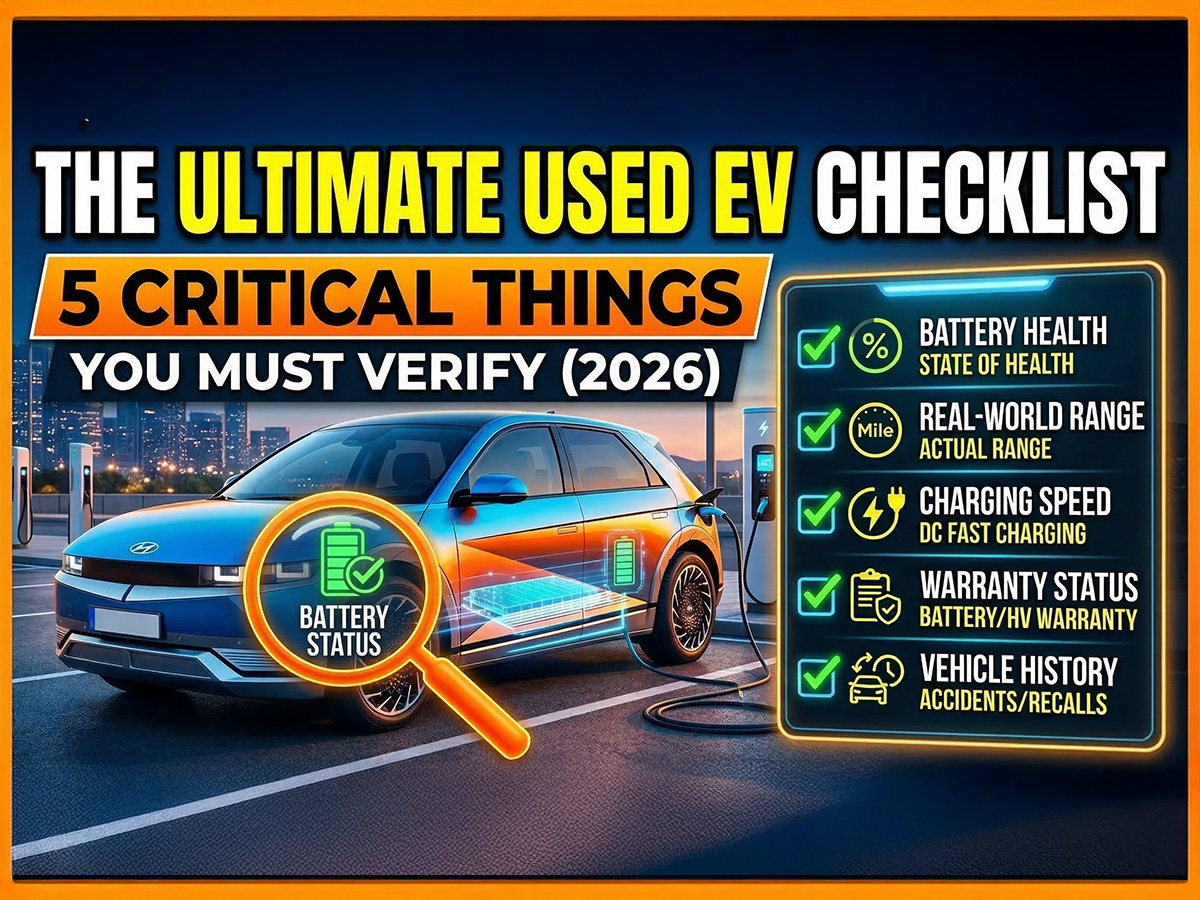
1. The SOH Factor: State of Health is the New Mileage
In the world of internal combustion, high mileage is the red flag. In the EV world, it’s Battery State of Health (SOH).
Unlike a fuel tank that stays the same size forever, an EV battery degrades over time. A car might show a 100% charge, but if the SOH is at 80%, you’ve lost a fifth of your original range. Beware the “Guess-O-Meter”: The range displayed on the dashboard is an estimate based on the previous owner’s driving habits, not a true indicator of battery health. A heavy-footed driver will make the range look artificially low, while a hyper-miler will make it look artificially high.
The Pro Tip:
Ask for a certified battery health report. Most modern EVs allow technicians (or even some advanced OBD-II scanners) to pull a precise SOH percentage.
Red Flag:
Avoid any vehicle with an SOH below 80% unless the price is significantly discounted to cover a future battery swap. In 2026, a replacement battery pack can easily exceed $10,000 (or upwards of ₹8 Lakhs), quickly turning a cheap car into an expensive mistake.
2. Hunting for the “Battery Birth Certificate” (Warranty)
Most EV manufacturers offer a separate, longer warranty for the battery pack—typically 8 years or 160,000 km.
Check the Transfer:
Verify that the battery warranty is legally transferable to the second owner without hidden fees.
The Fine Print:
Some warranties only kick in if the battery capacity drops below 70%. Knowing exactly where the car stands in its warranty lifecycle is far more important than the odometer reading.
3. Software & OTA Compatibility
A used EV is essentially a “smartphone on wheels.” As software evolves, older hardware can struggle to keep up.
The Update History:
Check if the vehicle has received its latest Over-The-Air (OTA) updates. A car that hasn’t been updated in years might have underlying “bricking” risks, missed safety patches, or outdated charging protocols.
Infotainment Lag:
Test the touchscreen rigorously. If the UI feels sluggish, it’s a sign the onboard processor is outdated. This can heavily affect navigation, everyday usability, and charging station pre-conditioning features.
4. Inspecting the “Invisible” Hardware: Charging Ports & Tires
While you aren’t checking an engine belt, two physical areas demand 100% of your attention:
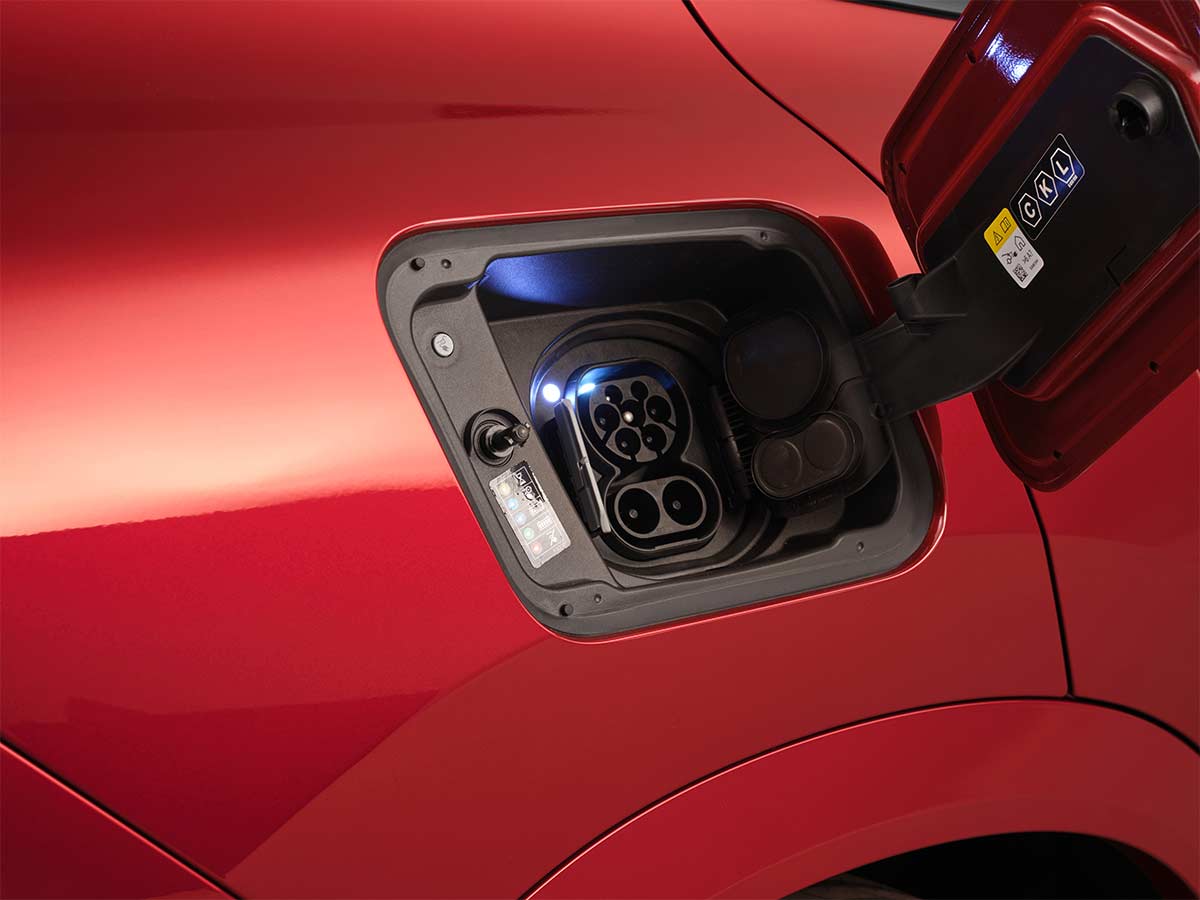
The Charging Port & Adapters:
Look for signs of overheating, melted plastic, or bent pins. A faulty port can cost thousands to replace and is often overlooked during a quick test drive. Additionally, with the massive shift in charging standards by 2026, verify if the car requires a specific adapter (like NACS to CCS) to use modern public fast chargers in your region.
EV-Specific Tires:
EVs are heavier than ICE cars and deliver instant torque, which eats through rubber. Check if the previous owner fitted EV-specific tires (designed for low rolling resistance and high weight capacity). If they slapped on cheap, standard tires to make a quick sale, expect a 10-15% drop in your range and faster tire wear.
5. The Thermal Management Test
The longevity of an EV battery depends heavily on how well it stays cool under pressure.
The Test:
During your test drive, locate a Level 3 DC Fast Charger and plug the car in. Observe the charging speed on the dashboard. If the car throttles the charging speed significantly (even if the battery level is relatively low), the thermal management system or the cooling pumps might be failing.
Summary Checklist for Your Test Drive:
- Battery SOH Report: Is it above 85%?
- Charging Cable Integrity: Are the Home and Public cables included, compatible, and fray-free?
- Brake Feel: Are the regenerative brakes smooth, or is there a “grinding” sound from lack of use?
- Suspension: Does it handle the extra battery weight without “bottoming out” over speed bumps?
The Bottom Line
Buying a used EV in 2026 is a brilliant way to beat depreciation, provided you prioritize the chemistry over the chrome. Do your homework on the battery health, ensure the software is up to date, and you’ll enjoy years of low-cost, high-torque driving.
Frequently Asked Questions (FAQ)
Q: What is a good battery SOH for a used EV?
A: Anything above 85% State of Health (SOH) is generally considered healthy for a used EV. If it drops below 80%, you should factor a potential battery replacement into your budget.
Q: Do EV battery warranties transfer to the second owner?
A: In most cases, yes. Major manufacturers typically offer an 8-year/160,000 km battery warranty that follows the vehicle, but you must read the fine print to confirm there are no specific transfer clauses or capacity degradation limits (usually 70%).
Q: Why do electric cars need special tires?
A: EVs are significantly heavier than traditional gas cars due to the battery packs, and they deliver instant torque to the wheels. EV-specific tires are reinforced for the extra weight and designed with low rolling resistance to maximize driving range.